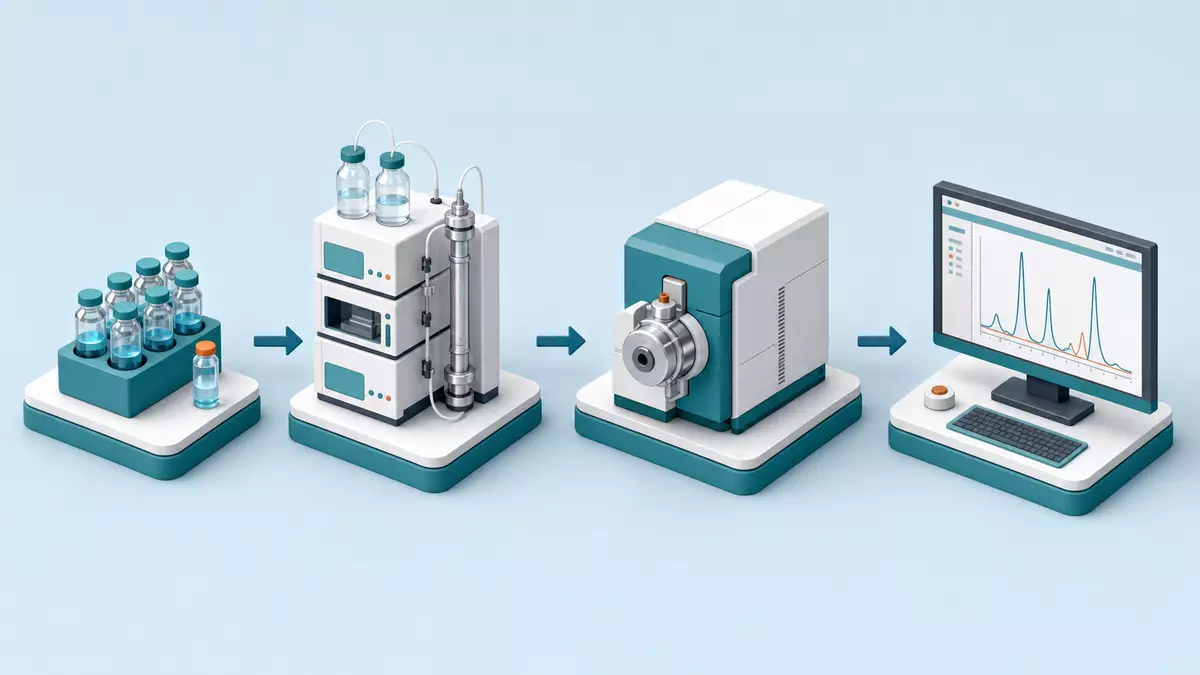
Agilent 1260 Infinity II LC by Agilent Technologies Inc. - mid-range workhorse for routine labs
Published on 07/18/2026 at 11:09 | Editorial responsibility: Rafael Müller, Editor-in-Chief AD HOC NEWS
The Agilent 1260 Infinity II LC hums steadily in the corner of a bright analytical lab, its solvent lines vibrating softly as the autosampler snaps each vial into place. Technicians watch gradient curves on the screen while the familiar solvent smell hangs in the air.
What the 1260 Infinity II LC is built for
Agilent 1260 Infinity II LC is a modular liquid chromatograph targeting routine analysis in pharmaceutical, chemical and food labs, not just research power users. It sits in the mid-range of Agilent’s Infinity II LC portfolio, below the faster 1290 Infinity II system. The system offers up to 600 bar operating pressure, letting analysts run conventional HPLC methods and many UHPLC-style gradients on standard columns without moving to top-end hardware.
Agilent positions the 1260 Infinity II LC as a scalable platform: labs can start with a basic isocratic pump and manual injector, then later add autosamplers, column compartments and detectors as throughput requirements grow. Product manager Michael Franke has highlighted this modularity in customer seminars, explaining how small labs often extend the system over several budget cycles rather than buying a fully loaded configuration on day one.
Key modules and configuration options
At the heart of most 1260 Infinity II LC configurations is the Quaternary Pump, which can mix up to four solvents for flexible gradient methods. For more focused workflows, like routine quality control with fewer mobile phases, Agilent also offers a Binary Pump that prioritizes precision and speed over solvent flexibility. Both pump types are designed for flow rates typically between 0.001 and 5 mL/min, covering standard analytical HPLC applications.
Sampling is usually handled by the 1260 Infinity II Multisampler, capable of handling up to 6 microplates or 132 vials depending on configuration. In practice, that means a night shift technician can load a tray of samples at the end of the day and come back in the morning to finished sequences rather than babysitting injections. The Multisampler supports injection volumes from 0.1 µL to 100 µL, giving method developers room to optimize sensitivity and peak shape.
Agilent Technologies Inc. and the 1260 Infinity II LC line
Background, filings and recent news on Agilent Technologies Inc. and how chromatography systems like the 1260 Infinity II LC tie into segment revenues.
Detection options and data handling
The 1260 Infinity II LC supports multiple detectors, with the 1260 Infinity II Variable Wavelength Detector (VWD) and Diode Array Detector (DAD) being common choices in routine labs. The VWD covers typical UV applications, while the DAD lets users monitor entire UV spectra for peak purity checks and method development. For specific applications like pharmaceutical impurity profiling or food contaminant analysis, fluorescence and refractive index detectors can be added to the stack.
Chromatography data from the 1260 Infinity II LC is normally processed using Agilent OpenLab CDS software. In most labs, that means chromatograms appear with retention time, peak area and system suitability statistics in a unified interface, whether data comes from one 1260 system or an entire fleet of LCs. Agilent has pushed integration with laboratory information management systems (LIMS), as CIOs want instrument data to flow directly into batch release and stability study workflows without manual re-entry.
Practical performance in routine labs
Routine HPLC analysts typically care less about absolute speed and more about robustness and reproducibility. Here, the 1260 Infinity II LC aims to deliver stable retention times and consistent peak shapes over long runs. In a quality control lab running hundreds of samples per week, the ability to keep methods unchanged for months is a direct cost and compliance factor.
Agilent specifies gradient delay volumes and system dispersion values that fit standard 4.6 mm ID columns, so labs moving methods from older 1100 or 1200 series systems can usually adjust with minimal re-validation. That continuity is a selling point when regulatory teams prefer minor tweaks instead of full re-development. Users often mention that the slightly higher pressure rating compared to legacy systems allows modest flow rate increases without sacrificing column life.
Lab experience and ergonomics
From a practical standpoint, the 1260 Infinity II LC is designed with front-accessible components, so column changes and manual injections do not require technicians to reach awkwardly around the stack. The door of the Multisampler has a firm, smooth feel when closing; in busy labs, that tactile feedback matters more than glossy marketing pictures.
Agilent also adjusted the Infinity II chassis compared with older LC lines to reduce the bench footprint, freeing space for balances, pipettes and sample racks nearby. In conversations with customers, product manager Michael Franke often stresses these small design changes because they influence whether the instrument fits into existing lab furniture without costly rearrangements.
Application fields from pharma to food
The 1260 Infinity II LC is broadly used in pharmaceutical quality control, from API assay to impurity profiling, where validated HPLC methods form part of regulatory submissions. Analysts run gradient methods around 1 mL/min on C18 columns to separate active ingredients from related substances and degradation products, then calculate assay values from peak areas.
Outside pharma, the system appears in food testing labs that monitor pesticide residues, mycotoxins or vitamin content. Here, multi-residue methods often rely on gradient elution and UV detection; when sensitivity requirements rise, labs may combine the 1260 LC with mass spectrometry detection using Agilent LC/MS interfaces, though that moves into higher-end configurations.
Maintenance, uptime and service expectations
For lab managers, the main concern is uptime. The 1260 Infinity II LC uses standardized fittings and replaceable seals, and Agilent’s service contracts typically include preventive maintenance visits. Operators can swap pump seals, check degassing performance and verify leak sensors with routine checklists rather than waiting for a critical failure.
Agilent documentation specifies recommended replacement intervals for parts such as rotor seals and lamp assemblies in UV detectors, giving supervisors predictable cost planning. In regulated environments, those intervals often align with internal calibration and qualification schedules so auditors see cohesive maintenance records.
How it fits into Agilent’s portfolio
Agilent structures its LC offering with the 1260 Infinity II LC as the routine and mid-throughput workhorse, flanked by lower-end systems for basic tasks and higher-end 1290 Infinity II LC for fast UHPLC applications. That portfolio logic lets sales teams map instruments to budget tiers and method complexity rather than pushing a single flagship.
On Agilent’s website, chromatography systems are grouped under analytical instruments alongside GC, LC/MS and capillary electrophoresis. The company emphasizes interoperability, for example by showing how 1260 Infinity II LC modules can pair with certain detectors or sample prep solutions across lines, which simplifies purchasing decisions for multi-instrument labs.
Financial context and Agilent stock
Agilent CEO Michael R. McMullen regularly highlights chromatography and mass spectrometry as core revenue drivers in presentations to investors and analysts. In its reporting segments, Agilent bundles LC systems like the 1260 Infinity II LC within its Life Sciences and Applied Markets Group, which targets pharma, chemical and environmental testing customers.
For holders of Agilent Technologies Inc. stock, the 1260 Infinity II LC forms part of recurring instrument and service revenue from routine testing labs worldwide. While no single LC model dominates the balance sheet, the installed base and consumables stream from systems in this range support segment margins over many years.
Agilent 1260 Infinity II LC at a glance
- Product: Agilent 1260 Infinity II LC
- Manufacturer: Agilent Technologies Inc.
- Category: Chromatograph (Labor)
- Market launch: Introduced as part of the Agilent Infinity II LC series in the mid-2010s
- MSRP / Price: Typically offered as configurable systems in the tens of thousands of US dollars, depending on modules
- Availability: Available globally through Agilent sales and distribution, with strong presence in North America, Europe and Asia-Pacific
- Target group: Routine analytical laboratories in pharmaceuticals, chemicals, food testing and environmental analysis
- Highlight / USP: Modular, 600 bar-capable LC platform for scalable routine HPLC with Quaternary or Binary pump options
Disclaimer regarding our articles: No investment advice, no buy or sell recommendation. Information on prices, companies, and markets is provided without guarantee; changes are possible at any time. Stock market transactions can lead to substantial losses. Our articles are created and reviewed in whole or in part automatically with the support of AI.