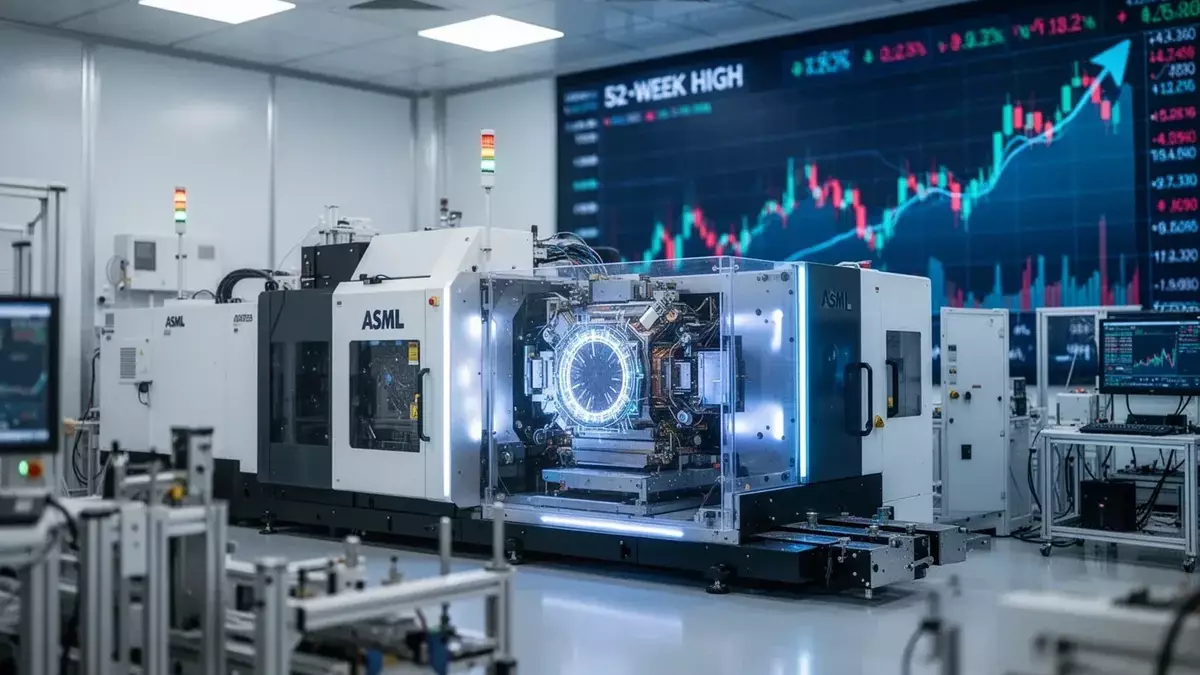
ASML Navigates Export Tightrope as Susquehanna Sees 46% Upside on Record Orders
Published on 07/06/2026 at 14:55 | Redaktion boerse-global.de
The Dutch trade minister’s plane touched down in Beijing on Monday, carrying with it executives from ASML and NXP – and a diplomatic minefield that could reshape the chip-equipment giant’s China exposure. Sjoerd Sjoerdsma’s delegation secured a crucial concession before departing: Chinese officials agreed not to raise human rights or Taiwan arms sales during the visit, a precondition the industry demanded. The 17-member group notably excludes Nexperia, a rival chipmaker.
The stakes could hardly be higher for ASML. Washington has been leaning hard on The Hague, and a US-led chip alliance that the Netherlands joined in June threatens to escalate restrictions. Under the proposed MATCH Act – which Sjoerdsma unsuccessfully opposed during a trip to Washington – ASML could lose the right to sell and service older lithography machines in China. Those legacy systems account for roughly a fifth of the company’s expected annual revenue. ASML’s most advanced equipment has been under an export ban since 2019, but the fresh threat targets a far larger revenue pool. The company has flatly denied recent US allegations of illegal shipments to China.
Yet even as geopolitical clouds gather, the financial case for ASML has never looked stronger. Susquehanna raised its price target from €1,475 to €2,350, implying roughly 46% upside from current levels. The trigger: supply-chain checks showing a sharp pickup in orders for lithography systems. ASML’s backlog stands at €38.8 billion, with lead times stretching beyond a year for new tools. The company is the world’s sole producer of EUV lithography machines, giving it an effective monopoly on the most advanced logic and memory chips.
Should investors sell immediately? Or is it worth buying Asml?
That monopoly is now entering a new phase with the rollout of High-NA EUV, a next-generation technology costing between €350 million and €400 million per tool. The adoption path, however, is uneven. Intel has already installed High-NA systems for its 14A process; SK Hynix is integrating them for next-generation DRAM; but TSMC, the world’s largest contract chipmaker, is balking at the per-chip cost and delaying broad deployment. That divergence means ASML will see different revenue trajectories from different customers in the coming quarters.
ASML has already nudged up its 2026 revenue forecast to €36-€40 billion (from €34-€39 billion), with gross margins of 51%-53%. To meet demand, it plans to deliver around 60 Low-NA EUV systems this year – a 25% increase from 2025 – and scale capacity to 80 Low-NA plus at least 10 High-NA units by 2027. The company reports second-quarter results on July 15, a date that will test whether the record order book can translate into actual revenue growth fast enough to justify the current valuation.
On the trading floor, investors are brushing off the short-term noise. The share price stands at €1,608, down 1.23% on the day but up nearly 63% year to date and more than 100% over the past twelve months. It sits about 8% below its 52-week high of €1,748, recorded in late June, and nearly 11% above its 50-day moving average of €1,449.83. The relative strength index of 53.2 points to a market that is neither stretched nor overly cautious. Meanwhile, the stock’s 63% annualised volatility reflects the heightened nervousness under the surface – a tension that the outcome of Sjoerdsma’s four-day mission in Peking will either soothe or amplify.
Ad
Asml Stock: New Analysis - 6 July
Fresh Asml information released. What's the impact for investors? Our latest independent report examines recent figures and market trends.
Disclaimer regarding our articles: No investment advice, no buy or sell recommendation. Information on prices, companies, and markets is provided without guarantee; changes are possible at any time. Stock market transactions can lead to substantial losses. Our articles are created and reviewed in whole or in part automatically with the support of AI.