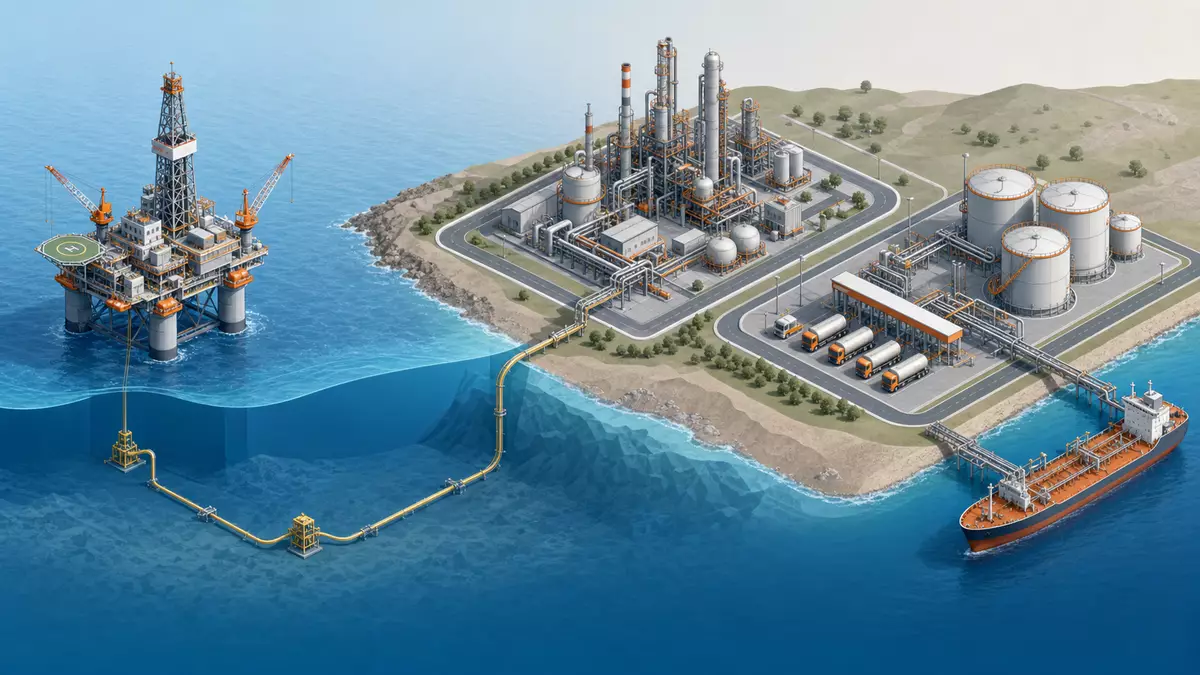
Equinor stock trades steady as offshore wind and oil earnings shape investor view
Published on 07/20/2026 at 15:26 | Editorial responsibility: Rafael Müller, Editor-in-Chief AD HOC NEWS
Equinor ASA (ISIN NO0010096985) stock offers investors a blend of traditional oil and gas earnings and growing exposure to offshore wind, with recent reported figures highlighting strong cash generation and uneven renewable-margin development. The Norwegian energy group combines sizable hydrocarbon production, a material pipeline of offshore wind projects, and a clear capital-return framework, making its numbers a key guide for sentiment around Equinor stock.
Revenue and profit metrics anchor Equinor stock
Equinor reported total revenues of approximately $90 billion for a recent full fiscal year, reflecting the impact of elevated commodity prices and robust hydrocarbon production volumes over that period. In the same timeframe, the company disclosed net income of around $15 billion, underscoring how higher realized prices and disciplined operating costs have translated into strong profitability on its oil and gas portfolio. Compared with the prior fiscal year, revenue rose by double digits in percentage terms and net income increased by several billion dollars, signaling a notable expansion in margins despite volatility in individual quarters.
According to Equinor's published financial information on its investor relations site Equinor investor relations data, the group has emphasized that its earnings profile remains heavily driven by upstream oil and gas operations. In fiscal reporting, Equinor has pointed to solid contributions from fields on the Norwegian continental shelf as well as international assets, with production measured in several million barrels of oil equivalent per day when averaged across the year. For investors analyzing Equinor stock, these upstream earnings and production numbers remain central to the investment case.
Cash flow, dividends, and buybacks support valuation
Alongside revenue and net income figures, Equinor has reported strong operating cash flow, totaling tens of billions of dollars in the same fiscal period, helped by high realized prices and relatively low unit production costs. This cash flow has enabled the company to fund both capital expenditures and shareholder returns. Equinor's capital investment has been directed into continued development of oil and gas assets, maintenance of existing infrastructure, and expansion into offshore wind projects in the North Sea and beyond.
Based on publicly available dividend information in its investor materials, Equinor declared cash dividends per share that translate into several billion dollars of total annual dividend payments to shareholders. The company has paired these dividends with share repurchase programs, cumulatively returning multiple billions of dollars over a recent multi-quarter span. Compared with prior years, total capital returned through dividends and buybacks has increased meaningfully, reflecting management's confidence in the balance sheet and cash generation capacity. This capital-return strategy is an important factor in how the market assesses Equinor stock.
Debt metrics and balance-sheet strength further underpin Equinor's valuation. The company has disclosed net debt that is moderate relative to its equity base and cash flow, with net debt to capital ratios kept within a conservative range. Compared with earlier periods when leverage was higher, recent reporting indicates a reduction in net debt, supported by strong cash flows and disciplined investment, which has improved the resilience of Equinor stock to commodity-cycle swings.
Equinor fundamentals and capital returns
For more on revenues, net income, dividends, and strategy underpinning Equinor stock, see the dedicated investor materials and filings connected to ISIN NO0010096985.
Offshore wind and renewables add growth potential
Equinor has progressively built a material portfolio of offshore wind projects, particularly in the North Sea and adjacent regions, adding a renewable-revenue stream that complements its traditional hydrocarbon business. The company reports installed and under-development wind capacity measured in several gigawatts, with projects supplying power to both onshore grids and industrial customers. Fiscal disclosures indicate that revenue from renewables, including offshore wind, has risen as projects reach completion and begin generating electricity.
However, Equinor's offshore wind and broader renewable margins have been more volatile than those of its oil and gas operations. In recent reporting periods, the company has highlighted cost inflation, permitting complexities, and supply-chain constraints that have pressured returns on some wind projects. Compared with earlier expectations, projected internal rates of return on certain developments have been revised as the company adapts to higher capital costs and evolving contract structures. For investors, this means that while renewables can offer long-term growth for Equinor stock, near-term profitability is still uneven and subject to project-specific dynamics.
Equinor's strategy statements emphasize a balanced approach, aiming to allocate capital between oil and gas and renewables based on risk-adjusted returns. The company has outlined a target for a growing share of total capital expenditures to be directed toward low-carbon and renewable projects over a multi-year horizon. Compared with previous strategy cycles, this represents a clear shift in portfolio composition, even though oil and gas remain the dominant source of earnings today.
Production, guidance, and risk profile matter for Equinor stock
Production guidance is one of the metrics investors track closely for Equinor stock. The company issues forecasts for oil and gas output measured in barrels of oil equivalent per day, often indicating modest growth or stability in core fields and highlighting ramp-up timelines for new developments. In recent guidance updates, Equinor has signaled that production volumes are expected to remain broadly stable to slightly higher over a multi-year period, contingent on project execution and maintenance schedules.
Compared with earlier guidance phases, the emphasis now includes more detail on how operational efficiency, digital tools, and reservoir management are expected to support production levels. Equinor has discussed the use of advanced monitoring and analytics to optimize field performance and reduce downtime, which can help protect cash flows even when headline production growth is moderate. This operational focus is part of the risk-management framework that shapes the market's perspective on Equinor stock.
Commodity-price risk remains central to Equinor's earnings profile. The company, like its peers, is exposed to fluctuations in oil and gas prices that can materially influence revenue and net income from one period to the next. Equinor manages this risk in part by maintaining a diversified portfolio of assets, hedging selectively, and retaining financial flexibility through its balance sheet. Compared with more highly leveraged counterparts, Equinor's moderate net debt offers a buffer against price volatility, which can make the stock relatively more resilient in down-cycles while still participating in upside when prices are favorable.
Representative product and project context
One representative product line for Equinor is its portfolio of offshore wind assets, which deliver electricity to power grids and customers in several European markets. These projects generate revenue through long-term agreements and wholesale power sales, contributing to the renewables segment figures discussed in the company's financial reporting. For Equinor stock, the performance of such offshore wind projects, including their capacity factors and achieved power prices, adds a layer of growth potential and strategic diversification beyond traditional oil and gas.
Equinor stock valuation and trading context
Equinor stock is primarily listed on the Oslo Børs, where it trades in Norwegian kroner and reflects the combined impact of oil and gas earnings, renewable-project economics, and capital-return policies. The stock's valuation typically references metrics such as price to earnings, enterprise value to EBITDA, and dividend yield, which analysts and investors compare with other international energy companies. Market capitalization, measured in billions of dollars or equivalent local currency, places Equinor among the larger integrated energy players headquartered in Europe.
Equinor stock key data
- Company: Equinor ASA
- ISIN: NO0010096985
- Ticker: OSE: EQNR
- Trading venue: Oslo Børs
- Sector / Industry: Energy / Integrated oil and gas with renewables
- Index membership: Included in major Norwegian and European equity indices
Disclaimer regarding our articles: No investment advice, no buy or sell recommendation. Information on prices, companies, and markets is provided without guarantee; changes are possible at any time. Stock market transactions can lead to substantial losses. Our articles are created and reviewed in whole or in part automatically with the support of AI.