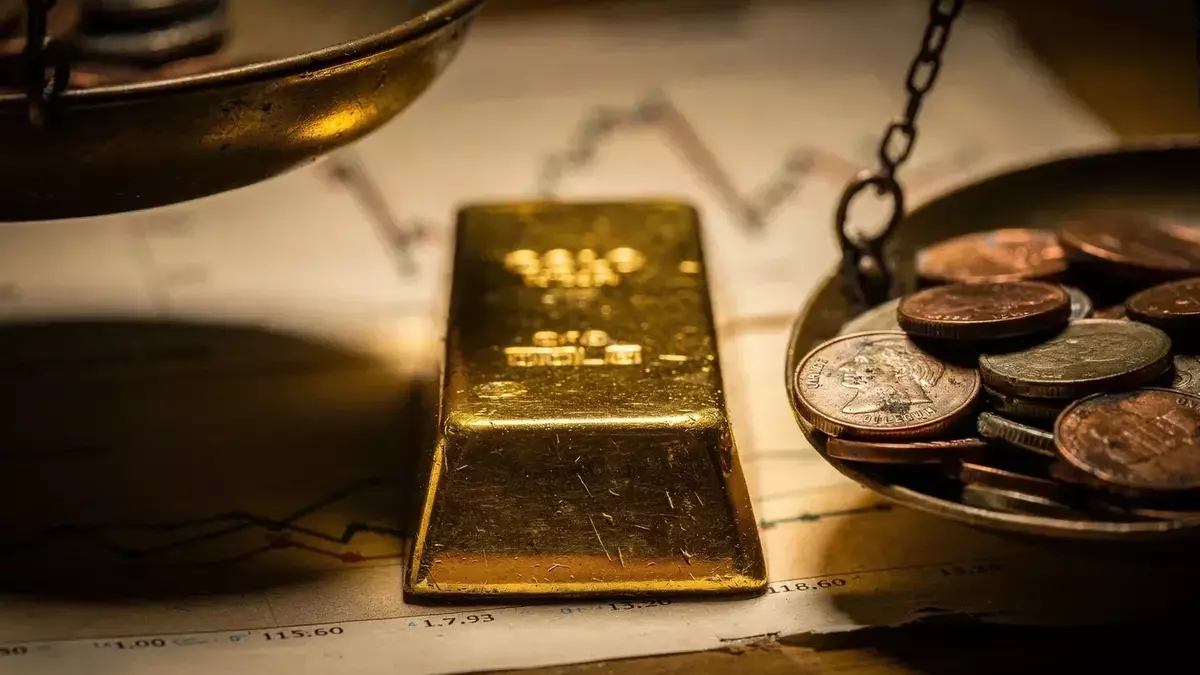
Gold’s $4,053 Floor Test: How an Oil Shock Is Rewriting the Bullion Playbook
Published on 07/23/2026 at 21:41 | Redaktion boerse-global.de
Gold took a sharp hit on Thursday, sliding 1.97 percent to $4,053.40 an ounce after briefly touching a two-week high of $4,165.87 earlier in the session. The reversal erased gains built on geopolitical anxiety, as a surge in crude prices reshuffled the market’s priorities. US gold futures for August settled 0.4 percent lower at $4,134.60, while spot bullion now sits 4.69 percent below its 50-day moving average of $4,252.94. Year-to-date, the precious metal has shed 6.45 percent of its value.
The trigger was unmistakable: Brent crude jumped 6.5 percent to reclaim the $100-a-barrel threshold for the first time since late May, settling at $100.05. Houthi attacks on Saudi tankers Encelia and Layla in the Red Sea added a fresh layer of risk to an already volatile Persian Gulf, where US airstrikes against Iranian targets entered a twelfth consecutive night and Tehran threatened retaliation. Goldman Sachs warned that a sustained blockade of the Strait of Hormuz could push Brent to $120 by the fourth quarter.
Rising oil prices are a double-edged sword for gold. While they typically stoke haven demand, the current move is feeding inflation expectations that reinforce bets on tighter monetary policy — a toxic mix for a non-yielding asset. The European Central Bank held its deposit rate at 2.25 percent, but President Christine Lagarde described developments in the Gulf as alarming. With eurozone inflation running at 2.8 percent in June, economists now pencil in a rate hike for September. The yield on ten-year German Bunds climbed to 3.20 percent, its highest since 2011.
The intraday range told the story of a market torn between opposing forces. Gold oscillated between roughly $4,120 and $4,165 before the oil-driven selloff accelerated, dragging it below the psychologically important $4,100 handle. ANZ noted that speculative net-long positions on gold futures had reached their highest since January, while inflows into gold-backed ETFs remained robust. For ANZ, the $4,200 resistance level is the key pivot: a sustained break above it could open the door to fresh highs, while a fall back under $4,000 would put the fragile recovery at risk.
Should investors sell immediately? Or is it worth buying Gold?
Central banks, meanwhile, continue to underpin the structural case for gold. A World Gold Council survey found that 89 percent of reserve managers expect global central bank holdings to rise over the next twelve months, with 45 percent planning to expand their own reserves — a record high in the survey’s history. Gold now accounts for 27 percent of official global reserves, surpassing US Treasuries at 22 percent, according to Bloomberg data from late 2025. Some 93 percent of surveyed institutions now hold gold, up from 81 percent a year earlier.
Not all central banks are buying. Russia sold roughly 43.5 tonnes of gold in the first half of 2026, apparently to plug a budget deficit, leaving it with 73.4 million ounces. Turkey trimmed its holdings by 81 tonnes over the same period. But UBS views these as exceptions to a global trend that remains firmly supportive, forecasting 2026 central bank purchases of 750 to 1,000 tonnes. The bank described the recent dip to $3,850 as a buying opportunity.
Hedge fund investor John Paulson struck a bullish long-term note, telling Business Insider that the gold rally is just getting started as faith in fiat currencies erodes. He noted that while gold sits well below its late-January record of $5,600, central bank buying appetite remains intact. Paulson prefers early-stage miners over physical bullion — his firm NovaGold took over his 40 percent stake in the Donlin Gold project, creating a $4.2 billion entity. JPMorgan, while trimming its fourth-quarter forecast, maintained a long-term bullish stance.
Gold at a turning point? This analysis reveals what investors need to know now.
Silver is flashing a warning. The white metal fell to $54.77 an ounce, an eight-month low and roughly 55 percent below its all-time high of $121.64 set on January 29. Analyst Florian Grummes pointed to technical support between $54 and $56, anchored by the October 2025 high of $54.48. He sees gold needing to trade in a $3,900-to-$4,200 range to form a sustainable base; a break below $3,900 could target $3,500 for gold and $45 for silver. Shawn Khunkhun of Contango Silver & Gold describes the current environment as a “pre-mania phase” with higher prices ahead, but warns that short-term downside pressure could push gold as low as $3,400 to $3,500 before the next leg up begins.
Ad
Gold Stock: New Analysis - 23 July
Fresh Gold information released. What's the impact for investors? Our latest independent report examines recent figures and market trends.
Disclaimer regarding our articles: No investment advice, no buy or sell recommendation. Information on prices, companies, and markets is provided without guarantee; changes are possible at any time. Stock market transactions can lead to substantial losses. Our articles are created and reviewed in whole or in part automatically with the support of AI.