Gold’s $4,100 Flash Fades as Fed Chair Warsh Warns Inflation Fight Is Far From Over
Published on 07/16/2026 at 11:44 | Redaktion boerse-global.de
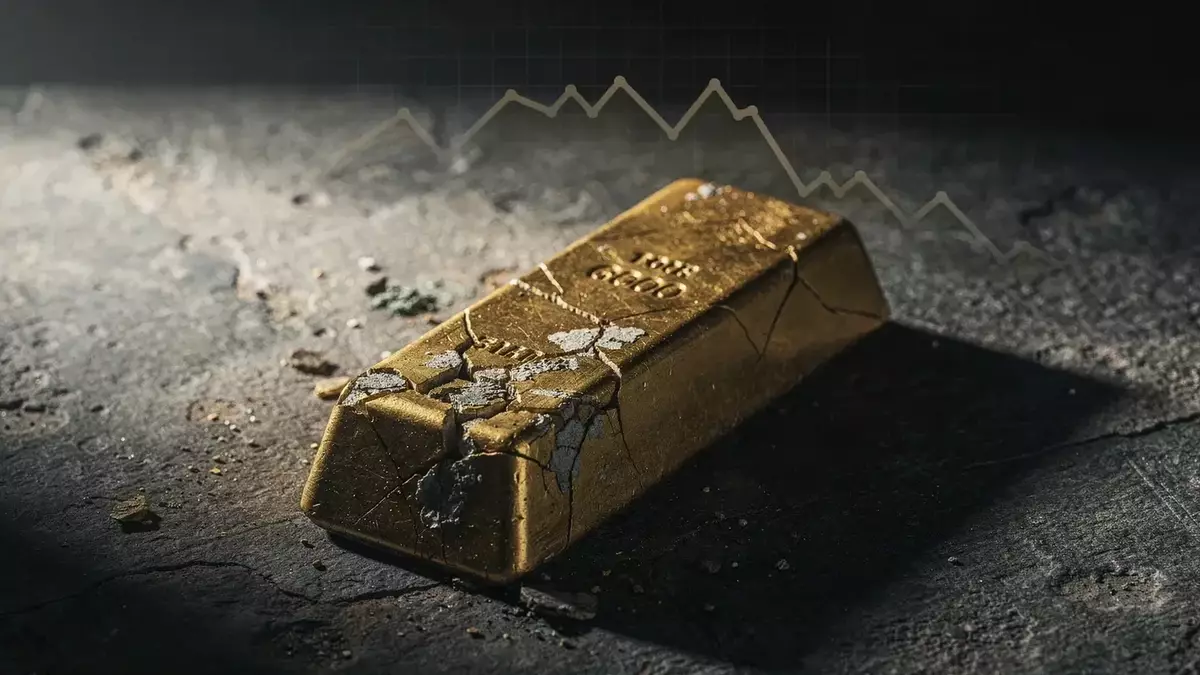
Gold hit the World Gold Council’s price target of $4,100 an ounce on 15 July — briefly touching $4,100.49 — before retreating just as quickly. By the morning of 16 July, spot gold in Germany was trading at $4,060.90, up 0.23% on the day but still well below the intraday spike. The August futures contract settled at $4,033.90 on the 15th, a decline of 0.9%. The brief rally and subsequent pullback encapsulate the conflicting forces that have kept the metal tethered in a narrow band around $4,000-$4,080 in recent days.
The immediate catalyst for the volatility was a set of softer-than-expected US inflation figures for June. The consumer price index fell 0.4% month-on-month — the first monthly drop since April 2020 — bringing the annual rate down to 3.5% from 4.2% in May. Core CPI stood at 2.6%. Producer prices also surprised to the downside, declining by an unexpected 0.3% on the month. At first glance, fading inflation pressure should be bearish for gold, since it reduces the urgency for further monetary tightening and lowers the opportunity cost of holding the non-yielding asset.
But Federal Reserve Chair Kevin Warsh quickly poured cold water on any hopes of an imminent policy pivot. Testifying before the Senate Banking Committee and the House Financial Services Committee on 14 and 15 July, Warsh declared that the central bank has “zero tolerance” for persistently high inflation and intends to make it “a thing of the past.” One month of softer data, he argued, does not constitute an all-clear signal. The Fed left its key interest rate unchanged at 3.5-3.75% and is scheduled to meet again on 28-29 July. Market pricing for a rate hike at the September FOMC meeting now stands at roughly 44%, down sharply from around 76% earlier this month as traders recalibrated after the inflation data.
Should investors sell immediately? Or is it worth buying Gold?
Compounding the uncertainty, geopolitical tensions in the Middle East have surged back into the spotlight. The US has launched new attacks on Iran and reimposed a naval blockade of Iranian ports near the Strait of Hormuz, while Tehran has responded by shutting the strategic waterway. The standoff has pushed West Texas Intermediate crude close to $80 a barrel, reigniting fears that energy-driven inflation could force the Fed’s hand even as headline CPI cools. For gold, the situation creates a dual-edged dynamic: safe-haven demand supports prices, but the inflation channel works in the opposite direction by raising rate expectations and the metal’s carrying cost.
Structural support from central bank buying remains a powerful counterweight. China’s central bank added 320,000 ounces to its gold reserves in May 2026, the 19th consecutive month of purchases, bringing its total holdings to 74.96 million ounces. Gold now represents 8.8% of China’s official reserves, compared with a global average of 27%. A European Central Bank report published in June 2026 revealed that gold overtook US Treasuries as the preferred sovereign reserve asset for the first time since 1996, with a 27% share versus 22% for Treasuries and 15% for the euro. The global gold stock stands at 21.99 million tonnes with a market value of $31.45 trillion; central banks hold 3.87 million tonnes worth $5.53 trillion. A World Gold Council survey found that a record 45% of central banks plan to increase their gold reserves over the next twelve months.
The correction from January’s high above $5,400 to around $4,000 in June has prompted several banks to revise their price targets lower. Bank of America now sees $4,360, JPMorgan $4,300 for the third quarter and $4,500 for the fourth, Deutsche Bank $4,300 and $4,800 respectively, and Morgan Stanley $5,200. The World Gold Council’s base case range is $3,895 to $4,305, with a bullish scenario above $4,500 in the event of a global recession and a bearish outcome below $4,000. Some institutional investors view the weakness as an opportunity. Fidelity International’s portfolio manager George Efstathopoulos plans to increase his strategic fund’s gold allocation from roughly 3% to about five percent and would add more aggressively on a further 5-7% pullback. Chinese banks such as CICC and ICBC have also characterized the current dip as a buying opportunity.
With the next key data point — US retail sales for June — still to come and the Fed meeting later this month, gold’s short-term direction hinges on whether inflation anxiety or geopolitical risk wins the tug-of-war. For now, the metal remains caught between a softer inflation narrative and the hard reality of a hawkish chair and a hot Middle East.
Ad
Gold Stock: New Analysis - 16 July
Fresh Gold information released. What's the impact for investors? Our latest independent report examines recent figures and market trends.
Disclaimer regarding our articles: No investment advice, no buy or sell recommendation. Information on prices, companies, and markets is provided without guarantee; changes are possible at any time. Stock market transactions can lead to substantial losses. Our articles are created and reviewed in whole or in part automatically with the support of AI.