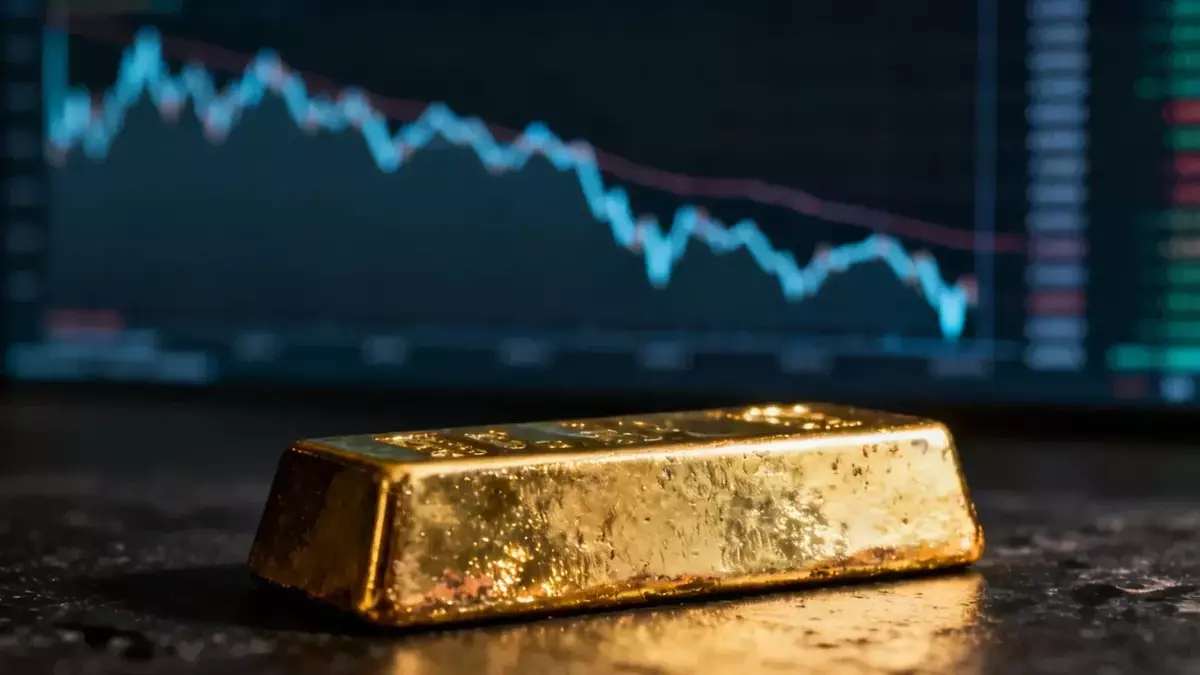
Gold’s Split Personality: Haven Demand Clashes With Rate Expectations as Silver Runs Ahead
Published on 07/22/2026 at 15:52 | Redaktion boerse-global.de
The gold market is sending mixed signals. While the precious metal inched higher on Wednesday, it did so with none of the conviction seen in its sister commodities, as investors struggle to reconcile escalating geopolitical tensions with a monetary policy outlook that is turning increasingly hawkish.
Spot gold reached $4,126.90 per troy ounce, a gain of 1.1% on the day. The August-dated futures contract settled at $4,076.40, up 1.5%. Yet for all the positive price action, bullion remains nearly 28% below its 52-week peak of $5,626.80 hit in January, and the recovery from recent lows has been tentative at best. The metal now sits just 5.78% above its 2025 trough from October 28.
A Divergence That Speaks Volumes
The real story on Wednesday was not gold itself, but the yawning gap between it and other precious metals. Silver surged 4.1% to $58.72 per ounce, platinum added 1.9% to $1,623.63, and palladium climbed 2.4% to $1,282.25. That means silver’s relative gain was more than six times that of gold — a divergence that market participants attribute to stronger industrial and speculative demand in the smaller, more volatile markets.
Gold, by contrast, is being held back by a powerful headwind that the other metals are less exposed to: the rising probability of another Federal Reserve rate hike. The CME FedWatch tool now prices in roughly 67% odds of a quarter-point increase at the September meeting, a dramatic shift from earlier expectations that the central bank would hold steady through year-end.
Should investors sell immediately? Or is it worth buying Gold?
Two Forces, One Metal
The competing dynamics pulling at gold are unusually stark. On one side, the military escalation between the United States and Iran continues to drive safe-haven flows. US forces carried out strikes on Iranian targets for the eleventh consecutive night, according to dpa-AFX, aimed at degrading Tehran’s ability to attack commercial shipping through the Strait of Hormuz — one of the world’s most critical oil transit chokepoints.
Typically, rising oil prices are toxic for gold. They stoke inflation fears and reinforce expectations of tighter monetary policy. This time, however, the market has temporarily set aside that logic, prioritizing the immediate security premium over the longer-term rate calculus.
But the oil rally is already reshaping the macro picture. Crude’s advance has pushed bond yields higher — the 10-year US Treasury yield hovers around 4.57%, while the 2-year note yields above 4.22%. Both levels raise the opportunity cost of holding a non-yielding asset like gold. The dollar index has also firmed to roughly 100.87, adding further pressure.
Ceasefire Hopes Complicate the Picture
Adding another layer of complexity, reports emerged on July 20 that a senior Iranian official had received a proposal from mediators for a ten-day truce. That news initially weighed on oil prices and briefly eased inflation concerns, but the situation remains fragile. Any credible move toward de-escalation could remove a key pillar of support for gold, while a breakdown in talks would likely reinforce the haven bid.
The net effect is a market that is directionless in the short term. Gold’s relative strength index stands at 45.9 — a neutral reading that confirms the metal is caught between opposing forces without a clear catalyst to break the deadlock.
The Fed Looms Large
All eyes are now on the Federal Open Market Committee meeting scheduled for July 28-29, where the benchmark rate is expected to remain unchanged at 3.50% to 3.75%. The decision itself may be less consequential than the accompanying statement and Chair Powell’s press conference, which will be scrutinized for any shift in language around the inflation outlook.
Gold at a turning point? This analysis reveals what investors need to know now.
If the Fed signals tolerance for higher inflation driven by energy costs, gold could rally on the back of a weaker dollar and lower real yields. If, however, policymakers emphasize the need to remain vigilant — as the oil-driven repricing of rate expectations suggests they might — the headwind for bullion will only intensify.
Gold remains below its 50-day moving average of $4,265.27, a technical level that would need to be reclaimed to confirm any sustained upward trend. Until then, the metal is likely to oscillate between its competing drivers: a geopolitical risk premium that supports prices and a rate environment that caps them.
The divergence with silver, platinum, and palladium may offer a clue. Those metals are rallying on industrial demand and speculative positioning, unburdened by the same interest-rate sensitivity. For gold to close the gap, either the Fed must soften its stance — or the conflict in the Middle East must escalate further. Neither outcome is assured, and both could shift abruptly.
Ad
Gold Stock: New Analysis - 22 July
Fresh Gold information released. What's the impact for investors? Our latest independent report examines recent figures and market trends.
Disclaimer regarding our articles: No investment advice, no buy or sell recommendation. Information on prices, companies, and markets is provided without guarantee; changes are possible at any time. Stock market transactions can lead to substantial losses. Our articles are created and reviewed in whole or in part automatically with the support of AI.