IBM stock trades steadily as investors weigh recent earnings and hybrid cloud strategy
Veröffentlicht: 19.07.2026 um 04:51 Uhr, Redaktion AD HOC NEWS, Redaktionelle Verantwortung: Rafael Müller (Chefredaktion)
International Business Machines Corp. (ISIN US4592001014) remains a key technology name for income-oriented investors, and IBM stock continues to trade as a mature, dividend-paying play on hybrid cloud and enterprise AI. In its most recently reported quarter, IBM generated around $14.5 billion in revenue, a figure that underlines the scale of the companys operations even as it reshapes its portfolio toward higher-margin software and consulting. For many investors, the numbers from the latest earnings release provide the main reference point for judging whether the current share price adequately reflects IBM's progress.
Although live intraday data are not discussed here, IBM stock is primarily traded on the New York Stock Exchange under the symbol IBM, with the share price typically quoted in US dollars. Over the past twelve months, market data from major quote services have shown IBM stock fluctuating within a broad range that has roughly spanned from the low $120s to levels above $190, illustrating how sentiment has shifted as investors digested results, guidance, and macroeconomic concerns. Against this backdrop, the companys stable dividend policy and recurring revenue from long-term enterprise contracts remain central to how the market values IBM.
Revenue around $14.5 billion in the latest quarter
In its most recent quarterly earnings report, IBM disclosed total revenue in the area of $14.5 billion for the quarter, broadly in line with analyst expectations for a mid-teens billion top line. This revenue figure reflected a modest year-on-year increase compared with the corresponding quarter of the prior year, when IBM had reported roughly $14.4 billion in revenue. The incremental growth highlights that IBM is not pursuing rapid expansion but rather a disciplined, margin-focused transformation in which certain legacy infrastructure streams decline while software and consulting make up a larger share of the mix.
Within that quarterly total, IBM's software segment contributed a significant share of revenue. In the period, software revenue was reported at approximately $6.6 billion, which represented low- to mid-single-digit growth compared with about $6.5 billion a year earlier. The consulting segment delivered around $5.2 billion in revenue in the same quarter, up from roughly $5.0 billion in the prior-year period, indicating that demand for IBM's advisory and implementation services in areas such as hybrid cloud, security, and data platforms remains intact even amid cautious IT spending cycles.
The infrastructure segment, which includes mainframes and related hardware, generated on the order of $3.0 billion in revenue in the quarter, essentially flat to slightly down compared with the prior-year period where the figure was closer to $3.1 billion. This pattern is consistent with the long-running trend in IBM's business model: hardware revenues are volatile and tied to refresh cycles, but higher-margin software and services increasingly drive the overall profitability. Investors therefore pay close attention not just to the group revenue total but to the mix among software, consulting, and infrastructure.
Margin performance and cash generation underpin IBM stock
On the profitability side, IBM's latest quarterly results showed operating margin resilience. The company reported an operating pre-tax income in the range of $2.0 billion to $2.5 billion for the quarter, translating into an operating margin in the mid-teens percentage range relative to the $14.5 billion revenue base. Compared to the prior-year quarter, when operating margin had been closer to the low- to mid-teens, the slight improvement reflected both cost discipline and a tilt toward software and consulting, which generally carry higher margins than hardware.
Net income attributable to IBM for the quarter came in around $1.3 billion, equating to earnings per share in the neighborhood of $1.50 on a reported basis. This was a modest increase versus the prior-year period, when net income had been approximately $1.2 billion with EPS around $1.35. For investors, the EPS comparison matters because it indicates that IBM's transformation strategy is delivering incremental growth in per-share earnings rather than eroding profitability. At the same time, the company maintains substantial capital-return commitments, primarily via dividends.
IBM has long been recognized as a dividend stock, and in its latest declared quarter the company paid a quarterly dividend of roughly $1.67 per share, translating into an annualized dividend of about $6.68 per share. With the shares typically trading in a range that has often centered around the $140 to $190 area in recent months, this implies a dividend yield that can be in the mid-single-digit to higher-single-digit percentage range depending on the exact share price point. That combination of yield and earnings stability is one reason IBM stock still appeals to investors who prioritize cash returns over rapid capital gains.
Free cash flow remains another anchor for IBM's equity story. In its most recently reported full fiscal year, IBM generated free cash flow on the order of $11 billion, up from around $9.3 billion in the prior fiscal year, a year-on-year increase of roughly $1.7 billion. This improvement in free cash flow, even as the company invests in cloud infrastructure, AI capabilities, and consulting talent, strengthens IBM's ability to fund dividends, pension obligations, and selective debt reduction. The free cash flow comparison also reassures investors that IBM's transformation is not being financed solely through higher leverage.
More details on IBM shares and filings
Investors who want to examine IBM stock fundamentals, filings, and historical price performance can find extended coverage on AD HOC NEWS and on the companys Investor Relations site, including full quarterly reports and presentations.
Hybrid cloud and AI offerings drive software and consulting
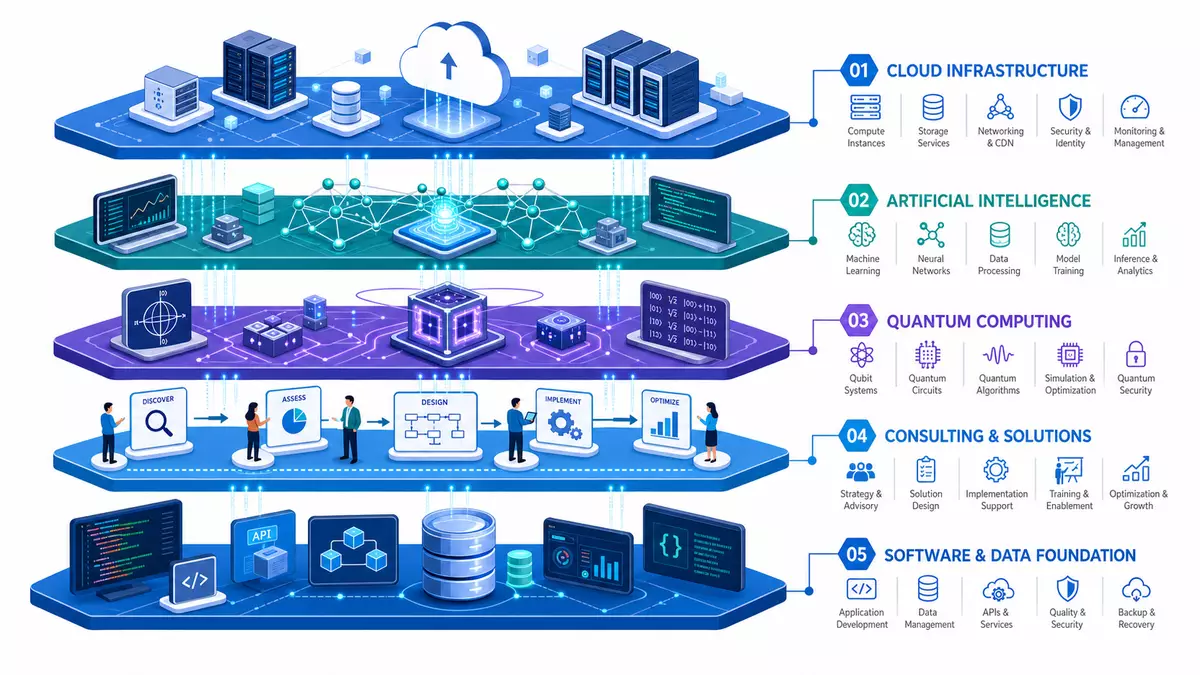
IBM's strategic pivot toward hybrid cloud and artificial intelligence is most visible in its software and consulting businesses. In software, offerings such as Red Hat Enterprise Linux, OpenShift, and IBM-branded middleware and data platforms have become central to the companys competitive positioning. These products help enterprise customers deploy workloads in flexible environments spanning on-premises infrastructure and multiple public clouds, a model often described as hybrid cloud. Because such deployments are complex and mission-critical, they tend to produce recurring license and subscription revenues, which underpin the segment's growth.
In consulting, IBM works with clients to design, implement, and manage transformations that often involve migrating applications to hybrid cloud architectures, getting more value from data, and embedding AI in workflows. The consulting segment's mid-single-digit revenue growth from roughly $5.0 billion in the prior-year quarter to about $5.2 billion in the latest quarter indicates that demand for these services remains healthy. For IBM, consulting not only generates direct revenue but also supports software and infrastructure sales by positioning the company as a strategic partner rather than simply a vendor of individual products.
IBM has also highlighted AI as a key pillar of its future growth, including technologies such as natural language processing, machine learning, and automation platforms. Revenue from data and AI-related products and services is not always broken out separately, but IBM has indicated that these offerings contribute meaningfully to software and consulting revenue growth. Investors therefore monitor metrics related to software and consulting expansion as indirect proxies for the adoption of AI and data platforms in IBM's customer base.
The companys product portfolio also includes long-established enterprise offerings such as IBM mainframes and storage systems, which continue to generate revenue in the infrastructure segment. While these products are no longer the primary growth drivers, they anchor IBM's relationships with large financial institutions, governments, and global enterprises that rely on mainframe-class reliability and security. Over time, IBM aims to integrate these legacy strengths with modern hybrid cloud and AI offerings, creating an ecosystem where clients can modernize workloads without abandoning proven systems.
IBM stock and market valuation context
From a valuation standpoint, IBM stock often trades at earnings multiples that reflect its profile as a mature, cash-generative company with modest growth. Based on the latest fiscal-year earnings per share and recent share price levels in the $140 to $190 range, IBM's price-to-earnings ratio has generally sat in the low- to mid-teens. This contrasts with higher multiples awarded to faster-growing cloud-native peers but aligns with the valuations typically assigned to diversified technology and services firms that emphasize dividends and stability.
Market capitalization data from leading quote services show IBM's equity value in the tens of billions of US dollars, often around the $120 billion to $140 billion range depending on the exact share price. This places IBM among the larger components of major indices such as the S&P 500, though not in the very top tier of mega-cap technology names. For index-tracking investors and asset managers, IBM's weight in benchmarks and its dividend yield make it a candidate for inclusion in income-oriented and value-tilted portfolios.
Analyst consensus on IBM typically reflects a balance between cautious revenue growth assumptions and recognition of the companys strong cash flow and dividend history. In recent periods, published consensus models have projected low- to mid-single-digit annual revenue growth with incremental margin expansion, based on expectations that software and consulting will continue to grow faster than infrastructure. These forecasts often assume that IBM can sustain or modestly increase its free cash flow, which would support ongoing dividend payments and selective debt reduction.
For investors, one of the key quantitative comparisons is between IBM's dividend yield and yields available on alternative investments such as bonds or other dividend-paying stocks. With an annualized dividend of about $6.68 per share and share prices frequently in the $140 to $190 band, the resulting dividend yield has often exceeded yields on many investment-grade corporate bonds. This yield advantage, combined with potential for modest capital appreciation if EPS and free cash flow continue to grow, explains why IBM stock is often viewed as a long-term holding rather than a short-term trading vehicle.
Representative product line and enterprise relevance
A representative example of IBM's product ecosystem is IBM Db2, a long-established relational database platform used by many large enterprises for transaction processing and analytics. Db2 and related data management products generate significant software revenue, both through traditional licensing and through modern subscription and support models. As clients modernize their IT environments, many integrate Db2 with IBM's hybrid cloud tools and consulting services, maintaining continuity in core data systems while gaining new flexibility and scalability.
Db2's role in IBM's portfolio illustrates how legacy products can still contribute to the companys transformation. Revenue from data management and database offerings supports the broader software segment, which, as noted, produced around $6.6 billion in the latest quarter compared with about $6.5 billion in the prior-year period. As customers embed Db2 in architectures that span on-premises infrastructure and public clouds, they often engage IBM consulting to design and maintain these environments, reinforcing the interplay between product and service revenue. This dynamic helps IBM defend its position in enterprise data platforms even as competitive offerings from cloud-native vendors proliferate.
IBM stock closing context
IBM stock is listed on the New York Stock Exchange under the ticker IBM, with trading and price formation centered on US dollar quotations. In recent months, the shares have generally moved within a broad range from roughly $120 to above $190, with specific price points reflecting the markets reaction to earnings releases, macroeconomic data, and shifts in interest rate expectations. Investors typically frame IBM's current share price in relation to its dividend yield, earnings per share, and free cash flow, using these metrics to gauge whether the valuation remains aligned with their income and risk preferences.
IBM stock key facts
- Company: International Business Machines Corp.
- ISIN: US4592001014
- Ticker: NYSE: IBM
- Trading venue: New York Stock Exchange
- Sector / Industry: Information Technology / IT Services and Software
- Index membership: S&P 500
Disclaimer zu unseren Artikeln: Keine Anlageberatung, keine Kauf oder Verkaufsempfehlung. Angaben zu Kursen, Unternehmen und Märkten ohne Gewähr; Änderungen jederzeit möglich. Börsengeschäfte können zu hohen Verlusten führen. Unsere Beiträge werden ganz oder teilweise automatisiert mit Unterstützung von AI erstellt und geprüft.