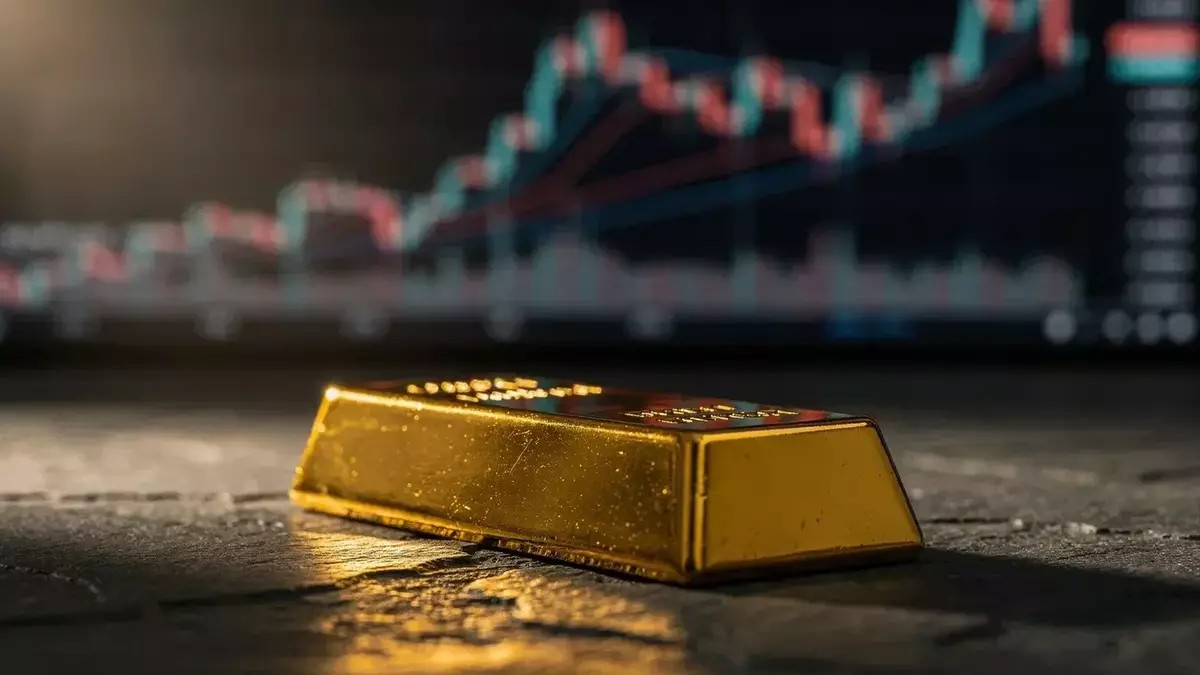
Institutional Gold Buying Surges as Oil-Driven Rate Fears Drag Spot Price Below $4,000
Published on 07/17/2026 at 14:45 | Redaktion boerse-global.de
Gold’s spot price spent Friday oscillating around the psychologically pivotal $4,000 mark, settling at $3,996.40 an ounce after a tentative 0.40% intraday gain — enough to register a small bounce but not enough to erase a weekly loss of 3.18%, its steepest in six weeks. The yellow metal now sits just 2.44% above its 52-week low of $3,901.30 struck on October 28, 2025. Yet beneath the surface of the price chart, a completely different story is unfolding: institutional money is flooding into gold at a pace that suggests large investors see the sell-off as an opportunity rather than a reason to flee.
The primary catalyst for the spot weakness is a two-pronged shock from the Middle East. US airstrikes on Iran entered a sixth consecutive night, hitting bridges in Hormozgan province and a tower in Chabahar, while shipping traffic through the Strait of Hormuz has contracted sharply. Iran has reportedly instructed the Houthi militia to shut the Red Sea to trade if US infrastructure is attacked. The White House insists dialogue remains open, but markets are pricing in a prolonged crisis. Brent crude jumped 1.25% to $85.28 a barrel on Friday, with WTI rising 1.3% to $79.98; both benchmarks gained roughly 12% on the week. That surge hits gold twice: higher energy costs stoke inflation expectations and reinforce the view that the Federal Reserve will keep interest rates elevated, making non-yielding bullion less attractive, while simultaneously squeezing miners’ margins by raising extraction costs.
Fed officials have reinforced that hawkish narrative. Chair Warsh reiterated the 2% inflation target and warned against premature easing, Vice Chair Jefferson left the door open to another rate increase if inflation proves sticky, and the Dallas Fed called for “moderately higher rates.” Markets now assign a 73% probability to a December rate hike. On the same day, the US imposed a fresh blockade on Iranian ports, adding another layer of upward pressure on oil and downward pressure on gold’s near-term appeal.
But while retail and short-term speculators have been backing away, large institutional players are moving in the opposite direction. The world’s largest gold ETF, SPDR Gold Shares (GLD), saw net inflows of $290.91 million in the week through July 15, even though its physical holdings edged down by a mere 0.63 tonnes to 1,001.88 tonnes. That marks a striking reversal from the prior week, when GLD lost 2.85 tonnes and $373.93 million in capital. According to the World Gold Council’s latest flows report, global gold ETFs bled $8.9 billion in June alone, yet the first half of 2026 still ended with net inflows of $8 billion — a resilient showing given the volatility.
Should investors sell immediately? Or is it worth buying Gold?
The most telling shift is happening on the COMEX. Total net-long open interest jumped 16% month-on-month in June to 538 tonnes, the highest month-end reading since January. Crucially, the buildup has been driven by large hedge funds, banks and other reportable traders who have been adding to their net-long positions since the start of June even as the spot price weakened. Non-reportable traders — typically retail — trimmed their net-long exposure over the same period. That institutional safety net helps explain why gold has not plummeted further despite the hostile rate and oil backdrop.
Regionally, the buying is concentrated in Asia, which posted a record $12 billion of first-half ETF inflows — its strongest six-month period ever. That more than offset a North American exodus of $7.7 billion, the region’s worst first half since 2013, driven by rising rate expectations tied to the oil shock. Asian demand has cooled slightly of late, with Chinese investors shifting toward equities and Japanese buyers staying on the sidelines, but the long-term structural bid from central banks remains. In the first quarter of 2026, central banks bought 244 tonnes of gold net; Poland added 14 tonnes in April, and China extended its buying streak to a 19th consecutive month. A World Gold Council survey found 83% of central banks plan to increase reserves over the next twelve months, up from 76% a year earlier. The European Central Bank separately noted that gold’s share of global official reserves overtook that of US Treasuries for the first time since 1996 at the end of 2025.
The analyst community remains deeply split on where gold heads next. Bank of America warns the correction is “far from over,” drawing historical parallels to the 1980 and 2011 bear markets, and recommends waiting for a drop to $3,450–$3,250 before buying aggressively. UBP slashed its year-end target to $4,800, trimming its portfolio allocation to a neutral 5% gold weighting, but says it will rebuild once a Middle East ceasefire and clearer rate signals emerge. Deutsche Bank and Commerzbank also target $4,800, while Citigroup sees just $4,300 as realistic over three months. ANZ stands out at $5,600. Should $4,000 give way decisively, some observers flag a possible slide to $3,500, though a technical bounce toward $4,100–$4,150 isn’t ruled out in the short term.
Gold at a turning point? This analysis reveals what investors need to know now.
For now, the spot price remains hostage to headlines from the Middle East and the Fed’s next move, but the cumulative evidence from ETF flows, COMEX positioning and central bank hoarding points to formidable demand lurking just beneath the surface. The relative strength index at 37.6 suggests the market is approaching oversold territory, and weaker-than-expected US inflation data has provided occasional relief. As one WGC analyst put it, the combination of geopolitical, growth and financial-market uncertainty could sustain gold’s appeal as portfolio insurance well into the second half of the year — even if the road back to $4,500 and beyond is anything but smooth.
Ad
Gold Stock: New Analysis - 17 July
Fresh Gold information released. What's the impact for investors? Our latest independent report examines recent figures and market trends.
Disclaimer regarding our articles: No investment advice, no buy or sell recommendation. Information on prices, companies, and markets is provided without guarantee; changes are possible at any time. Stock market transactions can lead to substantial losses. Our articles are created and reviewed in whole or in part automatically with the support of AI.