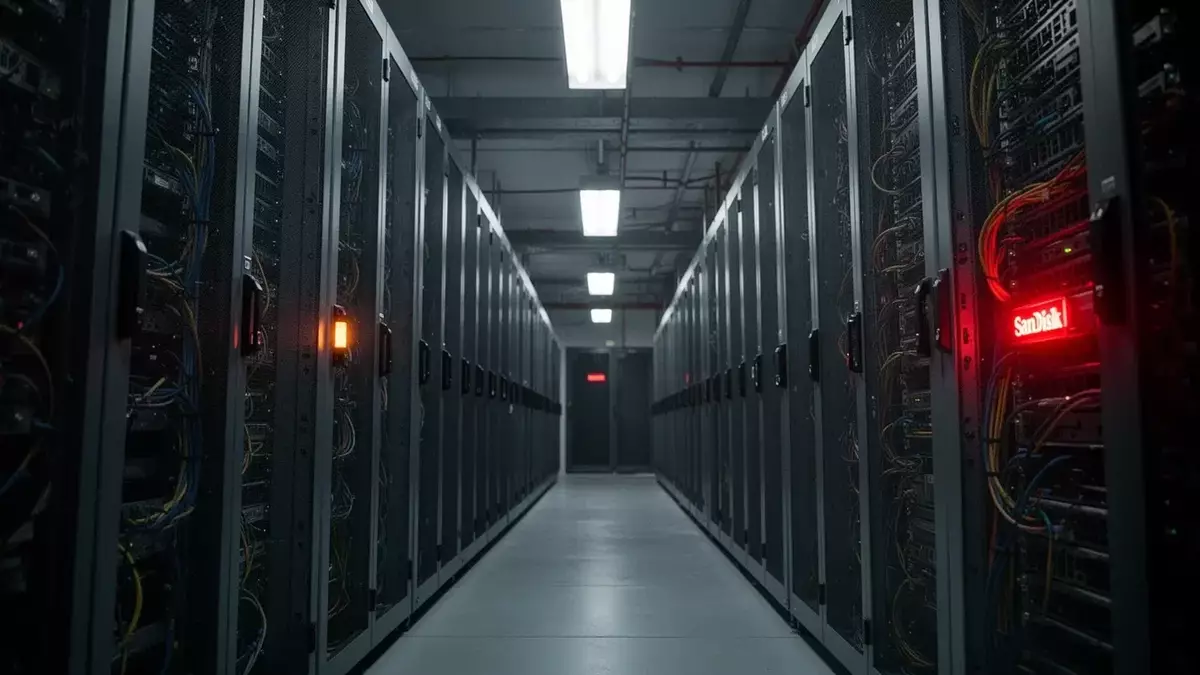
SanDisk’s Revenue Transformation: $42 Billion in Long-Term Deals Fuel Analyst Upgrades as Chip Supply Tightens
Published on 06/09/2026 at 17:35 | Redaktion boerse-global.de
SanDisk has fundamentally reshaped its business model with five long-term supply agreements that lock in $42 billion in guaranteed revenue, a move that has already sent its stock surging and prompted a flurry of analyst upgrades. The shares rose 5.4 percent on Tuesday to $1,648.41, building on a pre-market jump as investors digested the implications of the multi-year contracts. The agreements include $400 million in prepayments and binding minimum purchase commitments, with more than a third of the total already earmarked for 2027 alone.
Analysts from five different houses have raised their price targets over the past 48 hours, betting that the new contract structure will give SanDisk unprecedented earnings visibility. Cantor Fitzgerald set the most aggressive target at $2,900, up from $1,800, while Bank of America lifted its target to $2,100 from $1,550 and Mizuho raised its goal to $2,200. The consensus among 20 analysts now stands at 18 buy ratings and two holds. The upgrades come on the heels of a 15 percent correction in the stock, which some market participants now view as a buying opportunity.
The contracts arrive at a moment when the memory-chip market is tilting decisively in favor of suppliers. Industry-wide NAND flash production is expected to fall 5 percent in 2026, and new fabrication plants will not come online until at least 2028. Meanwhile, demand for DRAM is projected to jump 27 percent this year, and NAND demand is forecast to rise 18 percent. That supply-demand imbalance should keep prices climbing into mid-2027, delivering a double boost to SanDisk: higher spot prices plus the stability of pre-negotiated volumes.
Should investors sell immediately? Or is it worth buying SANDISK?
Bank of America has already revised its financial forecasts upward to reflect the new reality. For 2027, the bank now projects SanDisk’s revenue at $44 billion, up from $37.7 billion, and earnings per share of $187.65 versus an earlier estimate of $153.59. Free cash flow is expected to reach $27.5 billion in 2027 and $34.3 billion in 2028, giving the company ample firepower for stock buybacks or acquisitions.
SanDisk itself has undergone a remarkable revival since returning to public markets. After its spin-off from Western Digital, the company listed as an independent entity in February 2025 and was readmitted to the Nasdaq 100 index in April 2026. The artificial intelligence boom, which is driving explosive demand for high-performance storage, has provided powerful tailwinds — and the new contracts now make those tailwinds more predictable.
Analysts at Cantor Fitzgerald characterized the current “AI storage boom” as still in its early-to-middle innings, suggesting the runway for NAND demand could extend well beyond the near-term supply constraints. With fab capacity booked solid through 2028 and a guaranteed $42 billion backlog, SanDisk has effectively moved from the volatility of spot markets to the stability of a subscription-like revenue model — a shift that Wall Street is rewarding with increasingly bold price targets.
Ad
SANDISK Stock: New Analysis - 9 June
Fresh SANDISK information released. What's the impact for investors? Our latest independent report examines recent figures and market trends.
Disclaimer regarding our articles: No investment advice, no buy or sell recommendation. Information on prices, companies, and markets is provided without guarantee; changes are possible at any time. Stock market transactions can lead to substantial losses. Our articles are created and reviewed in whole or in part automatically with the support of AI.