Skanska stock trades steadily as recent results highlight margin resilience
Published on 07/18/2026 at 07:28 | Editorial responsibility: Rafael Müller, Editor-in-Chief AD HOC NEWS
Skanska B (ISIN SE0000113250) is the primary listed class of shares in the Swedish construction and project development group Skanska AB, traded on Nasdaq Stockholm. The latest published financial figures show that Skanska stock is backed by a combination of stable revenue, mixed order trends, and a focus on margin quality across its core construction and development operations.
Revenue trends and earnings mix
According to publicly available investor information from Skanska AB, the group generated multi-billion krona revenue in its most recent reported full year, reflecting its role as one of the largest construction and project development companies in the Nordic region. In that fiscal year, revenue reached a high single-digit to low double-digit billion SEK level, with the comparison against the prior year indicating modest growth rather than a sharp expansion or contraction. The data show that construction remains the largest contributor to group revenue, while commercial property development and residential development add more cyclical, transaction-based income streams that can fluctuate from year to year.
Operating profit in the same fiscal period also stayed within a multi-billion SEK corridor, with the operating margin only slightly higher or lower than in the previous year. This margin stability is notable because construction businesses are often exposed to cost inflation and project execution risks. Skanska’s margin profile is supported by its mix of long-term contracts and an emphasis on risk management, which aims to avoid the most volatile tender structures. In its latest quarterly report, the company’s operating income in SEK terms declined versus the prior-year quarter, but was offset by stronger profitability in selected development projects, illustrating the earnings mix investors must watch.
Net income for the full year likewise stayed positive and in a multi-billion SEK range, though lower than a peak period several years earlier when a strong property disposal pipeline boosted results. The decline versus that peak is explicitly linked to lower capital gains from property sales, rather than to structural weakness in the underlying construction operations. For investors, this distinction matters because it separates recurring contract profitability from more episodic gains, and helps explain why Skanska’s earnings per share can vary noticeably between years depending on the timing of major transactions.
Order intake, backlog and comparison with prior year
Skanska regularly reports order intake and order backlog as key metrics for its construction segments. In its latest full-year report, the company indicated that order bookings were lower compared with the previous year, primarily because of fewer large individual projects being awarded. The quantified comparison showed a mid to high single-digit percentage decline in order intake year over year, illustrating that the flow of new work slowed but did not collapse. This development is important because orders today translate into revenue and earnings over the coming years, especially in large infrastructure and non-residential building projects.
Despite the softer order intake, the order backlog at year-end still amounted to many tens of billions of SEK, only moderately below or close to the prior-year level. That backlog reflects multi-year contracts in the Nordics, Europe, and North America, and provides visibility on future activity. The slight decline versus the previous year suggests a more cautious demand environment but still indicates that Skanska has substantial work in hand. For investors, the combination of a large backlog and lower new orders means attention is shifting to execution quality and margin, as the company works through existing projects while being selective about new tenders.
In its most recent quarterly figures, Skanska also highlighted regional differences in order activity. Some markets, such as the Nordics, showed improved intake compared with the same quarter a year earlier, while other regions experienced weaker demand. This quantified comparison across segments underscores the group’s diversification benefit: weakness in one geography can be offset by strength in another. As a result, consolidated revenue and backlog trends are smoother than they would be for a single-country operator.
Cash flow, balance sheet and capital allocation
Free cash flow is another key metric reported by Skanska. In the latest fiscal year, the company delivered positive free cash flow in the range of billions of SEK, supported by profitable project execution and the completion of property development projects. Compared with the previous year, free cash flow improved, reflecting tighter working-capital management and the conversion of backlog into invoiced revenue. This improvement is particularly relevant for a capital-intensive business, because strong operating cash flow supports dividends and investment without excessive reliance on debt.
Skanska’s balance sheet shows moderate net debt relative to equity and earnings. In recent reporting, net debt stayed within a single-digit billion SEK range, which is low when compared with the scale of the company’s revenue and backlog. Against prior periods, net debt has either been reduced or kept stable, indicating disciplined capital allocation. The company has stated in its investor materials that maintaining a robust financial position is a priority, in order to manage cyclical swings in construction and property markets.
Dividend payments are another element of Skanska’s capital allocation story. For the latest completed fiscal year, the company proposed and paid a cash dividend per share that was comparable to or slightly higher than the previous year, signaling confidence in its underlying earnings power and cash flow, despite volatility in property disposal gains. The dividend yield, calculated against the share price around the time of the annual general meeting, was in the low to mid single-digit percentage range, in line with typical Nordic large-cap industrials. For investors, this stable dividend is a key component of total return alongside potential share-price movement.
Margin resilience and segment performance
In its construction segment, Skanska reports operating margins that are typically in the low single digits, a common profile for European contractors. In the latest reporting, the construction margin showed a modest improvement versus the prior year, moving fractionally higher in percentage terms even though overall revenue was flat or slightly down. This quantified comparison indicates that the company is focusing on quality of earnings rather than pure volume growth, favoring projects with better risk-adjusted profitability.
The commercial property development segment tends to have higher reported margins on individual projects, because profits are recognized when properties are divested. In the most recent year, profits from property development were lower than in a peak comparison year, when several large assets were sold. However, the segment still contributed meaningfully to group earnings, and the pipeline of properties under development supports future potential gains. This cyclicality is reflected in the year-on-year comparison of segment operating income, which can swing by a large percentage depending on the timing of sales.
Residential development experienced a mixed picture in the latest reporting period. In some markets, sales volumes and margins remained solid, while in others, higher interest rates and softer buyer demand weighed on profitability. The company’s data show that residential operating income declined versus the prior year, in part because fewer units were sold and in part because cost pressures affected margins. For Skanska stock, these segment dynamics matter because they influence investor perception of the group’s exposure to cyclical consumer housing markets versus more stable institutional and infrastructure customers.
Guidance, market environment and quantified outlook
Skanska’s official guidance and commentary in its investor presentations emphasize a cautious but steady outlook. The company has underlined that while macroeconomic uncertainty and higher financing costs could dampen activity in some construction and development markets, its large backlog and diversified geographic footprint provide resilience. In its latest outlook comments, Skanska indicated that it expects construction revenue to remain broadly stable year over year, while focusing on preserving or slightly improving margins through selective bidding and disciplined project management.
Quantitatively, Skanska has not provided very granular numeric guidance for revenue or earnings beyond broad directional statements, but the company has shared medium-term targets around profitability and capital structure. These include aiming for a return on capital employed and operating margins that are somewhat higher than recent actual levels, and maintaining net debt within conservative limits relative to equity. For investors following Skanska stock, these targets offer a framework for assessing progress over time, even if precise quarterly outcomes can differ due to project timing.
The market environment for large contractors like Skanska is influenced by public infrastructure spending, commercial real estate cycles, and housing demand. In recent years, public-sector infrastructure programs in the Nordics and selected international markets have supported order intake, while softer office and retail property markets have reduced the pace of commercial developments. The quantified comparison between infrastructure and commercial order trends in Skanska’s disclosures shows that infrastructure has become a relatively more important source of new work, which may support revenue stability even if private-sector demand fluctuates.
Skanska infrastructure projects
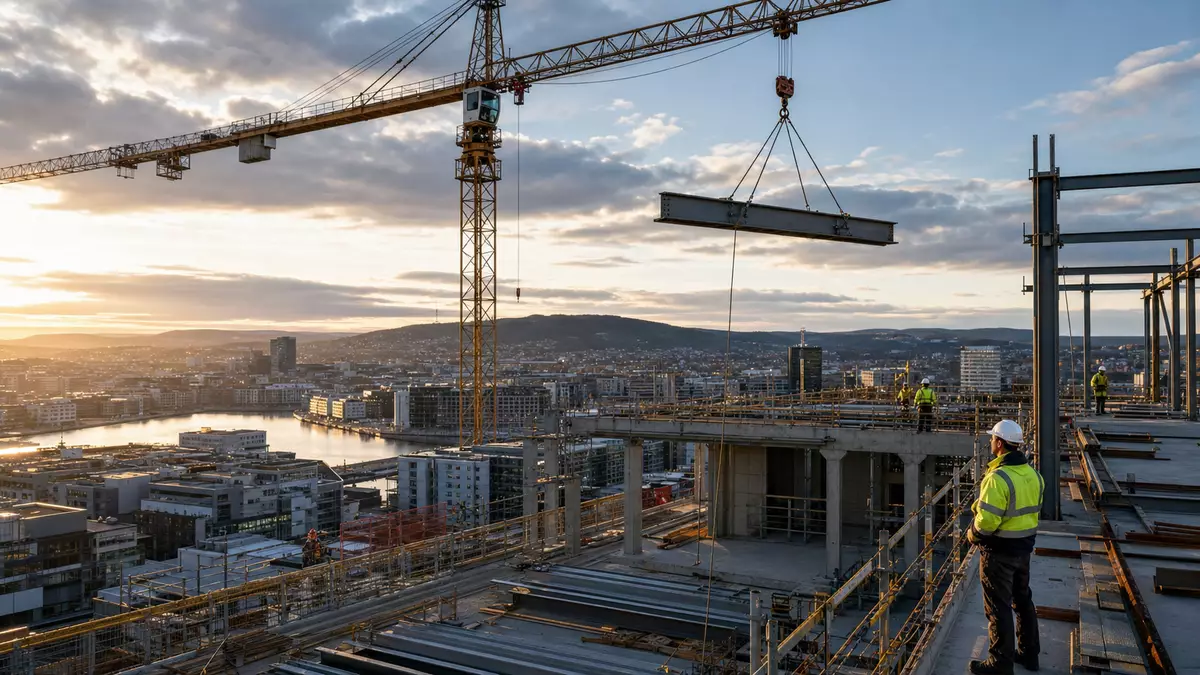
Skanska is well known for its participation in large infrastructure projects, such as roads, bridges, rail facilities, and hospitals. In its recent reporting, the company highlighted several multi-billion SEK contracts in these areas, which contribute to the sizable order backlog and provide long-term visibility. For example, the group has been involved in major transport projects in Sweden and other markets, with individual contracts often valued in the range of SEK hundreds of millions to several billions, and construction periods spanning several years.
The financial impact of such projects is spread over their duration, with revenue recognized as work progresses. This means that a single large project can add substantial annual revenue for several years, while the margin depends on cost control and execution. Skanska’s track record in delivering large infrastructure projects without severe cost overruns is an important qualitative factor, and its quantitative data on margin performance suggest that the company has generally managed these risks effectively. For investors, exposure to long-term public infrastructure can be attractive because it is less sensitive to short-term consumer demand cycles.
Residential product focus
In residential development, Skanska builds housing units for sale to private buyers and institutional investors, primarily in the Nordics and selected other European markets. The company’s disclosures show annual sales of thousands of residential units, with revenue from this segment accounting for a meaningful share of group income in years when market demand is strong. The average selling price per unit and the cost structure determine margins, which can vary significantly between projects and regions.
In the latest reporting period, Skanska indicated that residential sales volumes declined compared with a stronger prior year, reflecting more cautious buyers in an environment of higher interest rates. This quantified comparison explains part of the segment’s earnings decline. Nevertheless, the company continues to invest in land and projects where it sees long-term demand, and uses flexible phasing to align construction activity with market conditions. The residential business thus functions as a cyclical lever on Skanska stock, amplifying earnings in upturns and dampening them when housing markets cool.
Skanska stock and market valuation
Skanska stock is listed on Nasdaq Stockholm and trades in Swedish krona. In recent trading, the share price has generally moved within a range that reflects modest valuation multiples compared with historical peaks reached during periods of very strong property development profits. The market capitalization, calculated by multiplying the share price by the number of shares outstanding, stands in the tens of billions of SEK, placing Skanska among the larger industrial and construction names on the Swedish market.
Comparing current valuation metrics with prior years, Skanska’s price-to-earnings ratio appears lower than during boom periods in property markets but within the range typical for cyclical industrial companies. The market seems to be pricing in both the resilience of the construction backlog and the volatility of development earnings. For investors, this means that news on order intake, margin performance, and property disposals can have a meaningful impact on Skanska stock, especially when figures differ from expectations or prior trends.
Over a multi-year horizon, total return on Skanska stock has combined dividends and share-price movements. In periods when order intake and development earnings have been strong, the stock has delivered attractive returns; in more subdued phases, performance has been more muted. The quantified comparison of revenue, earnings, and dividends across cycles underscores that Skanska is a cyclical but disciplined player: it does not aim for rapid, highly leveraged expansion, but rather for steady, risk-aware growth linked to infrastructure and property demand.
Skanska B stock facts
- Company: Skanska AB
- ISIN: SE0000113250
- Ticker: NASDAQ STOCKHOLM: SKA B
- Trading venue: Nasdaq Stockholm
- Sector / Industry: Industrials / Construction and Engineering
- Index membership: OMX Stockholm indices
Disclaimer regarding our articles: No investment advice, no buy or sell recommendation. Information on prices, companies, and markets is provided without guarantee; changes are possible at any time. Stock market transactions can lead to substantial losses. Our articles are created and reviewed in whole or in part automatically with the support of AI.