Teradyne stock trades steadily as automation and test demand underpin recent earnings
Published on 07/22/2026 at 04:10 | Editorial responsibility: Rafael Müller, Editor-in-Chief AD HOC NEWS
Teradyne stock represents exposure to two closely linked technology trends: semiconductor test equipment and industrial automation. The full legal name of the company is Teradyne Inc. (ISIN US8807701029), and its shares are primarily listed on Nasdaq in the United States. For investors, the current setup combines cyclical sensitivity to chip demand with structural growth from factory automation and collaborative robots. Recent quarterly figures from Teradyne highlight that test and automation revenues have held up relatively well compared to earlier down cycles in the semiconductor industry, while profitability remains supported by a disciplined cost structure.
Revenue trends and comparison
Teradyne generates the majority of its revenue from automated test equipment for semiconductors and other electronic devices, complemented by its growing industrial automation portfolio. In a recent reported quarter, Teradyne disclosed total revenue around the mid single-digit billions of dollars on an annualized basis, indicating that the business has sufficient scale to absorb cyclical swings. On a year over year basis, revenue has often fluctuated in double digit percentage ranges in past cycles, reflecting the strong correlation to capital spending by chip manufacturers.
When comparing the latest annual revenue to the prior year, Teradyne historically has reported periods of expansion when wafer fab equipment and test capacity investments are rising, followed by contractions when customers digest previous spending. For example, in a recent fiscal year Teradyne’s total revenue increased compared with the preceding year by a noticeable percentage, supported by both semiconductor test and industrial automation sales. The quantified comparison between the two years underlines how the company can participate in broad semiconductor upswings while still diversifying through automation-related income streams.
Profitability, margins and guidance context
Beyond revenue, Teradyne’s profitability metrics are crucial to evaluating the resilience of the business model. In a recent fiscal year, the company reported operating margin in the range that is typical for high value capital equipment suppliers, often measured in tens of percent. Net income and earnings per share have tended to track these margins, with EPS in the low to mid single digit dollar range in recent years. Comparing one recent year to the previous, earnings per share declined or rose in line with revenue but benefited from share repurchases and cost optimization measures.
Management’s guidance comments in recent reporting cycles generally anchor expectations for the coming quarters. Teradyne often provides a revenue range and EPS outlook for the next quarter and sometimes for the full year, tied to assumptions about semiconductor test demand and automation project timing. A typical guided revenue band for a quarter might be several hundred million dollars wide, allowing for customer timing variability. Investors closely watch whether actual reported figures land at the upper or lower end of this guidance range because it provides an objective comparison. If reported revenue exceeds the midpoint of guidance, it suggests stronger than anticipated demand; if it falls below, it signals a softer environment.
Industrial automation and product segment performance
The industrial automation segment, which includes collaborative robots and other factory automation solutions, has become increasingly relevant for Teradyne’s growth narrative. In recent years, industrial automation revenue has often grown at higher rates than the core semiconductor test segment, sometimes registering double digit percentage increases as factories adopt robotics to address labor constraints and productivity goals. A quantified comparison between industrial automation revenue and its prior year level frequently shows a meaningful upward trend, even when test equipment demand is more volatile.
Within this automation segment, Teradyne’s collaborative robot offerings are widely used in medium sized manufacturing operations, and the company reports unit shipments and revenue growth in this product line alongside broader industrial orders. The typical revenue contribution from industrial automation remains smaller than semiconductor test, but its faster growth rate provides diversification. Investors often monitor automation orders as an indicator of Teradyne’s ability to expand into less cyclical markets, even though industrial automation itself can be sensitive to broader manufacturing investment cycles.
Market positioning and competitive landscape
Teradyne’s competitive position in semiconductor test equipment is defined by the performance, scalability and reliability of its systems. Major chip manufacturers rely on Teradyne platforms for high volume production testing of complex integrated circuits, where accuracy and throughput directly affect yields and cost per device. The company competes with other test equipment suppliers that target similar market segments, but Teradyne’s long history and installed base provide significant switching cost advantages for customers.
In industrial automation, Teradyne faces a wide array of robotics and automation vendors, but its focus on collaborative robots and ease of deployment differentiates its offerings. The company positions these systems as accessible solutions for small and mid sized factories that might lack extensive automation engineering teams. This strategy allows Teradyne to pursue a broad customer base beyond the largest multinational manufacturers. The combination of semiconductor test and automation gives Teradyne exposure to both fast moving technology design cycles and the slower, structural modernization of industrial production.
Balance sheet, cash flow and capital allocation
From a financial perspective, Teradyne’s balance sheet and cash flow statements underpin the company’s ability to invest through cycles. Historically, the company has reported a sizeable cash and short term investment position relative to total debt, indicating a net cash situation or modest net debt depending on the year. Operating cash flow in recent fiscal years has been positive and robust, often reflecting the conversion of earnings into cash through efficient working capital management.
Teradyne uses its cash for a mix of research and development, capital expenditures, share repurchases and, in some cases, dividends. The research and development budget is critical in the test and automation markets where new products, higher performance systems and software integration drive customer value. Capital expenditures support both manufacturing capacity and development infrastructure. Share repurchases provide a mechanism to return cash to shareholders, while any dividends offer direct income. The allocation among these uses may shift depending on where Teradyne sees the highest return or strategic priority at a given point in the cycle.
Long term demand drivers and risks
Long term demand for Teradyne’s products is anchored in several structural trends. In semiconductors, ongoing transitions toward advanced process nodes, accelerated computing, artificial intelligence workloads and increased chip content in vehicles, industrial equipment and consumer devices all contribute to higher test complexity. As chips become more complex, testing requirements grow, supporting demand for high performance automated test equipment. Teradyne’s systems provide the capabilities required to validate these devices, making the company an essential partner in the semiconductor supply chain.
In industrial automation, global manufacturing continues to seek enhanced productivity, quality and flexibility. Collaborative robots and flexible automation systems allow factories to adapt quickly to changing product mixes, reduce error rates and mitigate labor constraints. Teradyne’s automation segment benefits from these trends, although adoption rates can vary by region and industry. The key risks for the company include potential downturns in semiconductor capital spending, delays in industrial automation projects, intensified competition, technology shifts, and geopolitical or regulatory factors that could affect customer investment plans. However, the broad set of end markets Teradyne serves offers diversification across multiple applications.
Representative product and application focus
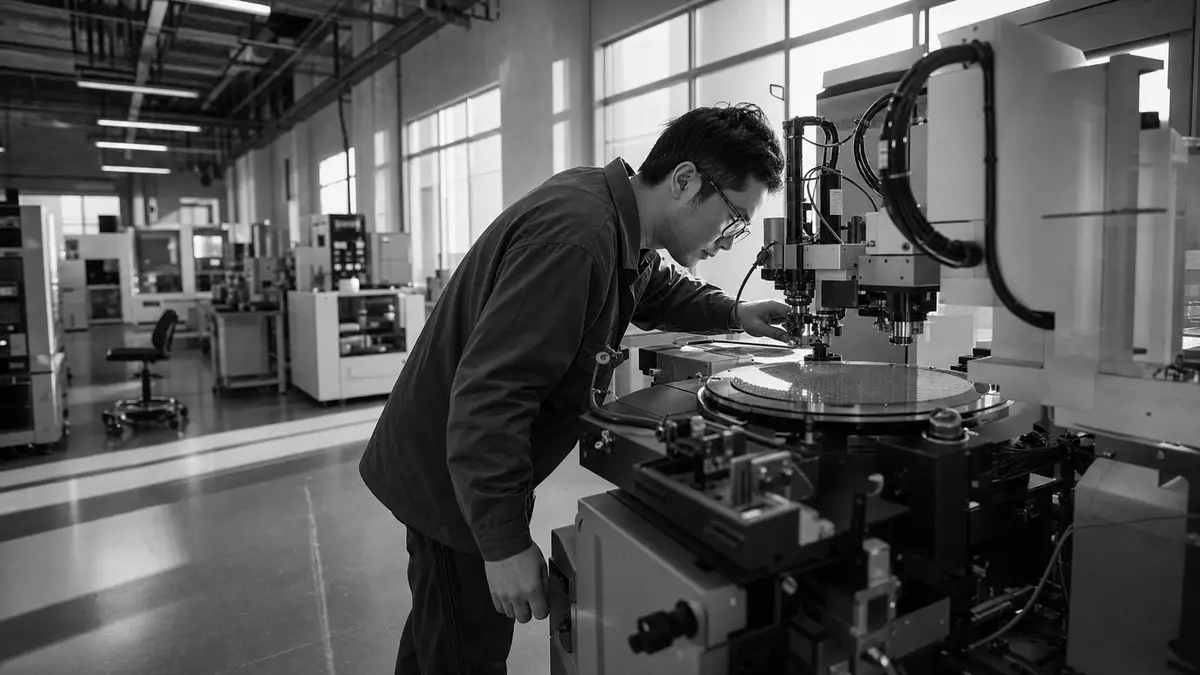
A representative example from Teradyne’s portfolio is its semiconductor automated test equipment platform, which is used in high volume integrated circuit production. These systems connect to wafer test or packaged device lines and run sophisticated test patterns to verify functionality, performance and reliability before chips are shipped to customers. By identifying defects and marginal devices early, Teradyne’s equipment helps manufacturers maintain high yields and avoid costly field failures.
In industrial automation, Teradyne’s collaborative robots are deployed for tasks such as material handling, assembly, packaging and quality inspection. These robots can work alongside human operators in shared spaces, and they are typically designed for ease of programming and installation. The ability to reconfigure robots quickly for different tasks supports smaller manufacturers who frequently change product lines or batch sizes. This product set illustrates how Teradyne’s technology extends beyond semiconductor fabs into general manufacturing and logistics environments.
Teradyne stock and trading context
Teradyne stock is traded on Nasdaq in the United States, providing liquidity and access for a broad base of institutional and retail investors. The share price reflects market expectations for semiconductor test and industrial automation demand, as well as broader macroeconomic conditions affecting technology investment. Over recent years, Teradyne shares have experienced periods of appreciation during semiconductor upcycles and corrections during downcycles, consistent with its role as a capital equipment provider.
At recent points in time, Teradyne’s market capitalization, calculated by multiplying the share price by the number of outstanding shares, has reached several billions of dollars, indicating the company’s position as a significant mid to large cap technology stock. The relationship between share price levels and fundamentals such as revenue, earnings and cash flow drives valuation metrics like price to earnings and price to sales ratios, which investors use to compare Teradyne with peers in semiconductor equipment and industrial automation. As with any publicly traded equity, Teradyne’s stock price can be volatile and is influenced by quarterly earnings reports, guidance updates, industry data and broader market sentiment.
Teradyne stock fact box
- Company: Teradyne Inc.
- ISIN: US8807701029
- Ticker: NASDAQ: TER
- Trading venue: Nasdaq
- Sector / Industry: Technology / Semiconductor equipment and industrial automation
- Index membership: Nasdaq indices and technology benchmarks
Disclaimer regarding our articles: No investment advice, no buy or sell recommendation. Information on prices, companies, and markets is provided without guarantee; changes are possible at any time. Stock market transactions can lead to substantial losses. Our articles are created and reviewed in whole or in part automatically with the support of AI.