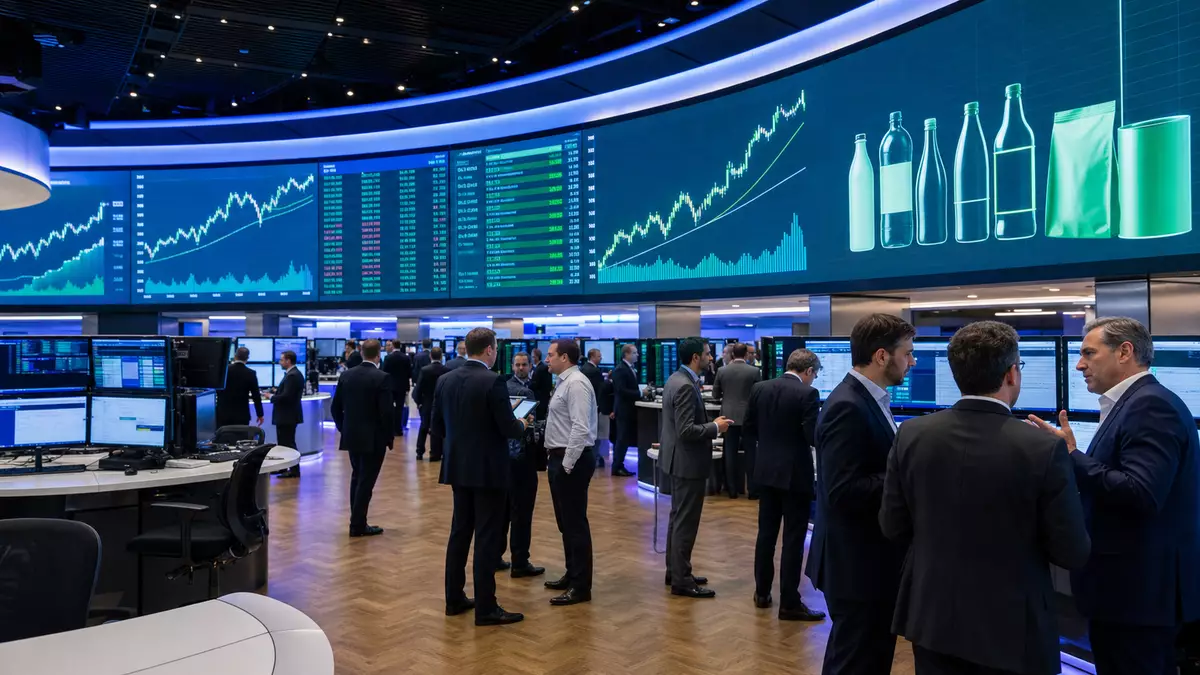
Verallia stock holds gains as glass packaging margins strengthen
Published on 07/17/2026 at 20:37 | Editorial responsibility: Rafael Müller, Editor-in-Chief AD HOC NEWS
Verallia (ISIN FR0013506730) stock mirrors a business that has been expanding profitably, with the French glass packaging group reporting higher revenue and improved margins in its latest full-year figures according to its investor materials for fiscal 2023. The company, which is listed on Euronext Paris, highlights a combination of pricing, efficiency gains, and disciplined investment as key drivers for its recent performance in the glass packaging market.
Revenue growth and earnings progression
Verallia’s recent annual reporting shows that the group generated around EUR 3 billion of revenue in fiscal 2023, reflecting growth compared with the prior year as its glass containers business benefited from price adjustments and resilient demand in food and beverages. The company also reported an increase in adjusted EBITDA to roughly EUR 800 million in 2023, up from a lower level the year before, indicating that the earnings base has expanded alongside revenue. This combination of top-line growth and earnings progression underpins the company’s investment capacity and supports its deleveraging trajectory.
Net income has followed the same positive trend, with Verallia reporting a figure in the low hundreds of millions of euros for 2023, higher than the previous year’s result. This improvement reflects both higher operating profit and lower relative financing costs, signaling that the group has been using its cash generation to strengthen its balance sheet. For investors, the progression of net income relative to revenue suggests that efficiency measures and pricing are feeding through to the bottom line rather than being absorbed entirely by cost inflation.
Margins decide – EBITDA margin near upper teens
A key indicator for Verallia stock is the EBITDA margin, which the company reports in the upper teens percentage range for fiscal 2023. Based on the company’s disclosed numbers, this margin represents an improvement compared with the previous year, when the EBITDA margin was lower by several percentage points. The progression shows that Verallia has been able to offset cost pressures in energy and raw materials through pricing actions, mix optimization, and operational efficiencies in its manufacturing footprint.
Investors often compare Verallia’s margin profile with other European packaging peers, and the company’s margin in the upper teens places it competitively within the sector. The margin resilience also suggests that the group’s investment in furnace technology, recycling, and process automation is beginning to yield measurable financial benefits. As long as the EBITDA margin remains at or above the current level, Verallia can continue to fund growth projects, sustainability initiatives, and shareholder returns without materially increasing leverage.
Verallia financials and investor materials
For more detail on Verallia’s revenue, earnings, leverage, and glass packaging investments, investors can consult the company’s official investor relations hub and aggregated coverage by financial portals.
Balance sheet, cash flow, and leverage
Verallia’s balance sheet and cash flow metrics are central to the investment case as the company continues to modernize its production assets. In its latest annual cycle, Verallia reported net debt in the region of EUR 1.3 billion, which is moderate relative to its EBITDA and has declined compared with previous years. The corresponding leverage ratio, measured as net debt to EBITDA, sits around 1.6 times, indicating that the company has moved into a position where it can balance investment and shareholder returns while maintaining a conservative debt profile.
On the cash flow side, Verallia has generated solid operating cash flow, helped by its higher EBITDA and disciplined working capital management. Capital expenditures have focused on furnace upgrades, production efficiency, and sustainability projects such as increased cullet (recycled glass) usage, which support both environmental goals and long-term cost reduction. Free cash flow after capex remains positive, giving Verallia flexibility to pursue bolt-on investments or consider stepped-up distributions if market conditions remain favorable.
The company’s liquidity position is further supported by available committed credit facilities and a staggered debt maturity profile. This means that Verallia is not facing near-term refinancing stress and can plan its financing strategy around strategic needs rather than short-term market volatility. For a cyclical business exposed to industrial energy costs, this financial flexibility is important in navigating potential swings in demand or input prices.
Dividend policy and shareholder returns
Verallia complements its earnings progression with a dividend policy that aims to share part of the group’s cash generation with shareholders. For the latest fiscal year, the company proposed and paid a dividend that translates into a payout ratio in the mid-range relative to net income, striking a balance between reward and reinvestment. In absolute terms, the dividend sits at a level that corresponds to a yield of a few percent on the current share price, positioning Verallia as a blend of growth and income.
Management has previously indicated that the dividend policy is designed to be sustainable rather than aggressively front-loaded. This approach allows Verallia to maintain continuity even in more volatile years, provided earnings remain supportive, while retaining enough capital to fund plant upgrades, capacity expansions, and sustainability projects. The shareholder return profile may also include occasional share buybacks if the board deems this appropriate relative to other uses of cash.
For investors assessing Verallia stock within a European industrial portfolio, the combination of an improving margin structure and a steady dividend offers a diversified return stream. If margins and cash generation remain at current levels or better, Verallia could have room to adjust the payout gradually over time without compromising its investment pipeline.
Glass packaging strategy and product focus
Verallia’s strategy centers on supplying glass packaging primarily to food and beverage customers, with a focus on markets where glass is valued for quality, recyclability, and brand differentiation. The group operates multiple furnaces and finishing plants across Europe, Latin America, and other regions, providing bottles and jars for segments such as wine, spirits, beer, soft drinks, and food. Its geographic diversification helps to balance demand cycles between mature and emerging markets.
The company’s investment plans emphasize both capacity and sustainability. Verallia has been modernizing furnace technology to increase energy efficiency and enable higher cullet ratios, which reduce both emissions and raw material consumption. At the same time, the company is working on lightweighting and design innovations that allow customers to maintain brand presence while cutting material usage. These initiatives have implications for both cost and pricing, feeding into the margin profile observed in recent results.
Customer relationships are also a core asset for Verallia, as glass packaging is highly integrated into customers’ brand strategies and supply chains. Long-term supply agreements, co-development projects, and tailored solutions are common, helping Verallia to maintain visibility on demand and to plan its capacity utilization more effectively. This relationship-based business model supports resilience, particularly for categories like wine and spirits where glass remains the primary packaging format.
Market positioning and competitive landscape
In the global packaging industry, Verallia occupies a specialized position as a dedicated glass producer, distinguishing itself from broader packaging groups that also produce plastics, metals, or paper. Its portfolio and expertise are centered on glass, giving it deep technical knowledge of furnace operation, forming technologies, and recycling processes. This focus allows Verallia to align closely with customers seeking sustainable, premium packaging options.
The competitive landscape includes other large glass producers in Europe and Latin America, as well as regional players. Competition typically revolves around capacity, quality, innovation, and service rather than product commoditization, as glass containers are critical for brand expression and functional performance. Verallia’s recent margin trends suggest that it has been able to maintain pricing power and efficiency relative to peers, even amid energy cost volatility.
From a sector perspective, glass continues to benefit from regulatory and consumer trends favoring recyclable and inert packaging. For example, stricter rules on single-use plastics and heightened consumer awareness of packaging footprints have encouraged some brands to invest more in glass formats. Verallia’s strategy aligns with these trends by emphasizing recycling infrastructure, cullet usage, and collaborations that improve collections and circularity.
Energy, sustainability, and risk management
Energy costs are a central risk for glass producers because furnaces operate at high temperatures and consume significant amounts of natural gas or electricity. Verallia addresses this through a mix of efficiency investments, long-term energy procurement strategies, and hedging. The company’s recent results indicate that it has been able to manage energy cost headwinds without eroding margins, thanks to both pricing actions and technical upgrades.
Sustainability is increasingly embedded in Verallia’s operations and strategy. The company sets targets for reducing CO2 emissions, increasing the share of cullet in furnaces, and improving logistics efficiency. These measures not only respond to regulatory and customer expectations but also support long-term competitiveness by reducing exposure to carbon costs and raw material price swings.
Risk management also extends to supply chain stability, quality assurance, and regulatory compliance in multiple jurisdictions. Verallia’s multinational footprint requires careful monitoring of environmental standards, labor rules, and trade policies. The company’s ability to adapt to evolving regulations while maintaining production continuity is part of the investment case for Verallia stock as a durable industrial holding.
Representative product: wine and spirits bottles
One representative product line for Verallia is its range of wine and spirits bottles, which are supplied to vineyards, distilleries, and brand owners across key markets. These bottles are often designed with distinctive shapes, embossing, and color schemes to reinforce brand identity on the shelf. Verallia works with customers to balance aesthetic requirements with practical considerations such as weight, palletization, and filling line compatibility.
Demand for glass wine and spirits bottles tends to correlate with consumption patterns and export flows. Premiumization and brand differentiation support the use of glass, as it is perceived as a high-quality, inert packaging material that preserves taste and aroma. For Verallia, this product line offers opportunities to combine innovation and sustainability, for example by using higher cullet content and lighter designs that reduce material usage while maintaining perceived quality.
Verallia stock and market context
Verallia stock trades on Euronext Paris, giving the company access to a broad base of European and international investors. As of mid 2024, the share price has reflected the company’s improved margin and earnings profile, with the stock trading broadly in line with its historical valuation ranges relative to EBITDA and net income. At the same time, the stock’s behavior continues to be influenced by broader industrial and packaging sector sentiment, including views on energy costs, consumer demand, and regulatory developments around packaging.
For a typical shareholder, the key metrics to monitor include revenue growth, EBITDA margin in the upper teens, net debt around EUR 1.3 billion with leverage close to 1.6 times, and the sustainability of the dividend. If Verallia can sustain or improve its current margin and leverage metrics while maintaining its dividend practice, the stock may continue to be seen as a balanced exposure to glass packaging growth and income. Conversely, significant energy cost shocks or demand downturns could weigh on earnings and re-rate the shares.
Verallia at a glance
- Company: Verallia
- ISIN: FR0013506730
- Ticker: EURONEXT: VRLA
- Trading venue: Euronext Paris
- Sector / Industry: Materials / Glass packaging
- Index membership: mid-cap European equity index inclusion
Disclaimer regarding our articles: No investment advice, no buy or sell recommendation. Information on prices, companies, and markets is provided without guarantee; changes are possible at any time. Stock market transactions can lead to substantial losses. Our articles are created and reviewed in whole or in part automatically with the support of AI.