

Airbus Balances Valkyrie Milestone and Avolon Order Against a Demanding Year-End Delivery Sprint
Published on 10/14/2026 at 00:52 | Editorial boerse-global.de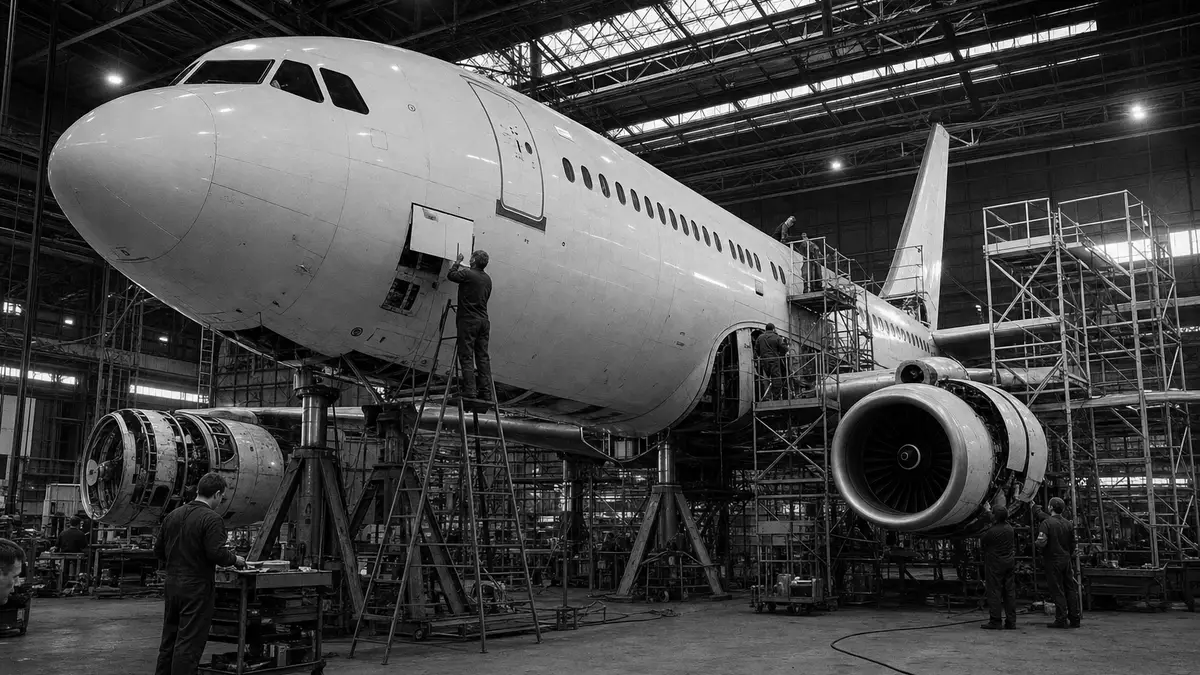
Airbus has spent the past week demonstrating that its ambitions stretch well beyond the passenger cabin. From a first European flight of an unmanned combat jet to a fresh mega-order from a leasing giant, the planemaker is steadily widening its revenue base — yet the market's attention is fixed squarely on whether its factories can hit an annual delivery target that now looks uncomfortably tight.
The stock changed hands at 186.30 euros on the day of the Avolon announcement, a modest decline of 0.9 percent, having traded at 187.42 euros a session earlier for a 0.3 percent dip. Either way, the shares sit roughly 15 to 16 percent below their 52-week high, a gap that speaks to investor caution ahead of the company's nine-month figures, due on 28 October.
A Full Order Book, and a Question of Execution
Friday brought the headline deal: a firm order from the leasing company Avolon for 110 aircraft, split between 35 widebody A330-900s and 75 jets from the A320neo family. The contract still requires the blessing of Avolon's majority shareholder, Bohai Leasing. Two days earlier, Biman Bangladesh Airlines had signed a firm order for four A350-900s and six A321neos, while Romania committed to twelve H225M multirole helicopters on 7 October.
Those bookings shift the debate away from demand and toward industrial stamina. The real test is no longer whether airlines want to buy, but whether the supply chain can feed the final assembly lines on schedule. Engine makers, electronics suppliers and structural-component vendors all have to keep pace; any shortfall risks costly delays, ties up inventory on the balance sheet, postpones customer final payments and weighs on free cash flow.
The numbers frame the challenge. Airbus handed over 72 aircraft in September, according to Reuters, bringing deliveries for the first nine months to 547 units — an eight percent increase over the same period a year earlier. To reach its full-year target of around 870 civil aircraft, plant managers must engineer a steep acceleration in the fourth quarter. Every undelivered jet is a metric that matters.
Should investors sell immediately? Or is it worth buying Airbus?
Defence, Space and Cyber Round Out the Portfolio
While the commercial backlog commands the spotlight, Airbus is quietly building out the rest of its portfolio. On Monday, the U740 Valkyrie unmanned combat aircraft, developed with partner Kratos Defense & Security Solutions, completed its maiden European flight. The two companies are targeting an operational system by 2029.
The helicopter business is also advancing, with Romania's firm order for twelve H225M multirole rotorcraft signed on 7 October. On the information-security front, Airbus closed its acquisition of French cybersecurity specialist Quarkslab on 1 October after securing all regulatory approvals. And on 2 October, the group delivered a batch of 32 next-generation OneWeb satellites to Eutelsat — the first tranche of a planned replenishment fleet for space-based communications networks. Together, these moves are designed to give the manufacturer broader earnings sources beyond passenger aviation.
A Consolidated Spanish Footprint — and a Labour Truce
On the industrial side, Airbus inaugurated its modernised plant in El Puerto de Santa María on Thursday, consolidating activities across the Cádiz region, where production lines for the A320, A330 and A350 civil families are now housed under one roof. More than 90 million euros were invested in the site, according to media reports, which now brings together 750 employees on a floor space expanded by 4,000 square metres.
A threatened labour dispute in Spain was also defused, after a collective agreement was accepted with 76.76 percent of the vote.
What the Fourth Quarter Hinges On
The bull case rests on management executing the assembly-line ramp-up without significant disruption. The Avolon order underscores the confidence large fleet operators place in the economics of the A330neo and A320neo, while the mix of civil aircraft and military contracts such as the Romanian helicopters stabilises revenue across multiple financial years. Military technology development, meanwhile, opens additional earnings potential for the coming decade. Should the civil ramp proceed as planned, the group could confirm its full-year financial targets, dispelling doubts about industrial scalability and letting operating leverage work its way to the bottom line.
The bear case centres on costs and still-fragile supply chains. A worsening shortage of critical components would stall final assembly, forcing partially built aircraft to be parked and requiring extra rework that drives up production costs. Such a scenario would squeeze margins in the civil aircraft division and could force adjustments to the annual guidance. Missing the 870-delivery goal would deal a tangible blow to confidence in management's medium-term plans, and new defence developments carry financial risk of their own should integration problems emerge. For cautious investors, the danger of insufficient supply-chain discipline currently outweighs the tailwind from fresh contract wins.
Everything now hinges on the 28 October interim report, when Airbus will disclose detailed financial progress for the first nine months and, crucially, give a credible read on how realistic the year-end sprint really is. Until then, the fundamental recovery thesis holds — provided management can stand by its 870-aircraft target. Should that marker fall because of persistent supplier bottlenecks, a re-rating of earnings expectations for both the current and next financial year becomes a live risk.
Ad
Airbus Stock: New Analysis - 14 October
Fresh Airbus information released. What's the impact for investors? Our latest independent report examines recent figures and market trends.


