
ASML's High-NA Commitments From Samsung and TSMC Cement Revenue Visibility Into the 2030s
Published on 09/19/2026 at 18:20 | Editorial boerse-global.de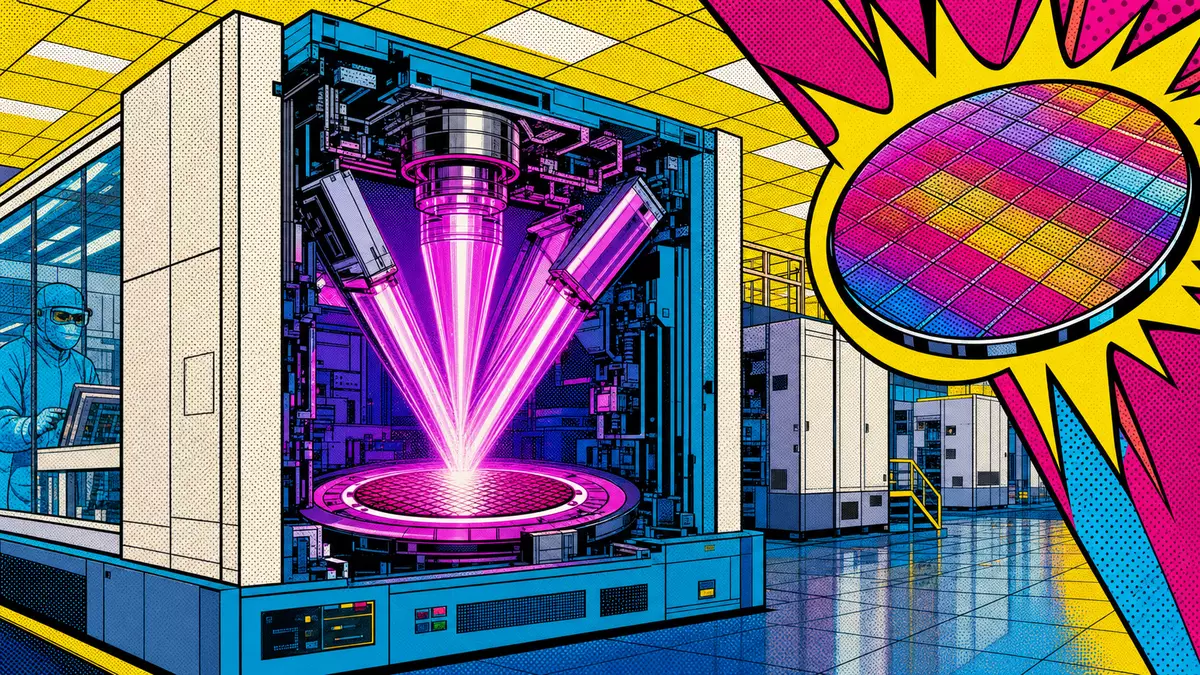
ASML Holding shares finished Friday's session 2.3% higher at EUR 1,456.80, lifted by a friendlier rate backdrop across European technology names and by binding customer commitments for its most advanced lithography tools. The advance leaves the Dutch semiconductor equipment maker trading 11% above its 200-day moving average.
The macro tailwind arrived at a useful moment. After the Federal Reserve's latest rate decision, softening oil prices and flatlining bond yields brought relief to growth-oriented tech stocks, easing the pressure on valuation multiples that had built up during months of repricing. With that headwind fading, investors are turning their attention back to the order book — and the order book is unusually full.
Samsung and TSMC Sign On for High-NA
According to Bloomberg, Samsung Electronics and Taiwan Semiconductor Manufacturing Co. have both committed to deploying ASML's High-NA EUV systems in volume production. Samsung intends to bring the technology online from 2028, while TSMC plans to follow from 2030. Each of these machines carries a price tag of roughly $400 million. The two chipmakers join Intel, which already runs the systems.
Running alongside those commitments is a joint industry initiative in which Samsung, TSMC and ASML are all participating. The project aims to shift from conventional photomasks to a larger 12-inch format, with a pilot line targeted for 2031 and full series maturity for advanced manufacturing nodes slated for 2033.
Should investors sell immediately? Or is it worth buying ASML Holding?
The demand side, in other words, is not the constraint. Media reports point to throughput in manufacturing and assembly as the company's principal operational bottleneck. Major global chipmakers are already testing faster assembly speeds for extreme ultraviolet systems — a dynamic that reinforces ASML's pricing power and stretches the visibility of its revenue well into the back half of the decade.
Capacity Is the Real Question
CFO Roger Dassen made clear on Monday that customer demand has strengthened further. Existing EUV lithography systems, priced at around $200 million apiece, are effectively sold out through 2027. At the same time, customers are entering firm commitments for the next generation — the High-NA tools valued at approximately $400 million per unit.
How quickly ASML can scale its highly complex production capacity is now the pivot on which the whole story turns. JPMorgan said in a Monday assessment that the company is examining options to build more than 110 EUV systems in 2028, well above its previous guidance of at least 80 of these advanced machines per year. The gap between secured capacity and the expanded ambition illustrates just how aggressively the production lines would need to be pushed — and that scalability will determine the company's future earnings profile.
A Second Campus Takes Shape in Brainport
To underwrite future delivery volumes, ASML broke ground on 8 September on a second industrial campus in the Dutch Brainport region. The project at Brainport Industries Campus North spans roughly 350,000 square metres across multiple expansion phases and is designed to eventually accommodate up to 20,000 jobs.
The first construction stage is scheduled for completion in 2029 and will house at least 3,000 employees. A new Flow Factory sits at its core, intended to modernise the manufacturing model for the TWINSCAN production line. If the expansion stays on schedule, the company can fully serve projected demand for advanced chip architectures from 2028 onward.
Analysts Welcome the Clarity
Market reaction to the signals on future utilisation has been supportive. Barclays emphasised on 8 September that the announcements provide greater clarity on the market launch of the new technology and should be viewed positively. Bank of America Securities reaffirmed its buy rating on the shares on Wednesday. ASML also reported deepened cooperation with Intel Foundry and Samsung Electronics on 8 September, aimed at advancing the industrial readiness of High-NA EUV for future semiconductor generations — with Samsung planning to integrate the technology into volume production of next-generation DRAM memory chips by 2028.
ASML Holding at a turning point? This analysis reveals what investors need to know now.
What Could Derail the Story
A credible bear case rests on operational and capital intensity. Building a new large-scale campus and scaling the intricate $400 million machines absorb enormous financial and management resources. Delays in completion or technical hurdles in rolling out High-NA systems could weigh on returns in the near term. Semiconductor equipment makers have historically been highly cyclical, and that pattern does not vanish even amid a sustained AI trend.
The chipmakers carry substantial investment risk of their own. Should end markets for advanced chips fall short of expectations, customers could stretch out planned purchases. A shift in the 2028 DRAM rollout at major customers such as Samsung would dampen utilisation of the new production lines — and in that scenario, the lofty valuations across technology stocks would quickly come under correction pressure.
For now, the fundamental case holds as long as major customers stick to their High-NA integration timelines and the existing EUV generation stays fully booked through 2027. The macro relief from lower rates reduces the drag on valuation multiples, giving investors a firmer footing provided demand for advanced manufacturing technology remains intact. The next real test will be progress reports from the Samsung and Intel collaborations — their accounts of High-NA integration will determine whether the planned capacity expansion beyond 110 units is justified.
Ad
ASML Holding Stock: New Analysis - 19 September
Fresh ASML Holding information released. What's the impact for investors? Our latest independent report examines recent figures and market trends.


