BMW's Award-Winning Lineup Meets a Factory-Floor Reality Check
Published on 11/13/2026 at 11:41 | Editorial boerse-global.de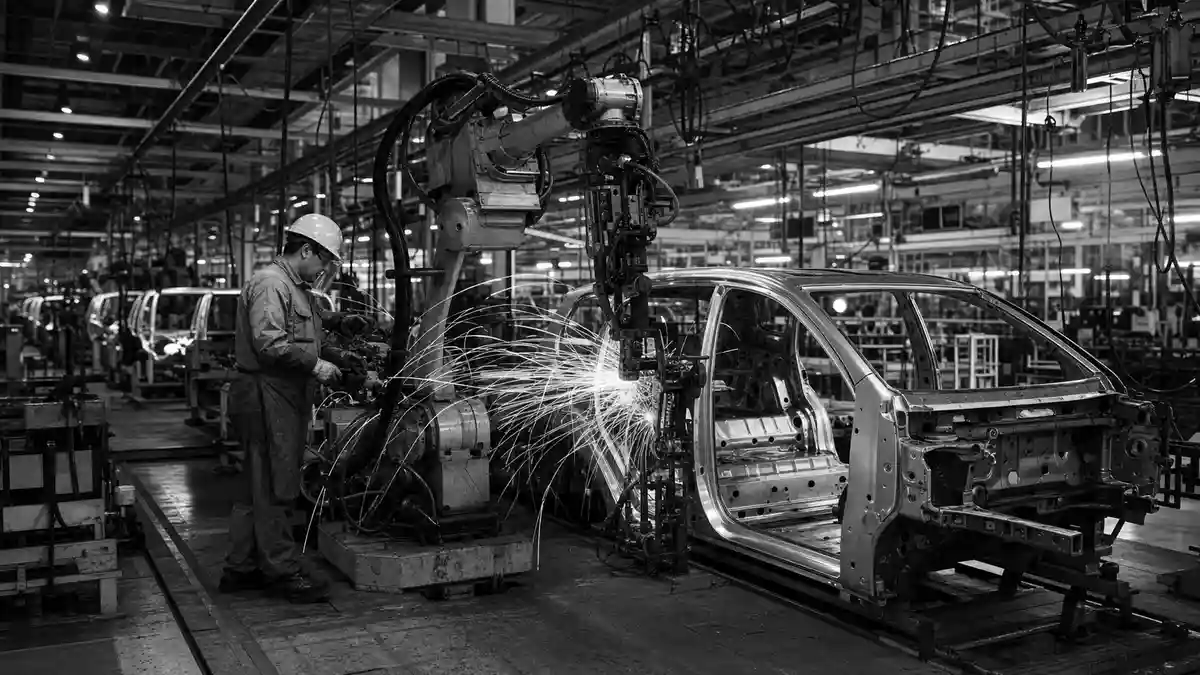
Two Golden Steering Wheels landed at BMW on Wednesday, with the i3 taking the mid-range category and the M2 CS winning among sports cars. The hardware plaudits arrive at an awkward moment. Just a day earlier, the carmaker had confirmed shift cancellations caused by short-notice shortages of externally supplied components, and investors are now weighing whether showroom acclaim can offset the drag from restructuring and disrupted output.
The company said it had already put measures in place to steady parts supply and get production running again. Reports, citing industry circles, pointed to wiring harnesses from Ukraine and named Regensburg, Leipzig and Oxford as the affected sites. BMW itself declined to comment on specific components or their origin. How quickly those countermeasures bite is now the operative question.
A Margin Band That Leaves Almost No Room
The financial backdrop is thin. On 4 November, BMW cut its guidance for the 2026 financial year, citing higher costs for portfolio and structural measures in particular. It subsequently guided to an EBIT margin of ?0.5% to +0.5% for the automotive segment — a corridor that turns the operating profit threshold into the central test. Even at the top end, the cushion against further strain would be slim.
The third quarter shows where the year started: BMW reported a 3.4% automotive EBIT margin for Q3 2026. Against a full-year outlook hovering around the zero line, the remaining months carry outsized weight. A credible recovery case therefore needs progress on the factory floor as well as financial resilience, and the announced portfolio and structural measures will keep shaping earnings regardless.
Cash Is the Yardstick, Not the Profit Line
What separates the two burdens is the free cash flow target. BMW still expects more than EUR 2.5 billion in the automotive segment for 2026 and held to that figure even after the November profit warning. For investors, that argues for treating earnings pressure and cash generation as separate stories — provided the company actually delivers the number.
Should investors sell immediately? Or is it worth buying BMW?
The distinction matters for how the overhaul is valued. BMW attributed the guidance cut to expanded and intensified portfolio and structural measures, which are set to produce non-operating charges in the fourth quarter. Financial headroom thus depends on whether cash flow holds up under those conditions. Hitting the target would give the company a financial argument that the earnings hit is not translating one-for-one into weaker liquidity.
Two Banks, Two Repricings, One Cautious Message
Sell-side reaction has been measured rather than panicked. Deutsche Bank Research trimmed its price target to EUR 66 from EUR 71 on 5 November while keeping a Buy rating; analyst Tim Rokossa also flagged limited visibility for 2027 following a management conversation, according to dpa-AFX. A day earlier, JPMorgan cut its target to EUR 68 from EUR 82 after the quarterly earnings call but stayed at Overweight, factoring in the announced one-off charges and lowering its adjusted EBIT forecasts for 2026 and 2027.
The pattern — lower targets, intact positive ratings — frames a conditional recovery story. It gains weight if the charges stay contained and BMW becomes operationally dependable again. That requires supply progress to coincide with a stable earnings trajectory; isolated positive production news would matter chiefly if it supports adherence to the revised margin band.
What the Fourth Quarter Has to Prove
The benign path starts with more reliable parts flow. If BMW's measures work, output stabilizes and the award-winning models meet better operating conditions — a combination more persuasive than a product headline on its own. Reaching the cash target despite restructuring costs would strengthen the case further, since it would show the charges are not eroding liquidity to the same degree.
The adverse path pairs continued disruption with the already-announced charges. Repeated shift losses would compound costs that sit alongside a margin close to breakeven, and the reports on the affected plants specified neither the scale of the interruptions nor the missing parts. The combination would become critical for investors if it also put the expected cash inflow at risk.
For now, the restructuring can be classed as a financially bounded phase as long as the cash target holds and supply stabilizes. The next concrete catalysts are a company update on the effect of the supply measures and the resumption of affected production — ideally alongside confirmation of the earnings outlook. Both developments need to line up for a more favorable view: steadier manufacturing and a cash performance that carries the confirmed expectation. The trophies provide tailwind; the financial execution decides how much it weighs.
Ad
BMW Stock: New Analysis - 13 November
Fresh BMW information released. What's the impact for investors? Our latest independent report examines recent figures and market trends.