Chip ETF Tries to Find Its Footing After a Month of Whiplash
Published on 08/01/2026 at 01:20 | Redaktion boerse-global.de
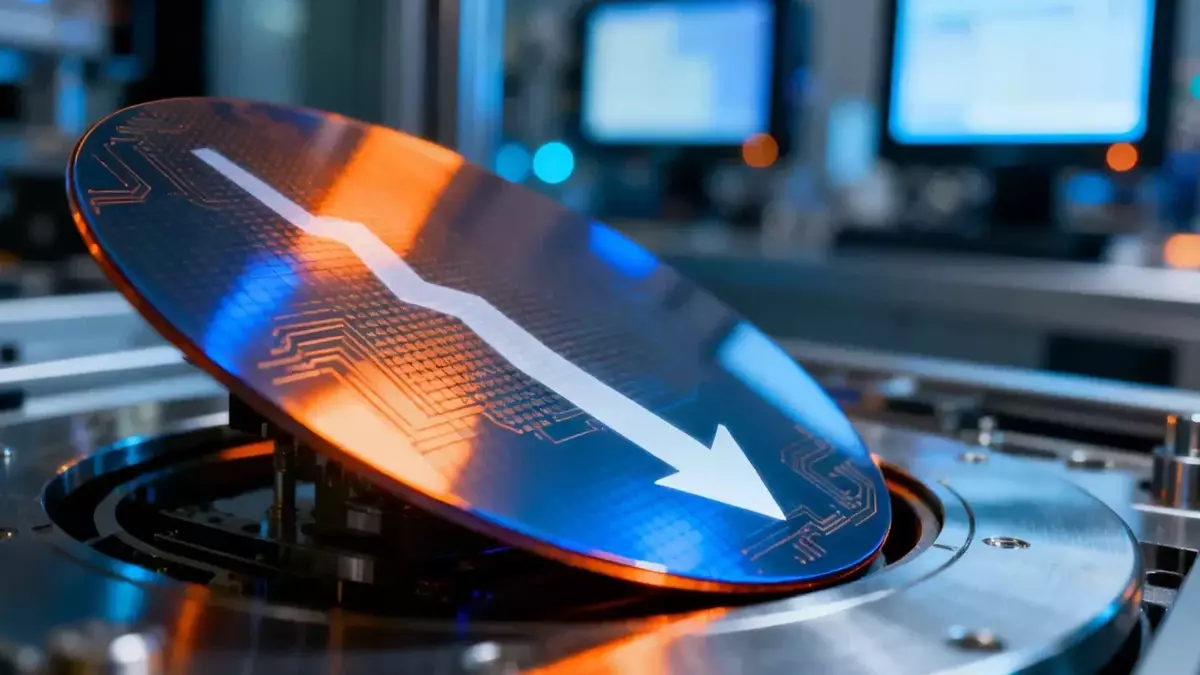
The VanEck Semiconductor UCITS ETF is attempting to stabilise after one of its most turbulent stretches of the year, with the fund trading around the €89 mark on Friday. The tentative bounce masks a brutal month: the fund has shed roughly a fifth of its value since its June peak, with losses of 5.18 percent over the past week and a steeper 14.41 percent slide over the last 30 days.
A Chinese Lithography Breakthrough Shakes the Sector
The sell-off traces back to reports that a Chinese manufacturer has developed its own immersion lithography machine — a technology long dominated by Dutch equipment giant ASML, whose shares tumbled more than 8 percent on the news. The ripple effects were felt across the sector, wiping out approximately $110 billion in market value at AMD and $119 billion at Taiwan Semiconductor. The Nasdaq 100 dropped 1.8 percent, edging toward correction territory.
Market observers, however, caution against reading the retreat as a fundamental break. Michael Field, chief equity strategist at Morningstar, describes the move as "largely sentiment-driven, not fundamentals-driven," pointing to a crisis of confidence among investors rather than deterioration in the underlying businesses. Sundeep Gantori, CIO for equities at Standard Chartered, similarly attributes the slide to media reports about China's ambitions in memory chips and lithography equipment, arguing the long-term outlook remains intact and that the risk-reward profile has actually improved after the pullback.
Kieron Poon, investment director for Asian equities at Aberdeen Investments, frames the weakness partly as a consequence of ongoing deleveraging in South Korea and a broader cooling of sentiment toward global tech names. Charlie Dai, vice president and principal analyst at Forrester, adds that investors are increasingly questioning whether short-term revenues can justify the unprecedented spending on AI infrastructure, with competitive concerns from China adding to the unease.
Should investors sell immediately? Or is it worth buying VanEck Semiconductor UCITS ETF?
Arm's Results Offer a Stabilising Force
Against this nervous backdrop, Arm Holdings delivered a quarterly report that helped steady the sector. The chip designer posted revenue of $1.29 billion for the first quarter of fiscal 2027, up 22 percent year over year and slightly ahead of the $1.27 billion analysts had pencilled in. Licence and royalty income both set records, climbing 23 percent and 22 percent respectively, with management citing robust demand for its compute platform across AI infrastructure and data centres.
The market initially responded cautiously to a guarded outlook on smartphone royalties, but the strength of the operational numbers gave the sector enough support to halt the bleeding.
Washington Steps In With Fresh Funding
Adding to the more constructive tone, the US Commerce Department signed seven memoranda of understanding on Wednesday totalling $874 million in funding under the CHIPS and Science Act. The money is earmarked for research and development aimed at shoring up the supply chain for high-performance computing.
The allocations break down as follows: GlobalFoundries stands to receive up to $300 million for silicon photonics and advanced packaging technologies, Kepler is in line for $245 million for high-bandwidth memory, and Multibeam Corp. secures $140 million for lithography equipment. The investments are designed to secure a domestic manufacturing base for the next generation of AI applications.
Earthquake Adds Another Layer of Uncertainty
The sector also had to digest a magnitude 7.1 earthquake that struck Japan's Kumamoto region on July 28. TSMC confirmed that its JASM fab escaped major structural damage, with operations gradually resuming. Still, detailed inspections and recalibration of sensitive equipment will take time, leaving a degree of uncertainty over production timelines.
Morningstar analysts, for their part, reaffirmed their fair value estimate for Nvidia at $280 on July 27, suggesting the stock may now represent a bargain after the recent sell-off given the company's dominant position in the AI ecosystem and its superior software integration.
A Rally That Still Has Room to Run
Despite the turbulence, the fund remains one of the year's standout performers. It is still up roughly 67 percent since the start of January, and has gained over 110 percent on a twelve-month view — a reminder of how much ground the AI rally had covered before this correction set in. The current drawdown of nearly 20 percent from the June record high of €111.18 leaves the fund trading at a notable discount to its recent peak.
Technical indicators suggest a market in neutral rather than panic. The 14-day RSI sits at 43.4, signalling neither overbought nor oversold conditions, while the annualised 30-day volatility hovers around 61 percent — a reflection of just how sensitive the sector remains to geopolitical shocks and macroeconomic headlines.
The central question hanging over the market is whether China's apparent progress in chip manufacturing represents a structural threat to Western technological leadership or a temporary sentiment shock within a fundamentally intact AI infrastructure build-out. The answer may become clearer in the coming weeks, as TSMC's recovery in Kumamoto and the next wave of earnings from chipmakers will test whether Arm's positive momentum can be sustained across the sector.
Ad
VanEck Semiconductor UCITS ETF Stock: New Analysis - 1 August
Fresh VanEck Semiconductor UCITS ETF information released. What's the impact for investors? Our latest independent report examines recent figures and market trends.
Disclaimer regarding our articles: No investment advice, no buy or sell recommendation. Information on prices, companies, and markets is provided without guarantee; changes are possible at any time. Stock market transactions can lead to substantial losses. Our articles are created and reviewed in whole or in part automatically with the support of AI.