Deutsche Telekom's Capital Test: Seven Million Fiber Units, a Satellite Maybe, and a November Scorecard
Published on 10/20/2026 at 08:20 | Editorial boerse-global.de
Deutsche Telekom has stacked up a hefty to-do list for the coming years: wiring seven million additional homes for fiber, finding roughly EUR 2.5 billion in indirect-cost savings through AI and automation by 2030, and now exploring a European satellite venture with three rival carriers. What binds these strands together is a single question investors will keep asking — whether the capital going out the door eventually comes back as earnings.
Fiber orders are a pipeline, not yet revenue
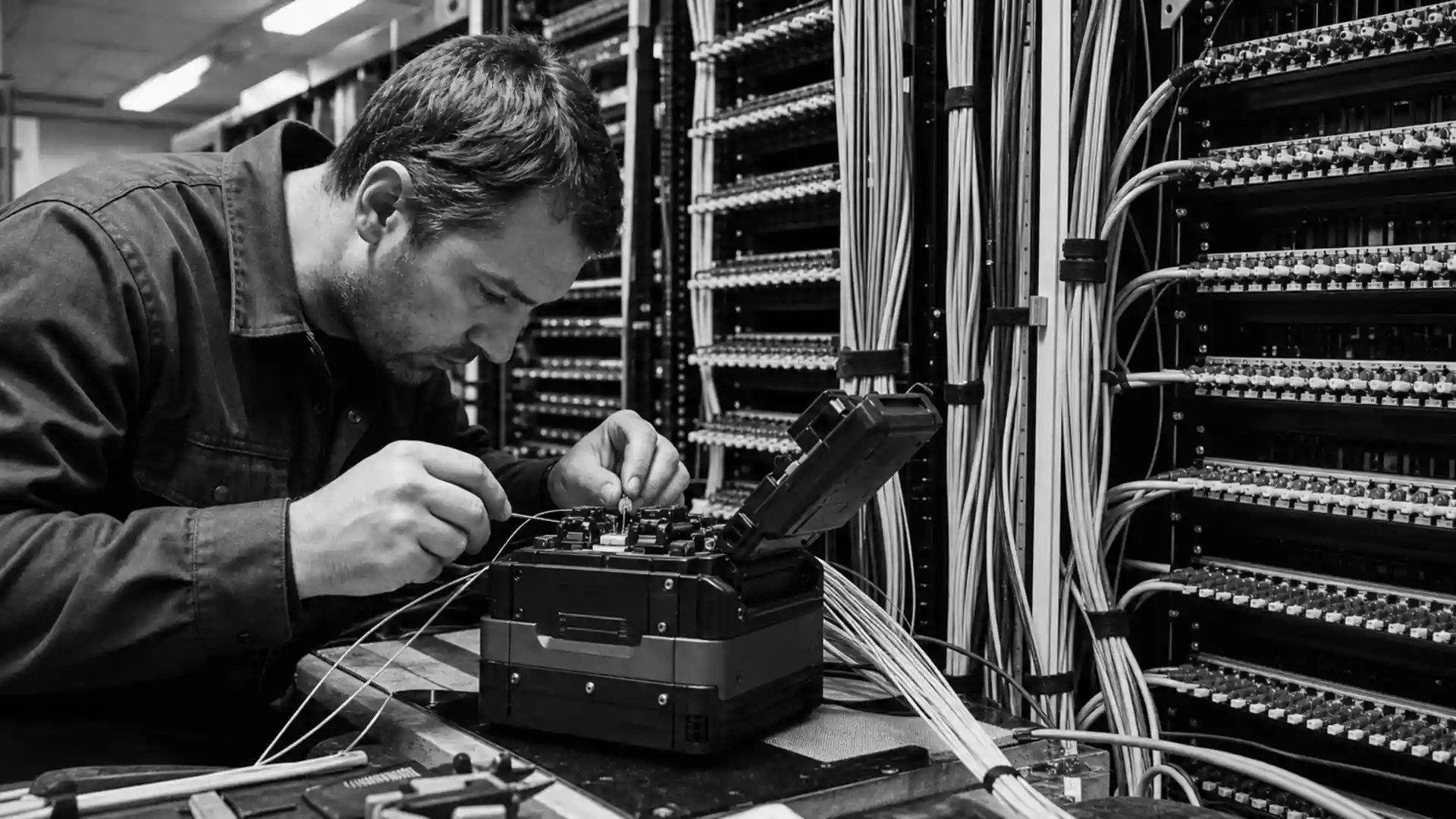
On October 6 the Bonn-based group reported build-out contracts with housing companies, property managers and project developers covering a total of seven million residential units. Over the next three years it plans to plough an extra EUR 800 million into the rollout. That gives the growth story a concrete foundation, but it also raises the bar for how convincingly that money gets deployed.
Orders on the books are not the same as customer revenue. The number that matters for valuation is how many of those commissioned connections turn into lines that are actually used and paid for. Reach, contracts signed and active subscriptions are three separate things, and shareholders would do well to keep them apart.
Baden-Württemberg illustrates the scale of the opportunity — and the gap. According to company figures from October 9, around 1.8 million households and businesses in the southwestern state could sign up for a Telekom fiber tariff. That is a marketing footprint, not a count of signed contracts. Anyone betting on the build-out is ultimately betting that the company can convert technical reach into commercial traction; without sufficient take-up, a bigger network mostly means a bigger capital bill.
Efficiency gains are a target, not a counterweight
A more benign scenario pairs fiber marketing with a leaner cost base. At its AI investor day roughly two weeks ago, Deutsche Telekom reaffirmed both its guidance and its medium-term targets, holding to its financial framework even as it pushes more money into infrastructure. Management expects AI and automation to deliver around EUR 2.5 billion in indirect-cost savings by 2030 compared with 2023.
Should investors sell immediately? Or is it worth buying Deutsche Telekom?
That figure is a goal, not a banked result. The proof will lie in whether the relief shows up step by step in the actual business. If fiber commercialization also succeeds, growth and efficiency could reinforce each other, with the investment looking less like a standalone outlay and more like part of a package where new business opportunities meet a slimmer cost structure. The two do not offset each other automatically, however: the savings and the build-out spending involve different economic processes and different time horizons.
The revenue side is where the arithmetic gets harder
The serious counterargument sits on the top line. A larger network and lower indirect costs guarantee nothing if pricing pressure intensifies — a scenario in which Deutsche Telekom expands its infrastructure but can only partially convert the added utility into revenue. Deutsche Bank Research kept its "Buy" rating and a EUR 40 price target yesterday, with analyst Robert Grindle flagging agentic AI as a risk to pricing and Starlink's US mobile ambitions as a drag on the stock's relative performance. In his view, the market had overreacted.
That call pairs confidence with a specific caveat. AI emerges not purely as a cost-cutting tool but also as a potential threat to pricing power. In the unfavorable case, efficiency gains would be partly eaten away by tougher revenue conditions — and a positive analyst rating does not make that trade-off disappear.
A satellite option with several gates still to clear
Alongside the fiber story, Deutsche Telekom signed a letter of intent yesterday with Orange, Telefónica and Vodafone to examine a joint bid for European mobile satellite spectrum. The aim is direct connections between satellites and handsets, backed by ground infrastructure and coordination functions in Europe. Notably, the four operators do not intend to fund a satellite constellation of their own.
The market gave the announcement a shrug: the shares closed yesterday at EUR 25.55, down 1.3% on the day. That tells you little about how the venture will be judged; what matters more is what obligations might flow from the current review. The decisive test is the choice of satellite partner, who would supply or operate the constellation and has yet to be picked — a gap that leaves a key precondition for execution wide open. A confirmed partner would say more than a restatement of shared intent, though even then spectrum allocation and implementation would remain separate steps. A partner contract would not automatically equal secured market access.
Timing reinforces the long-dated nature of the option. According to Der Spiegel, the EU plans to award the frequencies in 2027, with availability from 2029 — a separation that makes the project a strategic plaything for the long term rather than a reason to expect near-term profit.
Open platforms, open questions
In the favorable case, the cooperation fills coverage gaps and strengthens critical communications, exactly the goals the initiative describes. The plan envisages open, non-discriminatory access for all European mobile network operators, which could extend the project's relevance well beyond the four participants — provided the promised openness can be delivered in practice. Existing satellite partnerships are explicitly meant to stay in place, casting the new venture as a complement rather than a replacement.
Deutsche Telekom at a turning point? This analysis reveals what investors need to know now.
The division of labor is another plus from an investor's standpoint: the operators would take on ground infrastructure and control functions without financing a constellation themselves. That does not establish economic viability, but it sets the model clearly apart from building a full proprietary satellite system.
The bear case is straightforward. Between a joint review and a usable service sit several decisions: choosing a satellite partner, deciding whether to actually bid, and then prevailing in the spectrum award. The letter of intent pre-empts none of them. Nor does forgoing a constellation eliminate all execution risk — the ground infrastructure and European coordination functions remain tasks in their own right. A delayed partner selection or a missed spectrum allocation would leave the strategic upside correspondingly less certain.
Two yardsticks, one date
Analyst views offer no uniform all-clear. Goldman Sachs cut its price target to EUR 38 from EUR 40 on October 5 while keeping its buy recommendation, welcoming higher cost-saving ambitions but holding out the prospect of raised estimates only if execution succeeds. Operational delivery therefore remains a valuation yardstick in its own right, quite apart from the satellite option.
The next hard checkpoint is the third-quarter 2026 results, scheduled for November 5. That release gives investors the nearer occasion to test whether business momentum supports the medium-term case — and, for the fiber program in particular, whether a larger infrastructure is being matched by a visible ability to extract economic value from it. On the satellite side, a confirmed partner decision would be the next substantive step. Until then, the running business and the orbital ambition are best judged on separate ledgers: one by its results, the other by steps actually taken.
Ad
Deutsche Telekom Stock: New Analysis - 20 October
Fresh Deutsche Telekom information released. What's the impact for investors? Our latest independent report examines recent figures and market trends.