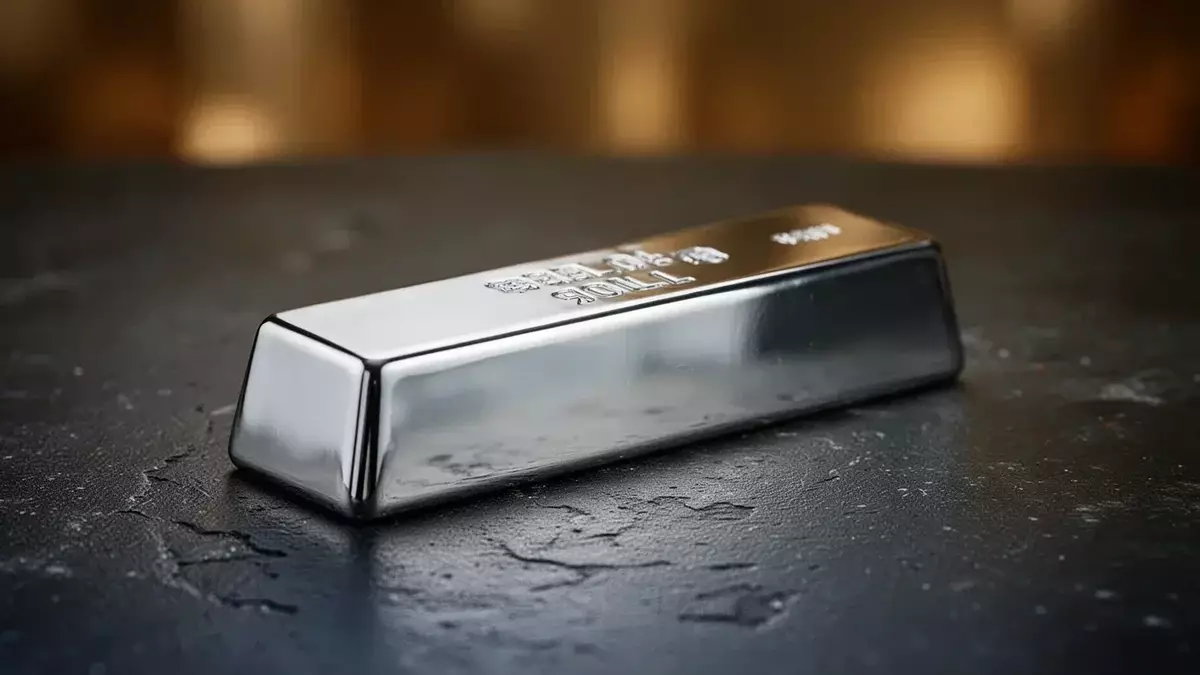
Silver's Rebound Masks a Fractured Market: Geopolitical Thaw Meets a Bearish Technical Cross
Published on 08/04/2026 at 06:42 | Redaktion boerse-global.de
Silver clawed its way back into positive territory on Monday, but the bounce tells only half the story. The metal that has spent 2026 on the defensive finds itself squeezed between a fragile diplomatic thaw in the Middle East, a Federal Reserve that refuses to blink, and a chart pattern that technical traders read as a harbinger of further pain.
Futures opened the session at $58.65 per ounce, a 1.5 percent advance from Friday's close, before giving back a chunk of those gains in morning trading. By 8:23 a.m. New York time, the contract had slipped to $58.03. Other data points put the spot price at $58.38, up 1.37 percent from Friday's $57.59 settlement, with the metal ultimately settling around $58.26, a 1.10 percent gain on the day.
Washington's Two-Step on Iran Lifts the Metal, Briefly
The initial surge traced back to the White House. President Donald Trump announced that peace talks with Iran would resume on Monday, a signal that sent oil prices sliding and, by extension, eased the inflation anxieties that have dogged precious metals for months. Trump also disclosed that key Gulf allies, Saudi Arabia among them, had pressed him to de-escalate rather than escalate — a push that led Washington to pause planned airstrikes on Iran for a second consecutive weekend. Sunday night had reportedly been slated for extensive strikes before allies convinced the president to stand down.
Yet the same statement that soothed markets carried a hard edge: Trump reiterated his demand that the Strait of Hormuz be reopened swiftly. That blend of conciliation and coercion gave silver its initial lift, but the momentum proved unsustainable as the session wore on.
A Red-Hot Factory Sector Complicates the Fed Calculus
The geopolitical headlines, however, are only one variable in an increasingly crowded equation. Fresh data out of Washington showed the ISM manufacturing purchasing managers index jumping to 55.6 points in July, up from 53.3 the prior month and well ahead of the 54.0 that analysts had penciled in. It marks the strongest stretch of US industrial growth in more than four years — and it throws cold water on any near-term hopes for Fed rate cuts.
The central bank, after all, left rates unchanged last week, and the decision was far from unanimous. Three members dissented, warning that prolonged hesitation could force a more aggressive tightening later. Markets now price a 68 percent probability of a September hike, a scenario that would further erode the appeal of an asset that pays no yield. Silver's bounce on Monday, in other words, owes as much to a technical correction after last week's losses and steady physical demand as it does to any fundamental shift.
For businesses managing workplace hazards, staying ahead of regulatory expectations is just as demanding as tracking market movements. A free Risk Assessment Toolkit provides 41 ready-to-use templates and checklists to help you document risks and protect your workforce. Download the free Risk Assessment Toolkit
The Death Cross Looms Over the Recovery
Chart watchers, meanwhile, are flagging a warning sign that emerged late last week: the 50-day moving average has crossed below the 200-day moving average, a formation known as a "death cross" that many technicians read as confirmation of a sustained downtrend. The pattern puts added weight on the support level at $56.00 per ounce — a break below that could invite further selling — while resistance sits at $62.00. Only a decisive move through the latter would invalidate the bearish momentum, with $60.00 serving as the immediate hurdle on any rally.
A Structural Deficit That the Market Keeps Ignoring
The short-term noise, however, obscures a fundamental picture that remains stubbornly supportive. The Silver Institute and Metals Focus project a global silver deficit of 46.3 million ounces in 2026, which would mark a sixth consecutive year of demand outstripping supply. The shortfall is expected to widen by roughly 15 percent year over year, driven by photovoltaic installations, electric vehicle production, and the buildout of data-center infrastructure.
That industrial appetite, though, has yet to translate into financial-market conviction. Investors remain wary given the weak price momentum, creating a disconnect between the physical market and the paper market — a divergence that leaves silver caught between scarcity on the ground and skepticism on the screen.
The Week Ahead: Jobs Data as the Next Catalyst
With the geopolitical picture in flux and the Fed's path contingent on incoming data, Friday's monthly employment report takes on outsized significance. A labor market as resilient as the ISM numbers suggest would leave little room for the Fed to pivot dovish, capping any silver rally. For now, the metal's trajectory hinges on two questions: whether US-Iran talks produce tangible progress, and whether the jobs report gives the hawks on the Federal Open Market Committee more ammunition.
While markets react to macroeconomic shifts, many UK employers face their own compliance pressures — especially when it comes to hazardous substances. A free COSHH Risk Assessment Toolkit offers 43 customisable templates, checklists and toolbox talks to help you meet your legal duties under COSHH regulations. Get the free COSHH Toolkit
The year-to-date scoreboard remains unflattering regardless: silver sits 17.88 percent lower since the start of 2026, even as it trades 55.68 percent above year-ago levels. The gold-silver ratio, which measures how many ounces of silver it takes to equal one ounce of gold, stood at 69.56 on Monday, down from 70.19 on Friday — a marginal improvement that does little to alter the broader picture. After a June that saw the metal shed more than 20 percent, July closed roughly flat, and the metal's slide toward $58 on Friday snapped a two-day winning streak. Since the US-Iran conflict erupted in late February, precious metals have faced persistent headwinds as rising oil prices fanned inflation fears and reinforced expectations of tighter monetary policy.