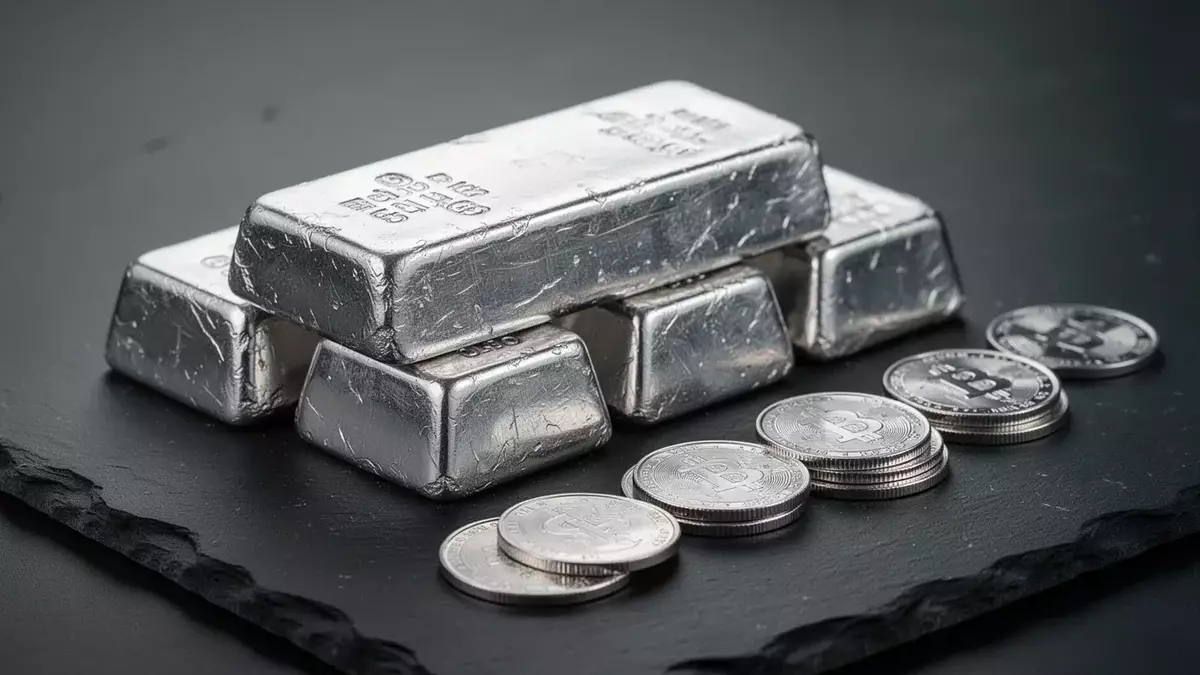
Silver's Two-Front Battle: Record Chinese Demand Meets a Thinning Solar Appetite
Published on 08/11/2026 at 13:21 | Redaktion boerse-global.de
Silver found itself caught between competing forces on Tuesday, with the metal pulling back roughly 2.7 percent to $64.78 per ounce after touching higher ground earlier in the session. The retreat came just a day after the precious metal had been changing hands near $66.59, a level that marked a seven-week peak and capped off a remarkable stretch of gains — up 15.26 percent over the past month and a hefty 75.17 percent year on year.
The pullback reads less like a change in sentiment and more like profit-taking after a strong run, according to market watchers. Silver had been pressing against key resistance levels, and traders opted to lock in gains ahead of a pivotal catalyst on the calendar.
The Inflation Data Hurdle
All eyes now turn to Wednesday's release of US consumer price data for July. The print carries outsized weight for silver, a zero-yield asset that tends to move in lockstep with shifts in interest-rate expectations. Higher-than-forecast inflation would likely keep the Federal Reserve's policy stance tighter for longer, raising the opportunity cost of holding the metal while simultaneously bolstering the dollar.
The Fed left its benchmark rate in a range of 3.5 to 3.75 percent at the end of July, and investors are scouring the inflation figures for clues about what comes next. The stakes are heightened by a broader nervousness across markets: rising oil prices have reignited inflation concerns, and geopolitical uncertainty in the Middle East — including questions over whether the US and Iran can reach a deal to end hostilities and reopen the Strait of Hormuz — is keeping traders on edge.
Should investors sell immediately? Or is it worth buying Silber Preis?
China's Unquenchable Thirst
Beneath the day-to-day volatility, a powerful demand story has been unfolding. China imported 219,000 tonnes of silver-bearing ores in June, a staggering 62.5 percent jump year on year. The surge underscores how deeply the country's industrial machine now depends on the metal.
Much of that appetite traces back to solar. Beijing has been pouring resources into expanding both its photovoltaic manufacturing capacity and its power grid, two sectors that consume silver in significant quantities. This industrial dimension sets silver apart from pure investment metals like gold — it responds more acutely to economic data flowing out of the electronics and energy-transition industries.
The Solar Industry's Thrifty Turn
Yet even as Chinese demand surges, the solar sector itself is finding ways to use less silver. Photovoltaic manufacturers are set to cut their silver consumption by roughly 19 percent in 2026 through a practice known as "thrifting," bringing their usage down to about 151 million ounces.
The motivation is straightforward: the elevated prices of recent years forced the industry to develop more efficient printing techniques and thinner paste layers. While silver remains indispensable for modern solar cells — particularly N-type designs, where its conductivity is hard to match — copper-based alternatives are steadily gaining ground in mass production.
A Structural Squeeze That Won't Quit
The softening solar appetite, however, does little to resolve the market's fundamental tightness. The World Silver Survey 2026 projects a sixth consecutive annual supply deficit, with the shortfall expected to widen to 46.3 million ounces this year, up from 40.3 million ounces in 2025.
Silber Preis at a turning point? This analysis reveals what investors need to know now.
The supply side offers little flexibility. Roughly 70 percent of global silver production emerges as a byproduct of copper, lead, and zinc mining, meaning operators can't simply ramp up output in response to higher prices. Disruptions from early 2026 compounded the problem: diplomatic tensions in the Middle East triggered sulfuric acid shortages, which temporarily hampered copper production and, by extension, silver output.
Since 2021, the market has drawn down more than 760 million ounces from above-ground inventories to bridge the gap. Those dwindling stockpiles continue to provide a structural floor under prices. The technical rebound from the July 16 low of $55 per ounce — a seven-month trough that marked the turning point after weak US jobs data and strong Chinese industrial demand — speaks to the resilience of that support.
For now, the immediate direction hinges on Wednesday's inflation print. But the longer-term calculus remains a tug-of-war between China's industrial hunger, the solar industry's efficiency gains, and a supply pipeline that simply cannot stretch to meet demand.
Ad
Silber Preis Stock: New Analysis - 11 August
Fresh Silber Preis information released. What's the impact for investors? Our latest independent report examines recent figures and market trends.