BYD’s 55% Profit Wipeout Masks an Aggressive Push Into European Factories and Autonomous Chips
30.05.2026 - 15:21:07 | boerse-global.de
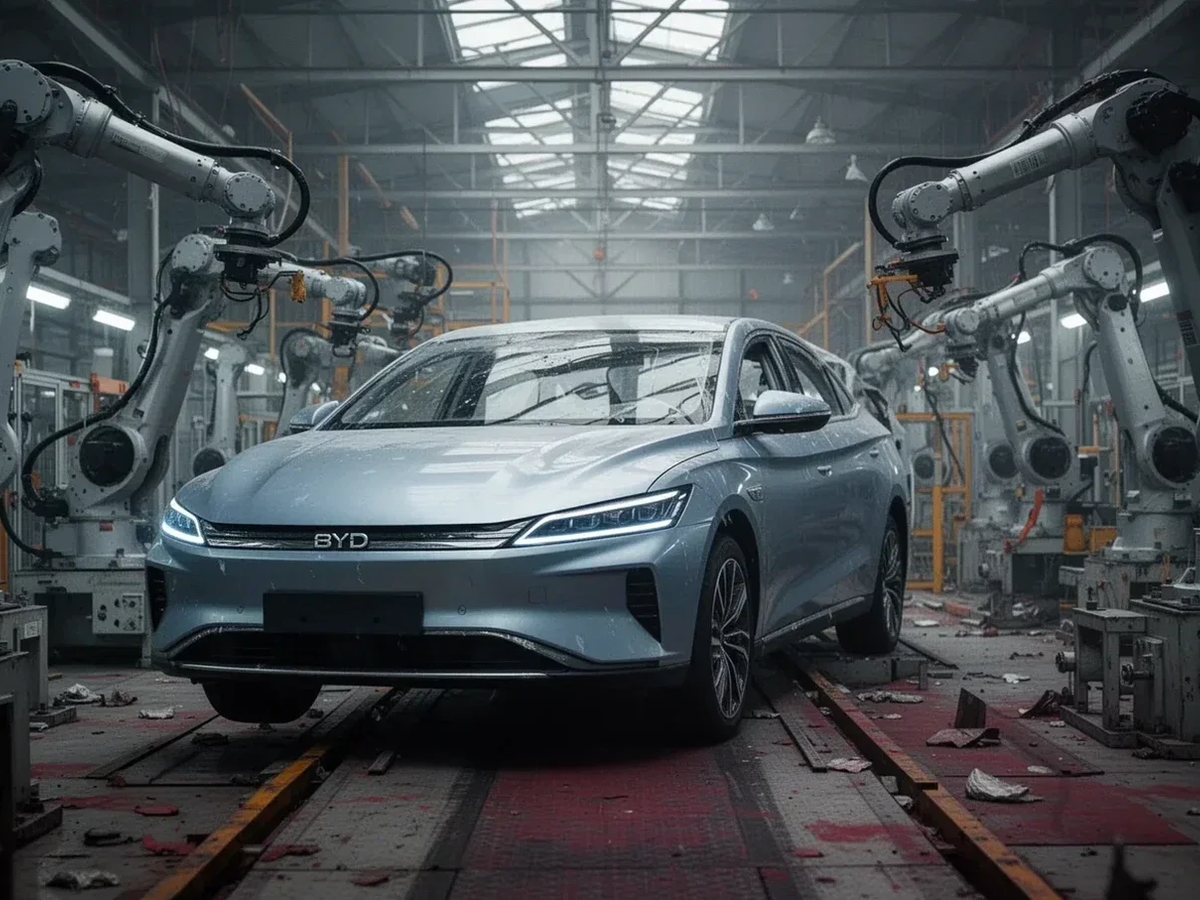
The contrast at BYD could hardly be starker. Net profit slumped 55.4% to 4.09 billion yuan in the first quarter, battered by a vicious price war at home and the expiry of government EV subsidies. Yet rather than retrench, the Chinese electric-vehicle giant is accelerating its overseas expansion and unveiling a homegrown chip that could upend the cost structure of autonomous driving.
On the factory front, BYD vice-president Stella Li confirmed that the company is in talks with Stellantis and other European manufacturers about acquiring underused plants — including sites in Italy — and insists on full ownership. “It is easier” to go it alone, she said. France is also under consideration, thanks to low electricity costs. The moves are designed to bypass the European Union’s punitive tariffs of 17% to 35% on Chinese-made EVs. BYD already has a plant under construction in Szeged, Hungary, with an annual capacity of 300,000 vehicles and an investment tag of up to €4 billion, due to open in 2026. A second factory in Turkey is slated for 2027.
Export figures underscore the urgency: BYD shipped 134,542 vehicles abroad in April, a 70.9% jump year-on-year and a new monthly record. In the first four months of 2026, total overseas deliveries hit roughly 456,000 units, compared with 285,000 in the same period last year. European registrations of BYD EVs surged more than 155% in the first quarter. The company’s full-year export target stands at 1.5 million vehicles — a bold ambition given domestic headwinds. At home, BYD sold roughly one million passenger cars from January to April, a 26.4% drop.
That domestic slump is one reason why the company is betting heavily on technology. On 28 May, at the “Dare to Be” event in Shenzhen, BYD unveiled the Xuanji A3, China’s first self-developed 4?nanometre chip for intelligent driving. A three-chip configuration delivers over 2,100 TOPS of computing power, easily outpacing Li Auto’s Mach 100 (1,280 TOPS) and Xpeng’s Turing chip (750 TOPS). Power consumption is 20% lower than comparable systems, and computing efficiency has doubled thanks to optimised algorithms. Citi analysts estimate that hardware costs will fall to just one-third of external solutions such as Nvidia’s Thor.
Should investors sell immediately? Or is it worth buying BYD?
Even more striking is BYD’s decision to assume full liability for accidents caused by its “God’s Eye” autonomous-driving systems — versions A and B — in urban traffic. The guarantee lasts one year with no cap, a global first for an automaker. The gamble is backed by data: 3.15 million BYD vehicles with intelligent driver-assist systems are already on China’s roads, generating more than 200 million kilometres of driving data daily. The uptake of the smart parking function has jumped from 21% to 93%. For 12,000 RMB (around US$1,660), buyers can now add the “God’s Eye B” package complete with LiDAR to any model, even the entry-level Seagull.
Internally, BYD calls the next phase the “second half of intelligence” with a target of zero accidents. To get there, it plans to invest more than 100 billion yuan (US$14.75 billion) over three years. Over 7,000 engineers are already working on semiconductors, and more than 5,000 specialists are focused on driver-assistance systems. The company also uses AgiBot A2 humanoid robots in its own factories to automate assembly further.
Wall Street reaction has been measured. The H?shares closed the week at HK$90.30, barely above the 52-week low of HK$88.50 and 37% below the May 2025 peak of HK$143.60. Trading volume was 51 million shares. Analysts are split: Goldman Sachs sees the first quarter as the trough and keeps a buy rating with a HK$134 target, while BNP Paribas recommends a sell with a HK$87 fair value, citing persistent margin pressure. CLSA and Citic Securities reiterated buy calls at HK$130 each, and DBS is the most bullish at HK$135, implying 48% upside.
BYD at a turning point? This analysis reveals what investors need to know now.
The coming weeks will be pivotal. May sales figures are due shortly, and any confirmation of a concrete factory deal in Europe could provide the catalyst that bulls have been waiting for. Meanwhile, BYD plans a major over-the-air update for the “God’s Eye C” system in December. With domestic price competition showing no signs of easing, the company is betting that cutting-edge technology and a European manufacturing foothold can turn its profit trajectory around.
Ad
BYD Stock: New Analysis - 30 May
Fresh BYD information released. What's the impact for investors? Our latest independent report examines recent figures and market trends.
So schätzen die Börsenprofis BYD’s Aktien ein!

Für. Immer. Kostenlos.