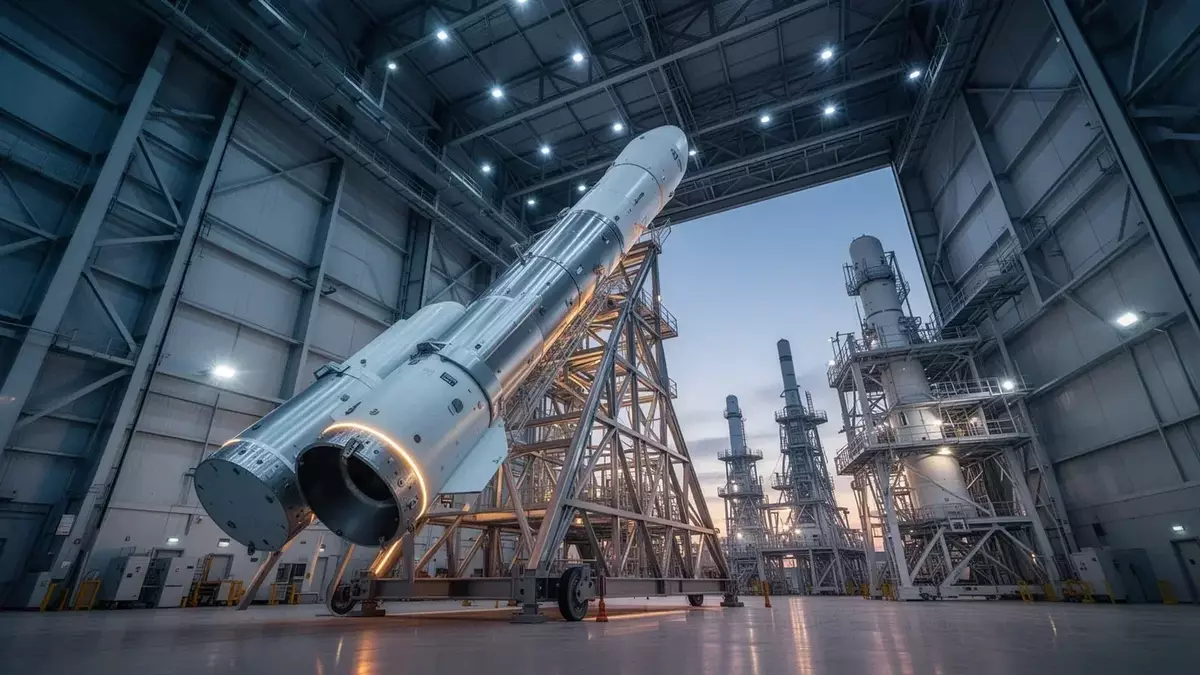
SpaceX’s $75 Billion IPO: Record Orders, Index Hurdles, and a Half-Price Valuation Warning
09.06.2026 - 18:08:54 | boerse-global.de
Not a single SpaceX share has traded on a public exchange, yet the order book is already stuffed. Institutional investors have piled in with orders worth roughly $10 billion or more, leaving the offering multiple times oversubscribed. The response is so ferocious that the underwriting banks stopped accepting new institutional bids on Monday evening in New York, buying time to assess demand and advise on final pricing.
The pricing is set for June 11, with the first trading day following on June 12. SpaceX is offering about 555.6 million Class A shares at $135 each, a deal that would raise $75 billion for the company and peg its market value at roughly $1.8 trillion. That would dwarf the $29.4 billion raised by Saudi Aramco in 2019, widely considered the largest IPO ever.
Retail investors are getting an unusually large slice. SpaceX is reserving up to 30% of the offering for individuals — reportedly a record allocation for an IPO of this scale. Online brokers across Europe, including in the UK, Germany, France and the Netherlands, have already started inviting clients to subscribe. Still, the deal comes with caveats: the free float sits below 5%, the voting rights on the shares being sold are limited, and a $1.8 trillion valuation leaves virtually no room for error.
Yet even before the first trade, the index gatekeepers have thrown cold water on one source of passive demand. S&P Dow Jones Indices has decided against making an exception for SpaceX: the company must meet standard inclusion criteria, including a minimum one-year trading history, profitability requirements, and sufficient public float. Bloomberg Intelligence estimates that immediate S&P 500 inclusion would have triggered roughly $14 billion in forced buying from passive funds. That money will have to wait until at least mid-2027.
Should investors sell immediately? Or is it worth buying SpaceX?
Other indices are moving faster. The Nasdaq?100 introduced a fast?track mechanism that can admit new listings with a sufficiently high market capitalisation just 15 trading days after the IPO. FTSE Russell has cut its waiting period to five trading days. Analysts reckon that combined, these two indices could generate between $22 billion and $27 billion in automatic buying later this summer. The result is a two?tier passive capital environment: Nasdaq?100 and Russell money arrives in 2026, S&P 500 flows stay on hold.
Geo-politics adds another constraint. Underwriters of the $75 billion offering are barred from accepting orders from investors based in China or Hong Kong, a restriction rooted in US export controls — specifically the International Traffic in Arms Regulations (ITAR), which apply to the satellite communications and government contracting technologies at SpaceX’s core. The company has already blocked access to its websites from users in Hong Kong and Shanghai.
Meanwhile, a separate industrial project is drawing attention. SpaceX, Tesla, and Intel are planning a joint semiconductor facility called Terafab near Giga Texas in Austin. The plant would produce chips for AI, robotics, and space?computing data centres using 2?nanometre?class technology built on Intel’s 14A process node. Texas legislative records describe a multi?phase fab with an initial investment of $55 billion and a potential total of up to $119 billion. Elon Musk is scheduled to present the project at an internal ASML conference on June 11 and 12 — precisely when the IPO prices.
Not everyone is convinced by the valuation. Morningstar analysts warn that the stock is worth less than half the IPO price. In the first quarter of 2026, SpaceX posted an operating loss of $1.9 billion. The main culprit was xAI, the artificial?intelligence company that merged with SpaceX in February and contributed $2.5 billion of red ink on its own. Starlink generated $4.4 billion in operating profit, but that wasn’t enough to offset the cost of the AI infrastructure build?out.
SpaceX at a turning point? This analysis reveals what investors need to know now.
Governance concerns are also emerging. Denmark’s Akademiker Pension has placed SpaceX on a blacklist, citing an inflated valuation and weak oversight. Three other large pension funds have criticised Elon Musk’s concentrated voting control and the limited rights available to minority shareholders.
The final share price will be set on the evening of June 11, and the first public trade is scheduled for June 12 on the Nasdaq. The order book is full. But whether that enthusiasm holds once early investors can move their positions — and whether the market shrugs off the index delay, the losses, and the valuation warnings — remains the real test.
Ad
SpaceX Stock: New Analysis - 9 June
Fresh SpaceX information released. What's the impact for investors? Our latest independent report examines recent figures and market trends.
So schätzen die Börsenprofis SpaceX’s Aktien ein!

Für. Immer. Kostenlos.