
Abu al-Hawl: the limestone guardian of Gizeh
Published on 08/19/2026 at 20:00 | Editorial responsibility: Rafael Müller, Editor-in-Chief AD HOC NEWS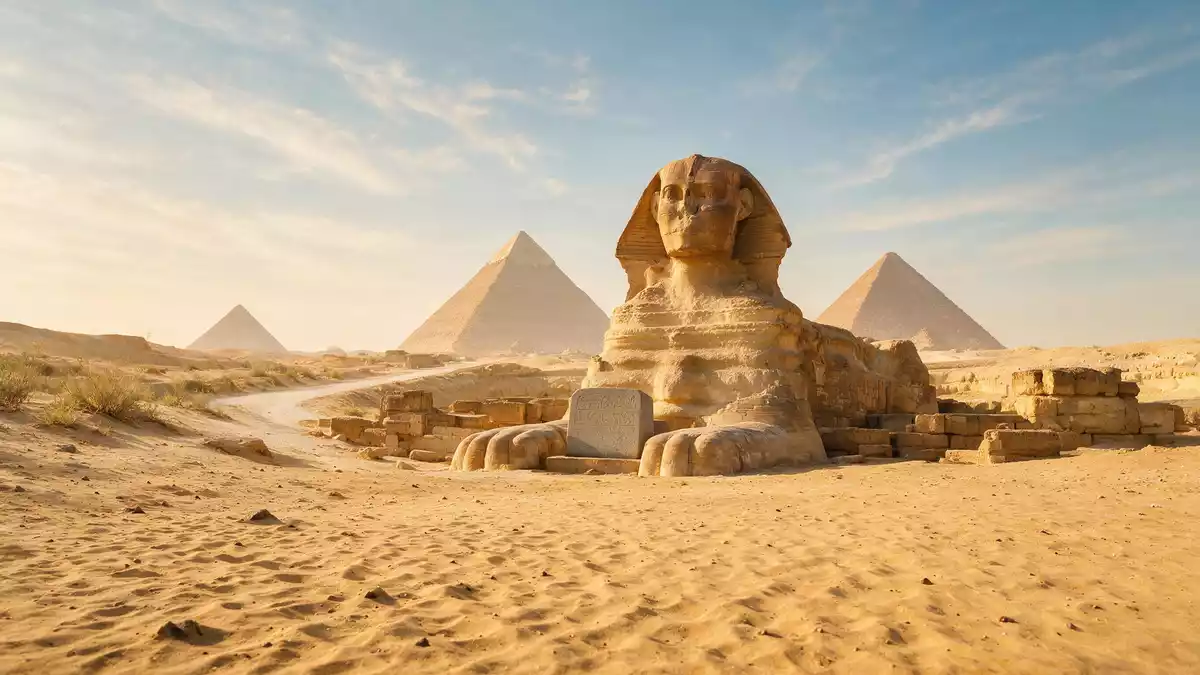
Abu al-Hawl, known in English as the Great Sphinx of Giza, is a colossal limestone figure lying on the desert plateau at Gizeh, facing the rising sun across the floodplain of the Nile. Sculpted in antiquity with the body of a lion and the head of an Egyptian ruler, it has become the enduring stone guardian of the pyramid field on the edge of modern Cairo.
A lion-bodied monarch carved from the Gizeh plateau
The Great Sphinx of Giza is carved directly from the limestone bedrock of the Giza Plateau, a spur of the Eocene-aged Mokattam Formation that rises above the Nile’s west bank.limestone statue of a reclining sphinx The sculptors left the creature recumbent, with extended forepaws, a massive chest and haunches, and a tail drawn along one flank, so that the entire form reads as a lion at rest in the sand.sculpture of a recumbent lion with the head of an Egyptian king
Above this lion’s body rises a human head wearing the royal nemes headdress, a visual fusion that ties the creature both to the natural strength of a predator and to the formal iconography of the pharaohs.colossal limestone statue of a recumbent sphinx The face has suffered erosion and later damage, but its alignment and proportions still evoke the image of a Fourth Dynasty king, conventionally linked with Khafre and his pyramid complex that rises immediately behind the monument on the plateau.dates to approximately 2558-2532 BC during the Old Kingdom period
Scale, age and the Old Kingdom setting
Abu al-Hawl ranks among the largest monolithic statues known, measuring around 73 m (240 ft) in length from paw to tail, with a height of about 20 m (66 ft) from the base to the top of the head.stretching 73 meters in length and 20 meters in height Its hindquarters span roughly 19 m (62 ft) in width, giving the statue a broad, grounded presence against the skyline of the Giza Plateau.73 meters long × 20 meters high These dimensions make the figure an unmistakable focal point in the landscape even with the towering pyramids of Khufu, Khafre and Menkaure nearby.
Most Egyptologists place the creation of the Great Sphinx in Egypt’s Old Kingdom, during the Fourth Dynasty and specifically in the reign of Khafre, around the middle of the third millennium BC.probably in the reign of the king Khafre (2558-2532 BCE) during the period of the Old Kingdom In broad terms the monument is therefore dated to around 2500 BC, aligning chronologically and spatially with Khafre’s pyramid and valley temple, which stand in close architectural relationship to the statue.Most archaeologists still date the Sphinx to Egypt's Old Kingdom, somewhere between 2600 and 2500 BC The Arabic name Abu al-Hawl, meaning “father of terror”, arose in a much later period, reflecting how post-pharaonic generations interpreted the monument’s imposing form.arabisch ??? ?????, DMG Ab? l-Haul
Abu al-Hawl within the Gizeh landscape
The Great Sphinx occupies the eastern edge of the Giza Plateau, set slightly below the main pyramid field where the tombs of Khufu, Khafre and Menkaure rise in sequence above the desert.located on the eastern edge of the Giza Plateau It faces east on a straight west–east axis, looking out towards the former floodplain of the Nile and the urban fabric of greater Cairo beyond.Facing directly from west to east, it was carved out of a low lying spur of the Giza Plateau on the west bank of the Nile Around the statue, excavation has revealed ancient causeways, temples and other structures that bind it into a wider complex of Old Kingdom ritual and funerary architecture on the plateau.
In spatial terms Abu al-Hawl stands close to Khafre’s valley temple and the lower end of the stone causeway that links this riverside zone to the pyramid above, creating a sequence from the Nile plain, through the Sphinx enclosure and up to the high desert. The monument is therefore encountered not as an isolated figure but as one element in a corridor of built and carved structures that together define the Gizeh pyramid field as a central landscape of ancient Egyptian royal power.
Visiting Abu al-Hawl: what travellers from Western Europe should know
- Abu al-Hawl stands on the Giza Plateau at the western edge of Cairo, in the Governorate of Giza, reached over the Nile from the city’s central districts by road and public transport.
- The ground around the Sphinx is uneven desert terrain and archaeological stonework, with low walls, rock-cut surfaces and steps leading through the enclosure and towards the neighbouring temples.
- The monument lies within an ancient necropolis where daytime temperatures in the warmer months can be high, and the surfaces underfoot are exposed rock and compacted sand rather than shaded pavements.
- The official language is Arabic and the currency is the Egyptian pound.
- Entry requirements depend on your nationality; UK travellers can check the FCDO travel advice at gov.uk/foreign-travel-advice, Irish travellers the Department of Foreign Affairs at ireland.ie.
Searching for Abu al-Hawl on social platforms
These links open searches for Abu al-Hawl on each platform.
Frequently asked questions about Abu al-Hawl
Where is Abu al-Hawl located?
Abu al-Hawl stands on the Giza Plateau in the Governorate of Giza, on the west bank of the Nile opposite Cairo, within the wider pyramid field of Gizeh.
What does a visit to Abu al-Hawl involve?
A visit brings travellers onto open desert ground and archaeological structures around the Sphinx enclosure, with sightlines to the pyramids and the surrounding necropolis.
What makes Abu al-Hawl distinctive among Egyptian monuments?
The monument combines a lion’s body and human head in a single colossal limestone figure, carved in the Old Kingdom and integrated into the Khafre pyramid complex on the Giza Plateau.


