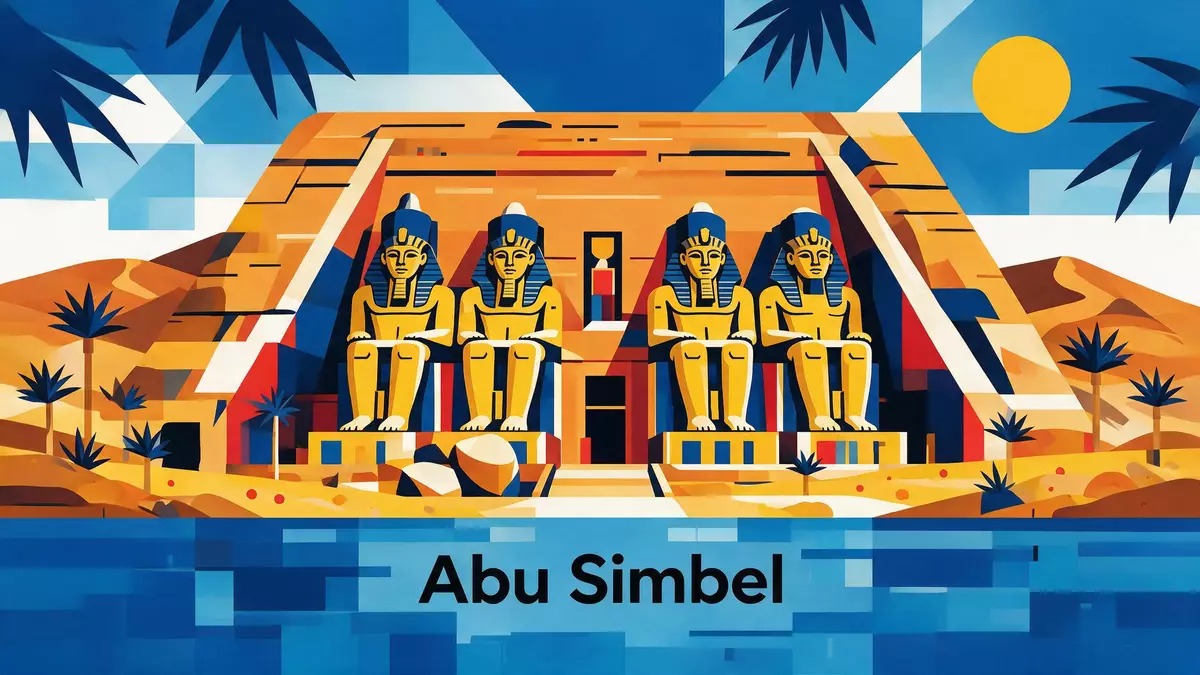
Abu Simbel and its colossal rock-cut temples on Lake Nasser
Published on 08/06/2026 at 18:45 | Editorial responsibility: Rafael Müller, Editor-in-Chief AD HOC NEWS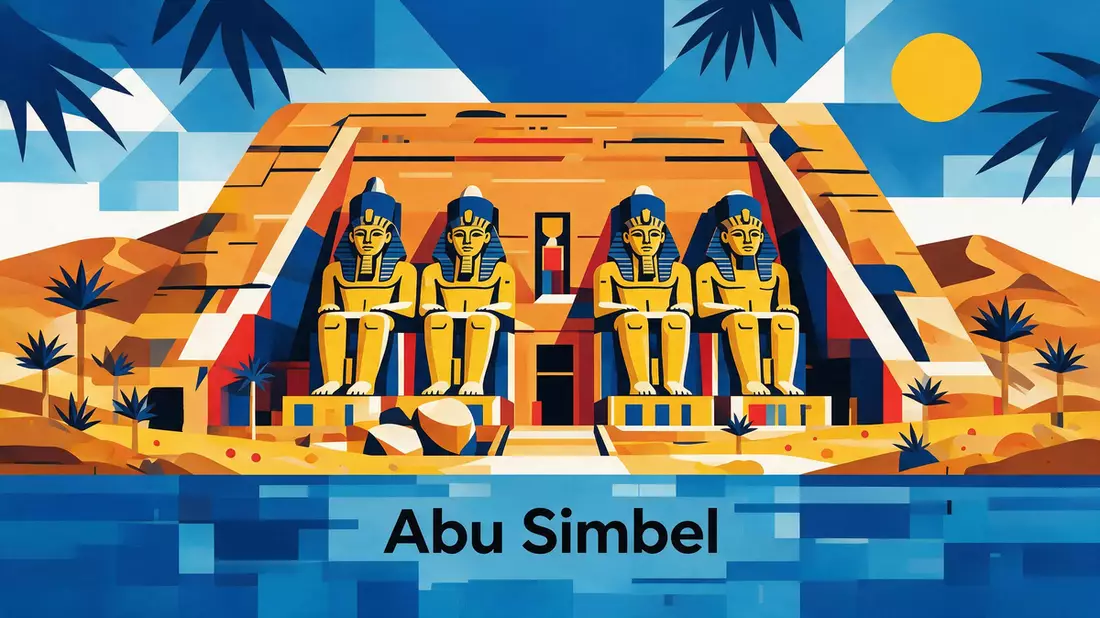
Colossal figures watching over the desert at Abu Simbel
Abu Simbel in southern Egypt is known for two vast temples carved directly into a sandstone cliff on the western shore of Lake Nasser. The setting is stark: pale rock, wide water and the hard light of the Nubian desert. What fixes the place in memory are the colossal seated figures that dominate the façade of the Great Temple, their faces looking out across the lake and the low shoreline.
The Great Temple is cut into the rock rather than built as a free-standing structure. Its façade rises above a broad terrace that meets the desert, and the giant statues sit against the cliff face like guardians. Each figure is carved with a detailed crown, placid eyes and hands resting on its knees, and between their legs and beside their feet stand smaller figures representing members of the royal family. At ground level, visitors approach across sand and simple paving towards a doorway framed by further carved reliefs.
Inside the rock: halls, columns and painted reliefs
Stepping inside the Great Temple takes you from blinding daylight into a long, axial interior cut into the same sandstone. The entrance leads into a hypostyle hall, where thick pillars stand in ranks on either side of a central passage. These pillars are often carved into the forms of standing figures, their bodies and headdresses emerging from the stone and their feet planted firmly on the floor, so that the visitor walks between them as if along a processional route.
The walls of this hall and the inner chambers are covered with low-relief scenes and texts, some still retaining traces of colour on their carved surfaces. Battle scenes, processions and offerings unfold in horizontal registers, with the king shown on a larger scale than accompanying figures. Further inside lie smaller halls and ultimately a sanctuary at the back of the temple, where seated statues occupy a rear chamber cut deep into the rock. The effect is of a sequence of spaces narrowing and darkening as you move away from the doorway and the lake outside.
The smaller temple and the lakeside setting
A short walk from the Great Temple stands the smaller rock-cut temple often associated with the king’s principal wife. Its façade is carved with standing figures instead of seated ones, their forms rising the full height of the front wall. Here, the king and queen appear side by side, flanked by smaller accompanying figures and framed by vertical bands of carved text. The doorway beneath them leads into a more intimate interior, with fewer chambers and a closer sense of enclosure than in the Great Temple.
Both temples face roughly east across the waters of Lake Nasser, with a forecourt or terrace in front of each and low stonework edging the transition from desert to built surface. From the lakeside, the façades appear as sculpted cuts in a long bank of rock, with the rest of the cliff forming a natural backdrop. The contrast between the monumental carvings and the flat, open landscape is one of the most striking qualities of Abu Simbel, especially in the angled light of early morning or late afternoon.
Visiting Abu Simbel: what travellers from Western Europe should know
- Abu Simbel lies in southern Egypt near the border with Sudan and is usually reached from Aswan by road or by scheduled flights to the local airport.
- Admission arrangements and opening hours are set by the site's operator and change with the season; the official website is the only binding source. Timed tickets or daily limits may apply, so it is worth checking the official booking page before travelling.
- The desert setting means strong sunlight for much of the year; many visitors aim for the cooler light of early morning or late afternoon rather than the harshest midday hours.
- The approach from vehicle drop-off to the temples involves a walk over gently sloping paths and steps, and the interiors include uneven floors and low-lit chambers; sturdy footwear helps.
- On site you will mainly encounter Arabic and English, with card payments accepted at many established businesses; modest clothing that covers shoulders and knees aligns well with local expectations.
- Entry requirements depend on your nationality. UK travellers should check the FCDO travel advice at gov.uk/foreign-travel-advice; Irish travellers the Department of Foreign Affairs at ireland.ie; EU and EEA citizens their own national foreign ministry.
Searching for Abu Simbel on social platforms
These links open searches for Abu Simbel on each platform.
Frequently asked questions about Abu Simbel
Where is Abu Simbel?
Abu Simbel is in southern Egypt near the western shore of Lake Nasser, not far from the border with Sudan and south of Aswan.
What should visitors expect at Abu Simbel?
Visitors encounter two rock-cut temples with colossal statues on their façades, richly carved interiors, strong desert light and a walk over sloping paths and steps.
What makes Abu Simbel distinctive among Egyptian temple sites?
Abu Simbel stands out for its giant seated and standing figures carved directly into a lakeside cliff, combined with deep axial interiors cut into the rock behind them.