
Abu Simbel and the rock-cut temples of Ramesses II
Published on 09/18/2026 at 06:21 | Editorial responsibility: Rafael Müller, Editor-in-Chief AD HOC NEWS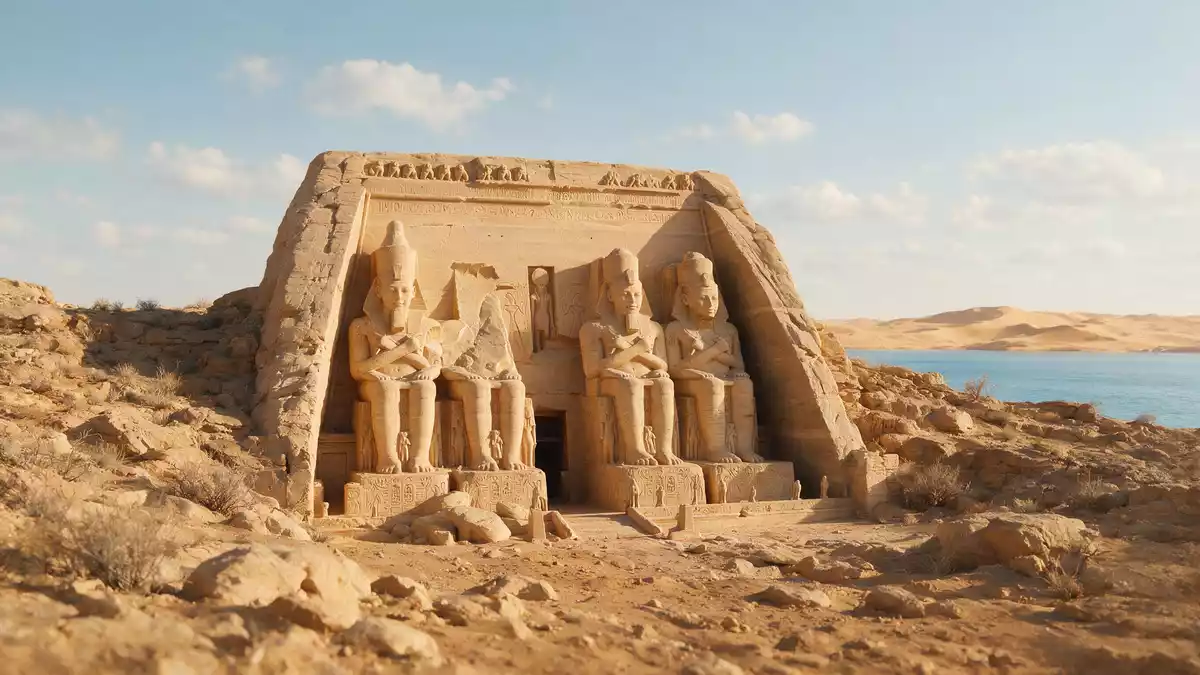
Abu Simbel in southern Egypt is a monumental rock-cut temple complex created under Pharaoh Ramesses II in the thirteenth century BC, facing ancient Nubia at Egypt’s southern frontier. The site brings together colossal royal imagery and finely carved interiors, and it survives in a relocated position above Lake Nasser after a twentieth-century engineering rescue.
Carved into the desert cliff in the New Kingdom
The temples at Abu Simbel belong to the New Kingdom of ancient Egypt and were created during the reign of Ramesses II of the Nineteenth Dynasty. Construction began around 1264 BC and continued for about twenty years, producing two sanctuaries cut directly into a sandstone cliff overlooking the Nile in Nubia.cut into the living rock by King Ramesses II The location near Egypt’s southern border, opposite Nubia, placed the complex on a frontier that connected pharaonic power with the wider region.southern frontier of pharaonic Egypt facing Nubia
The larger sanctuary is commonly referred to as the Great Temple of Ramesses II and is dedicated to the gods Amun, Ra-Horakhty and Ptah alongside the deified Ramesses himself.larger temple dedicated to Amun, Ra-Horakhty, Ptah and Ramesses II Nearby stands the Small Temple, hewn from the same cliff and dedicated to the goddess Hathor and Queen Nefertari, Ramesses II’s Great Royal Wife.Small Temple dedicated to Hathor and Queen Nefertari Together, the two sanctuaries form a single complex that combines royal cult, solar worship and devotion to Hathor within a landscape of desert rock and river.
Colossal façades and hieroglyph-filled halls
The Great Temple façade is dominated by seated statues of Ramesses II rising high above the entrance, carved directly from the cliff face and flanked by smaller standing figures. Each statue portrays the king with the double crown of Upper and Lower Egypt, while minor figures represent members of the royal family. Beneath these colossi, reliefs and inscriptions record royal names and images, setting the tone for the interior.
Inside the Great Temple, a series of pillared halls and side chambers lead towards a sanctuary where statues of deities and the deified Ramesses II stand together. The walls carry scenes of royal ritual and military campaigns, including detailed depictions of chariots, soldiers and offerings. Carving remains visible on pillars and ceilings, and hieroglyphic texts continue along the passageways, creating a dense decorative surface that reflects the temple’s ceremonial role.
The Small Temple presents a different emphasis, with its façade showing standing figures of Ramesses II and Nefertari framed by columns and sculpted reliefs. Its interior is smaller in scale but richly decorated, with Hathoric capitals and wall scenes honouring Hathor and the queen. Visitors encounter a sequence of halls that echo the pattern of the Great Temple on a reduced footprint while maintaining extensive decoration.
Relocated above Lake Nasser
Abu Simbel did not remain in its original position beside the Nile once the Aswan High Dam created the reservoir known as Lake Nasser. In the 1960s, rising water levels threatened to submerge the cliff and its carved temples, prompting an international rescue effort led by UNESCO to move the complex to higher ground.UNESCO-coordinated campaign to save Abu Simbel The relocation took place between 1964 and 1968 and involved dismantling the temples into hundreds of large blocks and reassembling them on an artificial hill above the future shoreline.relocation period 1964–1968 and block dismantling
The new setting retains the impression of a cliff rising above the lake, with the façades reconstructed along a similar orientation. Beneath the outer surface, reinforced concrete domes and internal support structures carry the weight of the reassembled rock-cut chambers.cutting, lifting and reassembling the mountain of stone Approaching the site, visitors encounter the reconstructed hill and the familiar profiles of the Great Temple and the Small Temple emerging from the sandstone, now set at a higher elevation above Lake Nasser’s waters.
Abu Simbel in its Nubian landscape
Abu Simbel lies in southern Egypt’s Nubia region, close to the modern border with Sudan and south of Aswan. The complex occupies a desert slope overlooking the reservoir of Lake Nasser, where water fills the former valley of the Nile behind the Aswan High Dam. From the temple plateau, the view extends across open water and barren rock, linking the ancient monuments with the transformed river landscape.
The surrounding terrain combines sandy ground, rock outcrops and the edge of the artificial lake. The reconstructed hill on which the temples stand rises above the lakeshore, and paths lead across sloping ground towards the façades. The impression is of monumental architecture set directly within a stark desert environment, with the cliff-like mound framing the colossal statues and sandstone walls.
Visiting Abu Simbel: what travellers from Western Europe should know
- Abu Simbel is in southern Egypt’s Nubia region, reached overland or by air from Aswan and positioned near the western shore of Lake Nasser.
- Within the complex, approaches to the Great Temple and the Small Temple cross sloping ground and stone paths, followed by internal corridors and halls cut into the rock.
- The official language is Arabic and the currency is the Egyptian pound.
- Entry requirements depend on your nationality; UK travellers can check the FCDO travel advice at gov.uk/foreign-travel-advice, Irish travellers the Department of Foreign Affairs at ireland.ie.
Searching for Abu Simbel on social platforms
These links open searches for Abu Simbel on each platform.
Frequently asked questions about Abu Simbel
Where is Abu Simbel located in Egypt?
Abu Simbel stands in the Nubia region of southern Egypt near the border with Sudan, on a desert slope above the reservoir of Lake Nasser.
What should visitors expect inside the temples?
Visitors enter rock-cut halls lined with pillars, reliefs and hieroglyphs, leading towards sanctuaries where statues of deities and the deified Ramesses II are displayed.
What makes Abu Simbel distinctive among Egyptian temple sites?
Abu Simbel combines colossal cliff-carved statues, a pair of royal temples dedicated to gods and Queen Nefertari, and a complete twentieth-century relocation above Lake Nasser.


