
Addo Elephant National Park and its wide-ranging landscape
Published on 09/05/2026 at 15:05 | Editorial responsibility: Rafael Müller, Editor-in-Chief AD HOC NEWS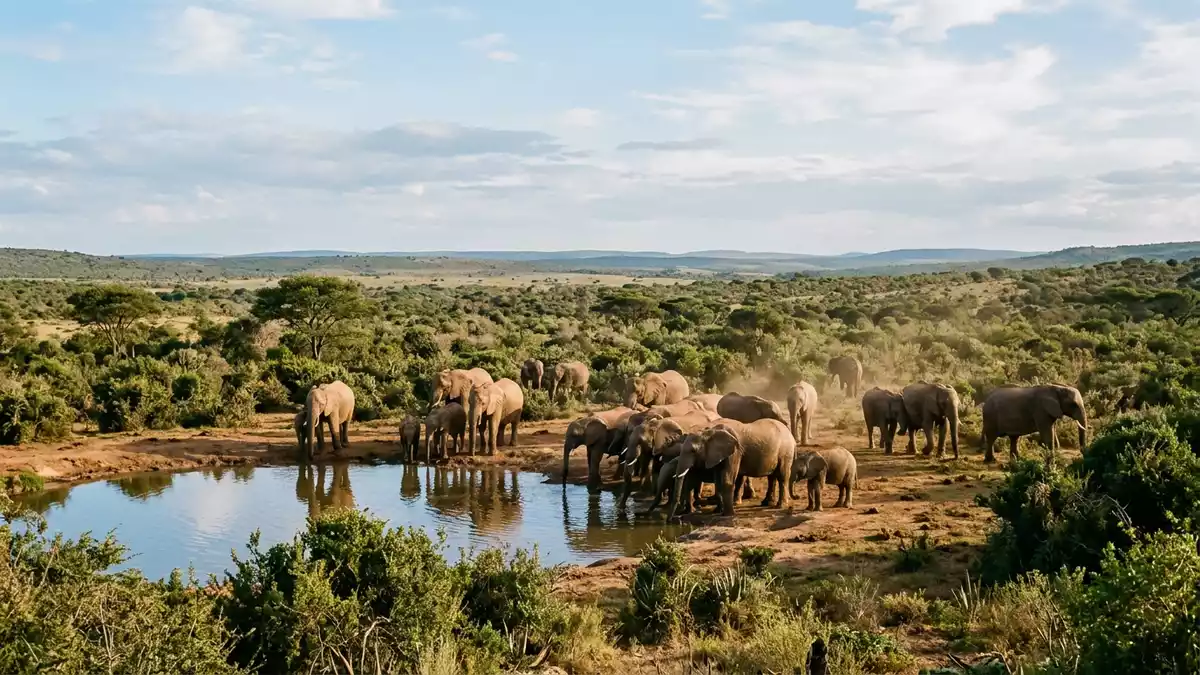
Addo Elephant National Park near Addo in South Africa stretches across bush, valley, mountain and coast. Proclaimed in 1931, it is anchored by the survival story of the Eastern Cape elephants and by a landscape that changes from inland scrub to shoreline.
Addo Elephant National Park and its 1931 core
The park’s modern identity began with the 1931 proclamation, a date that remains central to its name and history. Its story is tied to its 1931 proclamation and to the remaining elephants of the region, which gave the park its original conservation purpose.
Addo Elephant National Park belongs to South African National Parks and lies in the Eastern Cape, north of Gqeberha, the city long known as Port Elizabeth. Britannica places it in the Sundays River valley south of the Suurberg Range, a setting that already suggests the park’s mixed terrain.
The park between Sundays River and Suurberg
The park is not a single visual scene but a sequence of landscapes. Inland areas meet valley country, and the southern side opens towards the coast, with the Zuurberg Mountains forming part of the wider frame.
This range of terrain is one of the park’s most distinctive features. The southern section is described as lying north of Gqeberha and south of the Suurberg Range, while the national park as a whole is known for covering a broad conservation area rather than a compact enclosure.
Elephants, other wildlife and the park’s wider reach
Elephants remain the park’s defining animals, but the name no longer tells the whole story. The park also protects other large mammals and coastal habitats, and its coastal extension brings in marine territory as part of the broader protected area.
The wider park includes St Croix and Bird islands in Algoa Bay, and the marine protected area is part of the same conservation landscape. The marine section links the terrestrial park with offshore waters, adding a second setting to a place often thought of only in terms of elephants.
Visiting Addo Elephant National Park: what travellers from Western Europe should know
- The park lies in the Eastern Cape near Gqeberha and Addo. Road access is the usual approach, with main routes leading in from the Port Elizabeth side.
- The terrain shifts between bush, valley and coastal ground. A visit can involve long drives on gravel or tarred roads rather than a single short walk.
- The park sits in a malaria-free area of South Africa. The official language is English and the currency is the South African rand.
- The national park extends beyond the original elephant sanctuary into a much broader protected area. That wider extent includes islands and marine habitat.
Searching for Addo Elephant National Park on social platforms
These links open searches for Addo Elephant National Park on each platform.
Frequently asked questions about Addo Elephant National Park
Where is Addo Elephant National Park?
It is in South Africa’s Eastern Cape, near Addo and north of Gqeberha. The park lies in a landscape shaped by the Sundays River valley and the Suurberg Range.
What does a visit involve?
The park is organised around road-based wildlife viewing across a large area. The setting shifts from inland bush to coastal ground, so the scenery changes as the drive continues.
What makes Addo Elephant National Park distinct?
Its identity combines a 1931 conservation beginning with a broad landscape that includes elephants, inland terrain and marine protected areas. The park’s name points to elephants, but its scope reaches much further.


