
Addo Elephant National Park from thicket to ocean
Published on 09/23/2026 at 22:59 | Editorial responsibility: Rafael Müller, Editor-in-Chief AD HOC NEWS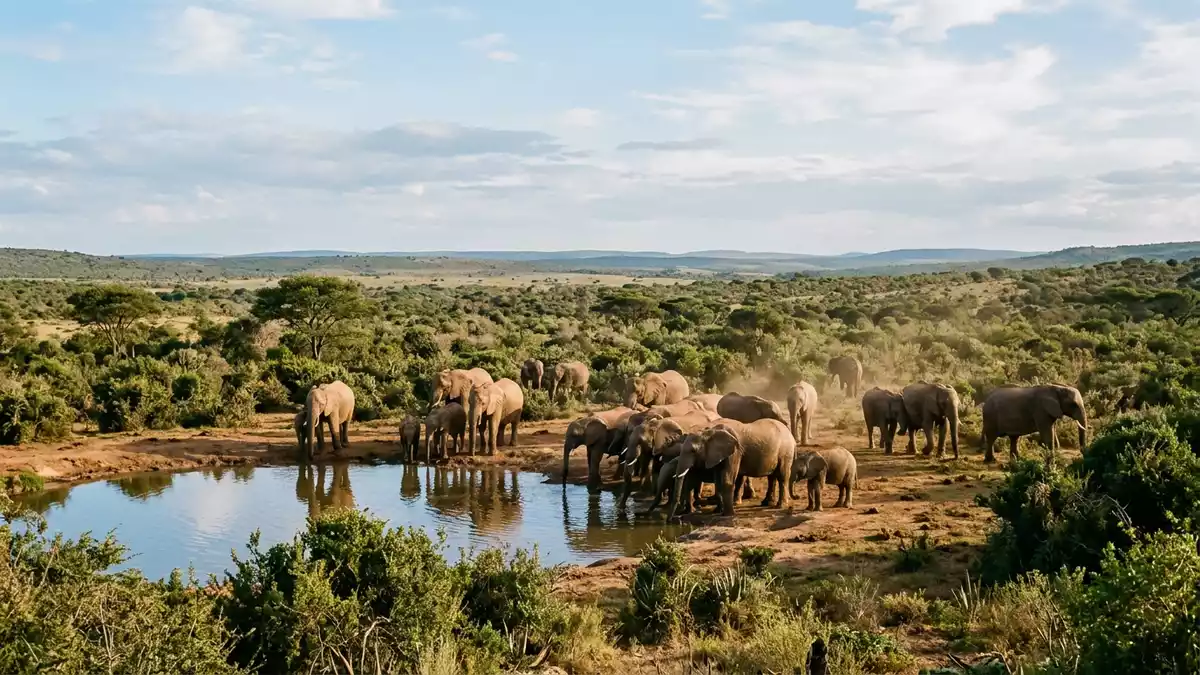
Addo Elephant National Park stretches from dense Albany thicket in the Sundays River valley towards the Zuurberg Mountains and the Indian Ocean coast. Its landscapes include woodland, grassland, forest, fynbos, Karoo country, coastal dunes and marine habitats.
Addo’s thicket and the eleven elephants
The park was proclaimed in 1931 after hunting and conflict with farmers had reduced the local elephant population to 11 animals. Its original protected area covered about 2,270 hectares, a small reserve in the Eastern Cape. The surviving elephants became the central subject of Addo’s conservation history, while the protected landscape expanded beyond the first reserve.
Dense evergreen thicket remains a defining feature of the original Addo section. Spekboom and other shrubs form a close vegetation cover, with clearings, water points and tracks opening through the bush. Addo’s conservation history records the park’s beginning as a refuge for the remaining elephants.
Five South African biomes in one protected landscape
Addo’s identity comes from its range of habitats. The original thicket lies alongside forest in the Woody Cape and Zuurberg areas, fynbos on mountain slopes, Nama Karoo in the northern sections and the Indian Ocean Coastal Belt near the shore.
The park is divided into linked sections across the Eastern Cape. The southern area lies near the Sundays River and north of Gqeberha, while the Zuurberg landscape contains hills and ravines. Darlington reaches into drier Karoo country, and Woody Cape connects the protected landscape with coastal vegetation.
The protected area also includes a marine component, with beaches, rocky shores, reefs, an estuary and offshore islands. This combination gives Addo a geographical range that extends from inland scrub to the ocean. the Eastern Cape landscape contains terrestrial, coastal and marine environments.
Elephants, black rhinoceros and coastal wildlife
Elephants remain the park’s central animal presence, moving through thicket and open clearings. Addo also provides habitat for Cape buffalo, lion, leopard, black rhinoceros, spotted hyena, antelope, birds, reptiles and smaller mammals.
The marine section adds animals absent from the inland bush. Southern right whales and great white sharks belong to the wider protected ecosystem, alongside coastal birds and marine life. The result is a park whose wildlife story includes both large mammals on land and species associated with the Indian Ocean.
Addo’s conservation history therefore has two scales. The 1931 reserve protected a small elephant population, while the expanded park represents a broader conservation landscape. Addo in the Eastern Cape includes the Sundays River valley, the Zuurberg range and habitats for elephants, black rhinoceros and other wildlife.
Visiting Addo Elephant National Park: what travellers from Western Europe should know
- Addo Elephant National Park lies in South Africa’s Eastern Cape, near the Sundays River and north of Gqeberha. The park is reached by road, with the main southern area connected to the regional road network.
- The landscape changes from dense thicket to mountain terrain, open grassland, Karoo vegetation and coastal country. Mountain sections include hills, ravines and uneven ground.
- The park is divided into named areas including Addo, Zuurberg, Darlington, Kabouga, Nyathi and Woody Cape. The coastal and marine sections extend the park beyond the inland game areas.
- The official language is English, and the currency is the South African rand.
- Entry requirements depend on your nationality; UK travellers can check the FCDO travel advice at gov.uk/foreign-travel-advice, Irish travellers the Department of Foreign Affairs at ireland.ie.
Searching for Addo Elephant National Park on social platforms
These links open searches for Addo Elephant National Park on each platform.Frequently asked questions about Addo Elephant National Park
Where is Addo Elephant National Park?
Addo Elephant National Park is in South Africa’s Eastern Cape, near the Sundays River and north of Gqeberha. Its protected landscape reaches from inland thicket towards the Zuurberg Mountains and the coast.
What can visitors expect in the park?
The park contains dense thicket, mountain terrain, grassland, Karoo vegetation, coastal habitats and marine environments. Wildlife includes elephants, Cape buffalo, lion, leopard, black rhinoceros, antelope and many bird species.
What makes Addo distinctive?
Addo began as a 1931 reserve for 11 surviving elephants and now encompasses a far broader ecological landscape. Its habitats connect inland wildlife country with the Indian Ocean coast.


