
Ait Ben Haddou, an earthen ksar above the Ounila Valley
Published on 09/17/2026 at 14:29 | Editorial responsibility: Rafael Müller, Editor-in-Chief AD HOC NEWS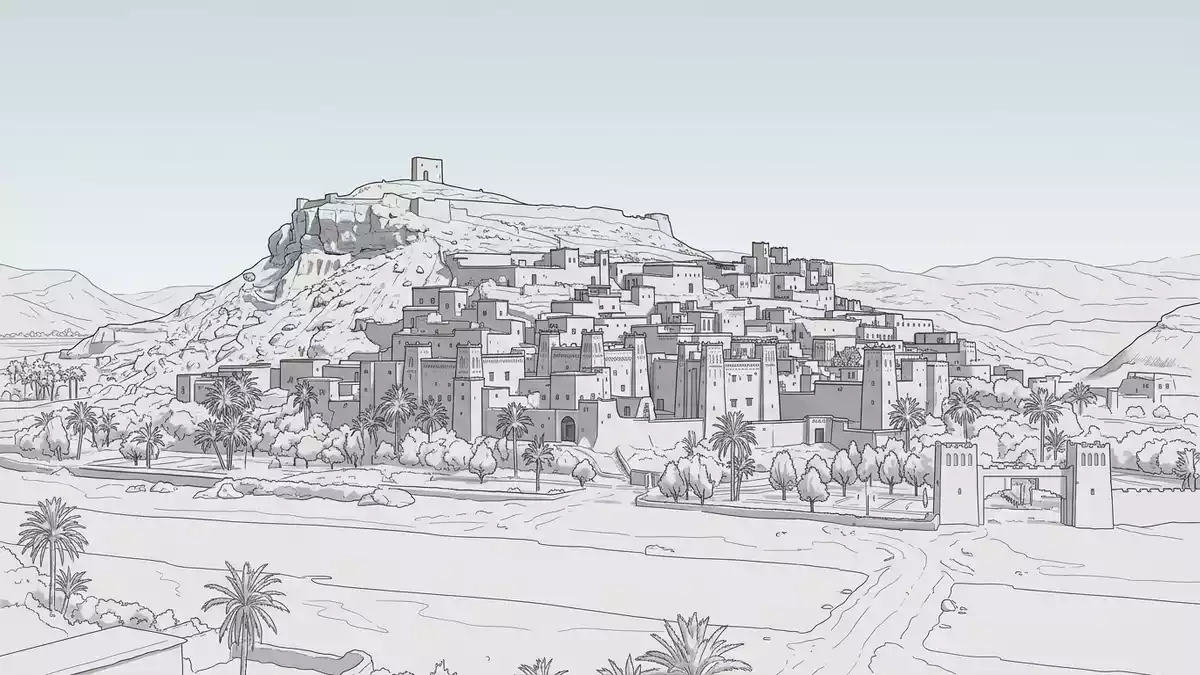
Rising above the Ounila Valley near Ouarzazate in Morocco, Ait Ben Haddou is an earthen fortified village where clay houses, walls and towers cluster on a hillside in the High Atlas foothills. Recognised by UNESCO as the Ksar of Ait Ben Haddou and inscribed on the World Heritage List in 1987, it offers a concentrated view of traditional pre-Saharan earthen architecture in southern Morocco.World Heritage inscription in 1987
An earthen hilltop village in the High Atlas foothills
Ait Ben Haddou stands on the southern slopes of the High Atlas, above the Ounila Valley in Ouarzazate Province in south-eastern Morocco. From the valley floor a compact mass of earthen buildings rises in steps up the hillside, enclosed by defensive walls reinforced by towers at key points.southern slopes of the High Atlas The term ksar, used across the Maghreb, describes this type of fortified village, a group of dwellings and communal buildings gathered behind walls.
The architecture of Ait Ben Haddou is based on locally available materials, particularly rammed earth, adobe and clay plaster, with timber used for beams and upper floors.earthen construction in the pre-Saharan valleys The walls carry a characteristic reddish colour that changes with the light through the day, and the massing of the buildings creates stepped terraces and lanes that climb towards the upper fortifications.
Layers of history along a trans-Saharan route
Ait Ben Haddou lies on a former trans-Saharan trading route linking regions described historically as ancient Sudan with Marrakech, passing through the Drâa Valley and the Tizi n'Telouet Pass.trading route linking ancient Sudan with Marrakech The site has long been associated with caravan traffic moving between the desert and the city, and its position above the valley offered a strategic vantage point over approaches from different directions.
It is thought to date from at least the 17th century in its present form, with older building traditions reflected in its layout and construction techniques.buildings from the 17th century Within the walls lie houses of varying sizes, some built on a grander scale with tower-like elements, alongside communal spaces, a mosque and burial grounds described in historical accounts. UNESCO recognises the ksar under cultural criteria for its representation of traditional earthen construction and its role in illustrating settlement patterns in the pre-Saharan valleys of Morocco.UNESCO cultural criteria and location
Exploring the clay lanes and towers
Approaching Ait Ben Haddou from the modern village on the valley floor, visitors cross towards the earthen ksar and begin to climb narrow lanes between high walls. The layout reveals a dense network of passages, stepped alleys and small squares, with houses opening onto enclosed spaces and views back across the valley.
Higher up the hillside, defensive structures and towers mark the upper limits of the settlement, and from these points the surrounding landscape of the Ounila Valley and the distant ridges of the High Atlas can be seen. The contrast between the compact earthen architecture and the open valley below is one of the defining visual experiences of the site, and the red tones of the clay structures stand out against the lighter riverbed and cultivated plots.
Visiting Ait Ben Haddou: what travellers from Western Europe should know
- Ait Ben Haddou lies west of Ouarzazate, on the road that follows the Ounila Valley towards the High Atlas. It is reached by road vehicles from Ouarzazate and other towns.
- The ksar climbs a hillside above the valley and exploring it involves walking up earthen lanes and stepped passages, some of them steep and uneven underfoot.
- The surrounding region is semi-arid and exposed, with limited shade on the slopes of the ksar and strong sun on clear days, particularly on the upper terraces.
- The official language is Arabic and the currency is the Moroccan dirham.
- Entry requirements depend on your nationality; UK travellers can check the FCDO travel advice at gov.uk/foreign-travel-advice, Irish travellers the Department of Foreign Affairs at ireland.ie.
Searching for Ait Ben Haddou on social platforms
These links open searches for Ait Ben Haddou on each platform.
Frequently asked questions about Ait Ben Haddou
Where is Ait Ben Haddou located?
Ait Ben Haddou is in Ouarzazate Province in south-eastern Morocco, on the southern slopes of the High Atlas above the Ounila Valley.
What should visitors expect during a visit?
Visitors can expect to walk through a compact earthen ksar, climbing lanes and stepped passages on a hillside, with extensive views over the valley and surrounding semi-arid landscape.
What makes Ait Ben Haddou distinctive among Moroccan sites?
Ait Ben Haddou is distinctive as a well-preserved earthen ksar recognised as a UNESCO World Heritage Site, illustrating traditional pre-Saharan fortified village architecture in southern Morocco.


