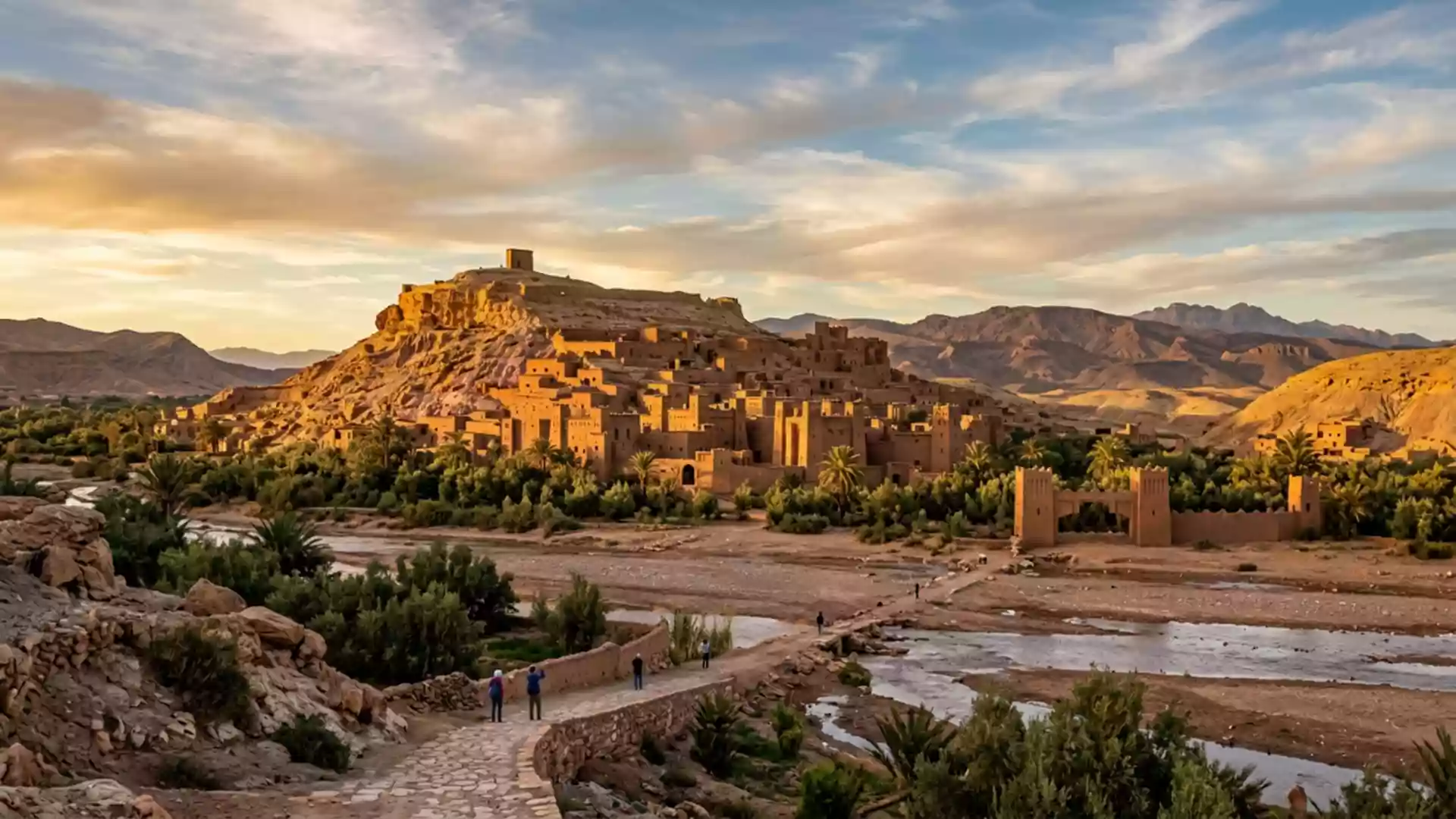
Ait Ben Haddou: earthen fortress above the Ounila Valley
Published on 08/14/2026 at 14:35 | Editorial responsibility: Rafael Müller, Editor-in-Chief AD HOC NEWS
Ait Ben Haddou, near Ouarzazate in southern Morocco, is a fortified earthen ksar where clay tower-houses rise in tiers above the Ounila Valley and the former caravan route between the Sahara and Marrakesh. The settlement, largely in its present form since around the seventeenth century, is recognised as a UNESCO World Heritage Site for its remarkably complete example of pre-Saharan earthen architecture.
An earthen fortress-settlement on the High Atlas foothills
Ait Ben Haddou lies on the southern slopes of the High Atlas Mountains in Ouarzazate Province, where the Ounila river cuts through dry hills before running towards the desert. The ksar occupies a hillside on one bank of the river, so that its compact mass of buildings forms a stepped profile in red-brown clay against the paler rock of the valley walls.southern slopes of the High Atlas The position on a former caravan route between Marrakesh and the Sahara meant that traders once passed this way with goods such as salt and other commodities, using the fortified houses as shelter.
The word ksar, used across the Maghreb, describes a fortified village rather than a single castle, and Ait Ben Haddou shows this clearly. Groups of earthen houses stand within high defensive walls reinforced by corner towers, with the walls of one house often continuing into the next so that the whole settlement reads as a connected block of earth construction.high defensive walls reinforced by corner towers Above the clustered dwellings a small fortification crowns the hill, overlooking the valley and the surrounding slopes.
Architecture in clay: kasbah tower-houses and communal spaces
The built fabric of Ait Ben Haddou is predominantly rammed earth and adobe brick, faced with local red clay that gives the ksar its distinctive colour. This earthen construction sits over timber elements and is organised into kasbah tower-houses, whose upper levels rise above thicker lower walls and parapets.rammed earth and adobe brick over timber Decorative elements, including geometric patterns in the clay and stepped crenellations, articulate the upper parts of some towers and recall a wider southern Moroccan building tradition.
Within the defensive walls, Ait Ben Haddou contains a variety of communal spaces that reflect its role as a historic fortified settlement. A mosque stands among the dwellings, and nearby a public square offers open space between the houses. Threshing areas outside the ramparts, a caravanserai for traders and two cemeteries, one Muslim and one Jewish, lie in the surroundings and show how the ksar functioned as a social and economic centre for the valley.mosque, public square and caravanserai Together, these elements form a textbook example of pre-Saharan earthen vernacular architecture.
World Heritage recognition and a life on screen
The Ksar of Ait Ben Haddou was inscribed on the UNESCO World Heritage List in 1987 as a cultural site recognised for its outstanding earthen architecture and traditional pre-Saharan settlement pattern.UNESCO World Heritage List in 1987 The inscription identifies the ksar as an important example of southern Moroccan architecture, with its compact group of clay buildings inside defensive walls providing a reference point for the wider tradition of earthen villages in the region.
Standing fabric at Ait Ben Haddou largely dates from the seventeenth century onwards, though settlement on the site goes back further in the history of the Ounila Valley.structures largely date from the 17th century In addition to its architectural and historical interest, the ksar has become a recognisable film location, used as a backdrop for productions that required a fortified earthen town on the edge of the desert. This second life on screen has drawn attention to its layered clay walls and hillside layout without changing the essential physical character of the settlement.
Visiting Ait Ben Haddou: what travellers from Western Europe should know
- Ait Ben Haddou lies north-west of the town of Ouarzazate in southern Morocco, reached by road through the Ounila Valley and the foothills of the High Atlas Mountains.
- Within the ksar, routes climb the hillside along stepped lanes and stairways between earthen houses, and crossing the river may involve walking across uneven ground before reaching the fortified gate.
- The surrounding landscape is arid, with low vegetation and exposed rock, and summer temperatures in the valley can be high, so shade within the clay buildings and alleys is limited away from covered areas.
- The official language is Arabic and the currency is the Moroccan dirham.
- Entry requirements depend on your nationality; UK travellers can check the FCDO travel advice at gov.uk/foreign-travel-advice, Irish travellers the Department of Foreign Affairs at ireland.ie.
Searching for Ait Ben Haddou on social platforms
These links open searches for Ait Ben Haddou on each platform.
Frequently asked questions about Ait Ben Haddou
Where is Ait Ben Haddou located?
Ait Ben Haddou is in Ouarzazate Province in southern Morocco, on the southern slopes of the High Atlas Mountains along the Ounila Valley.
What should visitors expect at the ksar?
Visitors encounter a compact fortified earthen village with clay tower-houses, steep lanes, stairways and views across the river and surrounding arid hills.
What makes Ait Ben Haddou distinctive among Moroccan sites?
The ksar is distinctive for its well-preserved earthen architecture, complete defensive layout and recognition as a UNESCO World Heritage Site representing pre-Saharan village traditions.