
Al-Masjid al-Haram in Mekka and the vast sanctuary around the Kaaba
Published on 09/01/2026 at 21:07 | Editorial responsibility: Rafael Müller, Editor-in-Chief AD HOC NEWS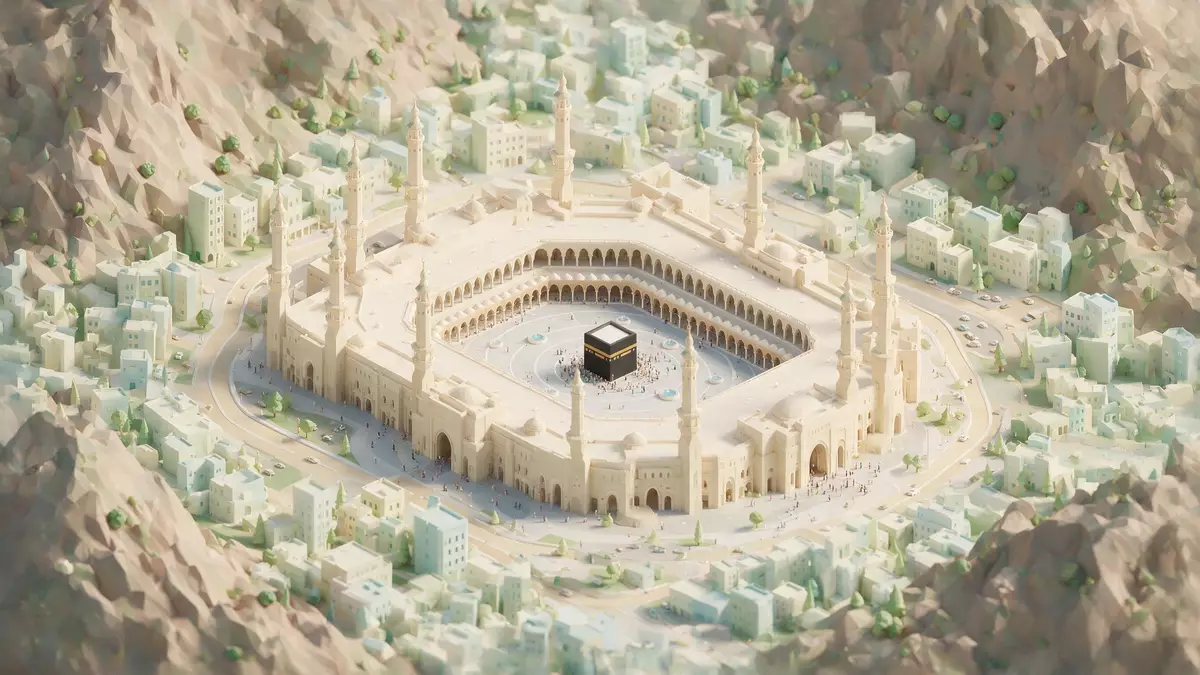
Al-Masjid al-Haram in Mekka is the central sanctuary of Islam, a vast mosque complex built around the Kaaba that has grown over many centuries into an immense, multi-level prayer space. The present mosque structure largely traces back to Ottoman rebuilding in the sixteenth century, combined with extensive twentieth-century expansions that transformed the scale of the site.
The Kaaba at the heart of the sanctuary
Every description of Al-Masjid al-Haram begins with the Kaaba, the cuboid building at the centre of the mosque’s inner courtyard and the focal point for prayer in Islam. Islamic tradition links the origins of the Kaaba to the prophet Ibrahim and his son Ismail, who are held to have raised its walls as a house of worship, long before the lifetime of the Prophet Muhammad.Islamic tradition connects the Kaaba to Ibrahim The Kaaba today stands as a simple masonry block draped in a black textile covering with woven inscriptions, framed by the broad paved courtyard used by pilgrims for the ritual of circumambulation.
The building itself has roughly rectangular plan dimensions and rises to a height of around 15 m (49 ft), giving it a compact but substantial presence within the wide open space around it.Approximate Kaaba dimensions At one corner sits the Black Stone, a revered object set into the wall and surrounded during pilgrimage by dense movement and devotional attention. Around the Kaaba, broad marble paving defines the Mataf, the area reserved for walking the ritual circuits, which is enclosed by high arcades and galleries on several levels.
Centuries of construction and expansion
As a mosque, Al-Masjid al-Haram took recognisable architectural form in the seventh century, when early caliphs enclosed the Kaaba within structured colonnades and prayer halls. Construction under the caliph Omar ibn al-Khattab in the period between 634 and 644 established an organised sanctuary, beginning a long sequence of extensions under subsequent rulers.Early construction under Omar ibn al-Khattab The mosque’s outline and interior arrangement changed repeatedly as the number of pilgrims grew, with notable enlargements in the Abbasid period and under later dynasties.
The oldest visible architectural fabric of the present mosque dates to the sixteenth century, when Ottoman sultan Selim II ordered a comprehensive rebuilding completed around 1571.Ottoman rebuilding in 1571 These Ottoman colonnades and arcades, characterised by repetitive arches and stone piers, formed the structural core that later twentieth-century works wrapped and extended. Modern Saudi-era expansion campaigns, initiated in the mid-twentieth century, multiplied the mosque’s floor area by enclosing new wings and courtyards, adding upper levels and expanding the outer perimeter to create one of the largest continuous mosque complexes in the world.Twentieth-century enlargements of the mosque
Scale, layout and surrounding structures
In its modern form Al-Masjid al-Haram covers several hundred thousand square metres, combining enclosed prayer halls, shaded arcades, roof areas and broad external terraces.Approximate total area of Masjid al-Haram The principal prayer spaces are arranged in concentric fashion around the central courtyard, with successive rings of arcades and interior halls that open through large gates to the surrounding city. Multiple levels provide vantage points over the Kaaba, from ground-floor arcades up to upper galleries and roof platforms used for prayer during busy periods.
The mosque’s perimeter is articulated by a series of tall minarets rising above the prayer blocks and entrance halls. These minarets mark important entry points and give the complex a recognisable silhouette against the buildings of Mekka.Basic specifications of the mosque complex Nearby, the Abraj Al Bait complex stands as a cluster of high-rise towers, including a clock tower whose height places it among the tallest buildings in the world, visually dominating the ridge line beside the sanctuary.Abraj Al Bait clock tower beside the mosque Together, the low, sprawling horizontal mass of the mosque and the vertical emphasis of the clock tower form a striking juxtaposition of traditional religious architecture and contemporary high-rise construction.
Ritual spaces and movement within Al-Masjid al-Haram
Beyond its architectural mass, Al-Masjid al-Haram is organised around specific ritual paths and zones embedded in the building fabric. The Mataf in front of the Kaaba is one such zone, a paved area whose width and openness accommodate overlapping circuits of worshippers performing the tawaf, the ritual of walking around the Kaaba. Surrounding arcades provide shaded space for prayer and rest, with clear sightlines into the courtyard from successive bands of pillars.
To one side of the main sanctuary, enclosed within the wider complex, lies the route between the hills of Safa and Marwa, the setting for the sa’i ritual walk. Over time this corridor has been roofed and extended into multi-level galleries, giving the masa path a distinct spatial character that is separate from the open courtyard yet still integrated with the wider mosque.Description of the masa route Elevators, escalators and staircases link these ritual spaces to the upper floors and roof platforms, embedding vertical circulation within the thick fabric of prayer halls and service areas.
Visiting Al-Masjid al-Haram: what travellers from Western Europe should know
- Al-Masjid al-Haram stands at the centre of Mekka in Saudi Arabia, enclosed by dense urban development and overlooked by the Abraj Al Bait clock tower complex rising immediately beside the sanctuary.
- The mosque complex extends over several levels, with broad paved courtyards, long interior corridors and staircases connecting upper galleries and roof areas, so movement on foot can involve substantial walking across hard surfaces.
- For visitors arriving by air, Mekka is reached via airports serving the wider region of western Saudi Arabia, from which road and rail links lead inland to the city and its surrounding hills.
- The official language in Mekka is Arabic and the currency is the Saudi riyal.
- Entry requirements depend on your nationality; UK travellers can check the FCDO travel advice at gov.uk/foreign-travel-advice, Irish travellers the Department of Foreign Affairs at ireland.ie.
Searching for Al-Masjid al-Haram on social platforms
These links open searches for Al-Masjid al-Haram on each platform.
Frequently asked questions about Al-Masjid al-Haram
Where is Al-Masjid al-Haram located?
Al-Masjid al-Haram is located in the city of Mekka in western Saudi Arabia, built in a basin surrounded by hills and closely encircled by urban development.
What should visitors expect inside Al-Masjid al-Haram?
Visitors encounter a vast mosque complex of courtyards, multi-level arcades and interior prayer halls centred on the Kaaba, with long walking distances and numerous staircases and passages.
What makes Al-Masjid al-Haram distinctive among mosque complexes?
Al-Masjid al-Haram is distinctive for enclosing the Kaaba, the global focus of Muslim prayer, within one of the largest integrated mosque structures in the world, shaped by centuries of layered expansion.


