
Al-Masjid an-Nabawi in Medina and its layered sacred architecture
Published on 09/18/2026 at 20:41 | Editorial responsibility: Rafael Müller, Editor-in-Chief AD HOC NEWS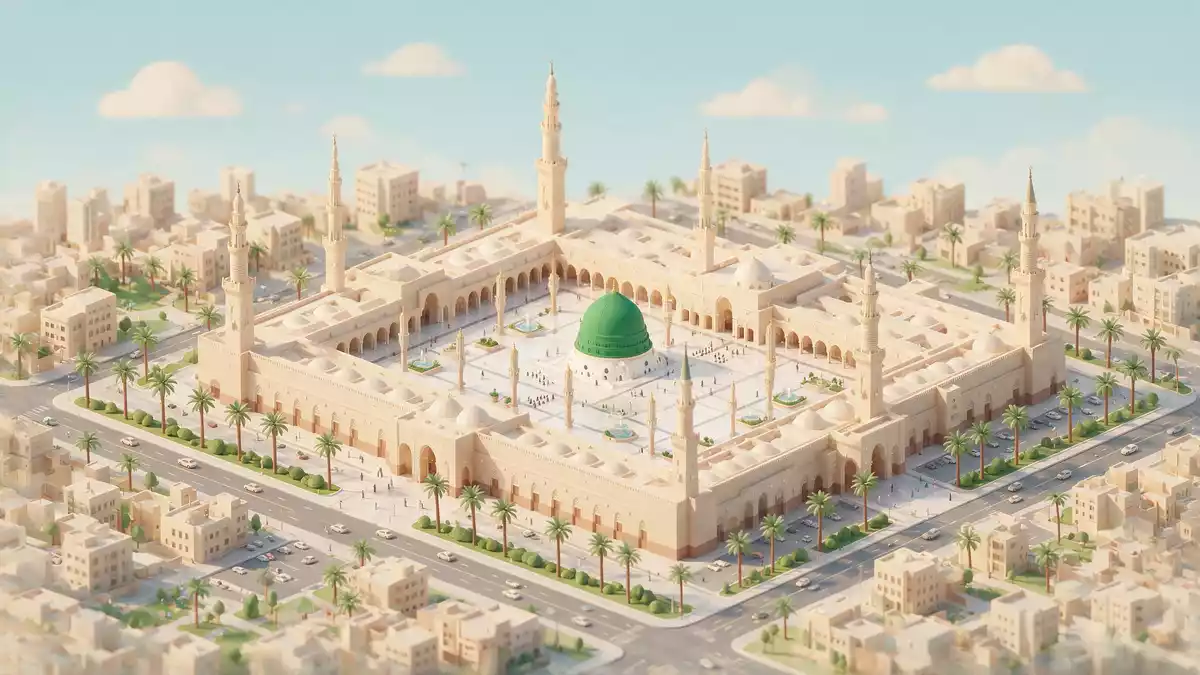
Al-Masjid an-Nabawi in Medina, known in English as the Prophet’s Mosque, began as a modest courtyard beside the house of Prophet Muhammad in 622 CE and has grown into a vast sanctuary of prayer halls, courtyards and domes built around his resting place.
From courtyard mosque to multi-layered sanctuary
The story of Al-Masjid an-Nabawi starts with the Hijra, Muhammad’s migration to Medina in 622 CE, when the first mosque was established beside his dwelling using mud-brick walls, palm-trunk columns and a roof of palm leaves around an open courtyard.first mosque was established In this early form it functioned as both place of worship and communal meeting space, with an enclosure that reflected the materials of an oasis town in the Arabian Peninsula.
Early expansions under the Rashidun caliphs Umar and Uthman replaced some of these elements with stone and plaster, enlarged the courtyard and introduced more durable timber, creating a more permanent architectural frame for the growing Muslim community.expansions under Umar and Uthman In the early eighth century, during the reign of the Umayyad caliph al-Walid I, the mosque gained a hypostyle prayer hall and corner minarets, marking one of the first major transformations from the original courtyard form.Umayyad hypostyle prayer hall
Architectural layers: Abbasid, Ottoman and Saudi eras
Later Abbasid works extended the northern side of Al-Masjid an-Nabawi and organised the interior into rows of columns and arches, strengthening the impression of a mosque built in successive architectural layers.Abbasid works extended the northern side Mamluk and Ottoman interventions added further domes, refined the arcades and introduced decorative programmes of geometric and calligraphic ornament that still give the mosque much of its visual character.
Within this layered complex lies the burial chamber of Muhammad and the tombs of the first two Rashidun caliphs, Abu Bakr and Umar, integrated into the mosque after early expansions.burial chamber of Muhammad, Abu Bakr and Umar Above this area rises the Green Dome, a distinctive landmark whose form is associated with works from the thirteenth century Mamluk period and subsequent restorations.Green Dome associated with Mamluk period
Courtyards, domes and prayer halls
Walking through Al-Masjid an-Nabawi, the most striking impression is of a complex built around expansive courtyards, marble floors and long arcades of columns supporting pointed arches, with domes rising above the main prayer halls.expansive courtyards and domes The overall layout reflects centuries of enlargement from an original rectangular enclosure into a broad complex that occupies a significant part of central Medina.
The mosque is regarded within Islamic tradition as the second holiest mosque after Masjid al-Haram in Mecca and serves as a central focus for worshippers visiting Medina.second holiest mosque Its combination of historical layers, from mud-brick origins to stone, plaster and marble surfaces, makes Al-Masjid an-Nabawi a key reference point for later mosque architecture across the Islamic world.model for later Islamic architecture
Visiting Al-Masjid an-Nabawi: what travellers from Western Europe should know
- Al-Masjid an-Nabawi stands in central Medina in the Hejaz region of Saudi Arabia and is reached from the city’s wider street network that converges on the mosque’s surrounding plazas.
- Within the complex, prayer halls and courtyards are connected by broad marble surfaces with steps at certain transitions, and interior movement often follows the lines of columns and arcades.
- The mosque lies within a wider district that includes associated facilities and accommodation, with the building’s domes and minarets visible from many surrounding streets in Medina.
- The official language is Arabic and the currency is the Saudi riyal.
- Entry requirements depend on your nationality; UK travellers can check the FCDO travel advice at gov.uk/foreign-travel-advice, Irish travellers the Department of Foreign Affairs at ireland.ie.
Searching for Al-Masjid an-Nabawi on social platforms
These links open searches for Al-Masjid an-Nabawi on each platform.
Frequently asked questions about Al-Masjid an-Nabawi
Where is Al-Masjid an-Nabawi and what is its religious status?
Al-Masjid an-Nabawi stands in Medina in the Hejaz region of Saudi Arabia and is regarded as the second holiest mosque in Islam after Masjid al-Haram in Mecca.
What can visitors expect when entering the mosque complex?
Visitors encounter large courtyards and prayer halls with marble floors, arcades of columns, domes above the main spaces and a complex shaped by successive historical expansions.
What makes Al-Masjid an-Nabawi architecturally distinctive?
Its layered architecture, from the mud-brick courtyard of 622 CE to Umayyad, Abbasid, Mamluk, Ottoman and Saudi-era elements, creates a sanctuary where multiple periods of Islamic design coexist.


