
Al-Masjid an-Nabawi in Medina: mosque, city and sanctuary
Published on 08/16/2026 at 14:52 | Editorial responsibility: Rafael Müller, Editor-in-Chief AD HOC NEWS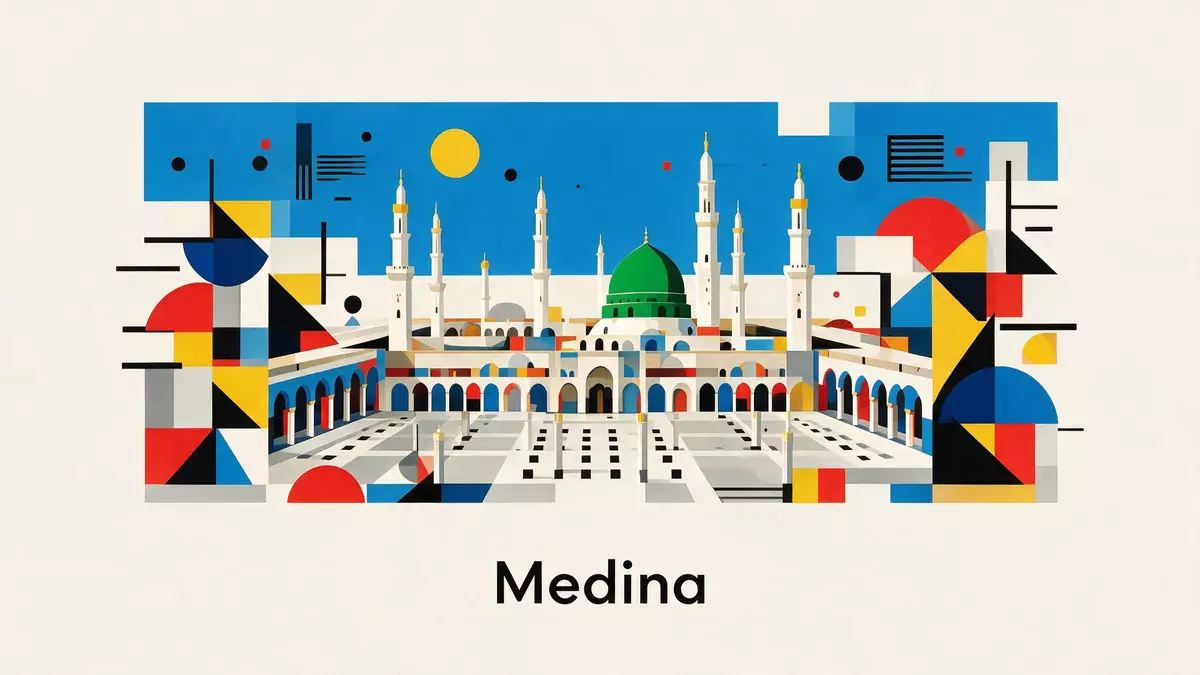
Al-Masjid an-Nabawi in Medina is the second holiest mosque in Islam after Masjid al-Haram in Mecca, and it has grown into a vast sanctuary embedded in the urban fabric of the city.second holiest mosque in Islam Built by the Prophet Muhammad in 622 CE following the Hijra, it began as a modest courtyard and has been reshaped across fourteen centuries of Islamic history.built by the Prophet Muhammad in 622 CE
A courtyard that became a city’s centre
When Muhammad arrived in Medina in 622 CE, he established Al-Masjid an-Nabawi on a rectangular plot near his dwelling, defining a simple enclosure with mud-brick walls and palm-trunk columns around an open courtyard.mud-brick and palm-trunk enclosure That early mosque functioned simultaneously as a place of prayer, a meeting hall, a teaching space and a seat of governance, tying spiritual life directly to the daily workings of the nascent Muslim community.place of worship and community centre
Successive caliphs and dynasties extended Al-Masjid an-Nabawi as Medina grew. In the seventh century, expansions under the Rashidun and Umayyad rulers replaced parts of the original fabric with stone walls, more durable columns and a timber roof, preserving the courtyard layout while increasing covered space.Rashidun and Umayyad expansions Later additions under Mamluk and Ottoman rule introduced decorative programmes such as glass mosaics and inscriptions, linking the Medina mosque visually to other major Islamic monuments of their periods.Mamluk and Ottoman expansions
The Green Dome and the Rawdah
Among the most recognisable features of Al-Masjid an-Nabawi is the Green Dome above the burial chamber of Muhammad, Abu Bakr and Umar.Green Dome above the tomb chamber The dome’s structure traces back to Mamluk interventions in the thirteenth century, while its present green colour dates to 1837 during the reign of Ottoman sultan Mahmud II, giving Medina a visual emblem that appears in countless representations of the city.dome built and painted under Mamluk and Ottoman rulers
Inside the mosque, the Rawdah ash-Sharifah, also known as Riyad-ul-Jannah or “Garden of Paradise”, occupies the area between the historic minbar and the tomb chamber.Rawdah ash-Sharifah between minbar and tomb Distinguished by its patterned carpet and dense arrangement of columns, this zone reflects a long tradition of reverence and marks a specific part of the interior where architecture and devotional memory are closely intertwined in the spatial organisation of the mosque.Rawdah ash-Sharifah as a marked interior area
A modern complex around historic cores
The present Al-Masjid an-Nabawi complex extends over a large area of Medina, integrating the historic nucleus with extensive prayer halls and courtyards framed by colonnades and minarets.large complex of halls and courtyards Major twentieth-century and later Saudi expansions introduced reinforced-concrete structures, additional levels and wide external plazas, creating a layered site where early mud-brick origins sit within an environment of polished stone, patterned flooring and controlled lighting.Saudi-era expansions with new structural systems
A notable feature of the contemporary mosque complex is its field of large umbrellas in the surrounding courtyard spaces, forming a rhythm of slender columns and fabric canopies that define shaded outdoor prayer areas. Within, rows of arches and pillars segment the interior into bays, while the cluster of minarets marks the mosque’s perimeter against the skyline of central Medina. Together these elements create a setting where historic rooms, tomb chamber and Rawdah sit within an extensive architectural frame designed to accommodate prayer in many directions.
Visiting Al-Masjid an-Nabawi: what travellers from Western Europe should know
- Al-Masjid an-Nabawi stands in the central Haram district of Medina in western Saudi Arabia, and the city is served by Prince Mohammad bin Abdulaziz International Airport.
- The mosque complex covers a broad area of paved courtyards and interior halls, and movement within it involves crossing large open squares and ascending or descending steps between levels.
- The city of Medina is surrounded by the Hejaz landscape of volcanic hills and plains, and some of these dark rocky elevations are visible from the mosque’s outer courtyards.
- The official language is Arabic and the currency is the Saudi riyal.
- Entry requirements depend on your nationality; UK travellers can check the FCDO travel advice at gov.uk/foreign-travel-advice, Irish travellers the Department of Foreign Affairs at ireland.ie.
Searching for Al-Masjid an-Nabawi on social platforms
These links open searches for Al-Masjid an-Nabawi on each platform.
Frequently asked questions about Al-Masjid an-Nabawi
Where is Al-Masjid an-Nabawi located?
Al-Masjid an-Nabawi is located in Medina, in the Hejaz region of western Saudi Arabia, occupying the city’s central Haram district.
What should a visitor expect on a visit to Al-Masjid an-Nabawi?
A visitor encounters an extensive mosque complex of interior halls and paved courtyards, with historic areas such as the Green Dome and the Rawdah embedded within modern structures.
What makes Al-Masjid an-Nabawi distinctive among mosques?
Al-Masjid an-Nabawi is distinctive as the mosque founded by the Prophet Muhammad, as the second holiest site in Islam, and through features such as the Green Dome and the Rawdah ash-Sharifah.


