
Alcatraz Island: a rocky fortress in San Francisco Bay
Published on 08/25/2026 at 19:50 | Editorial responsibility: Rafael Müller, Editor-in-Chief AD HOC NEWS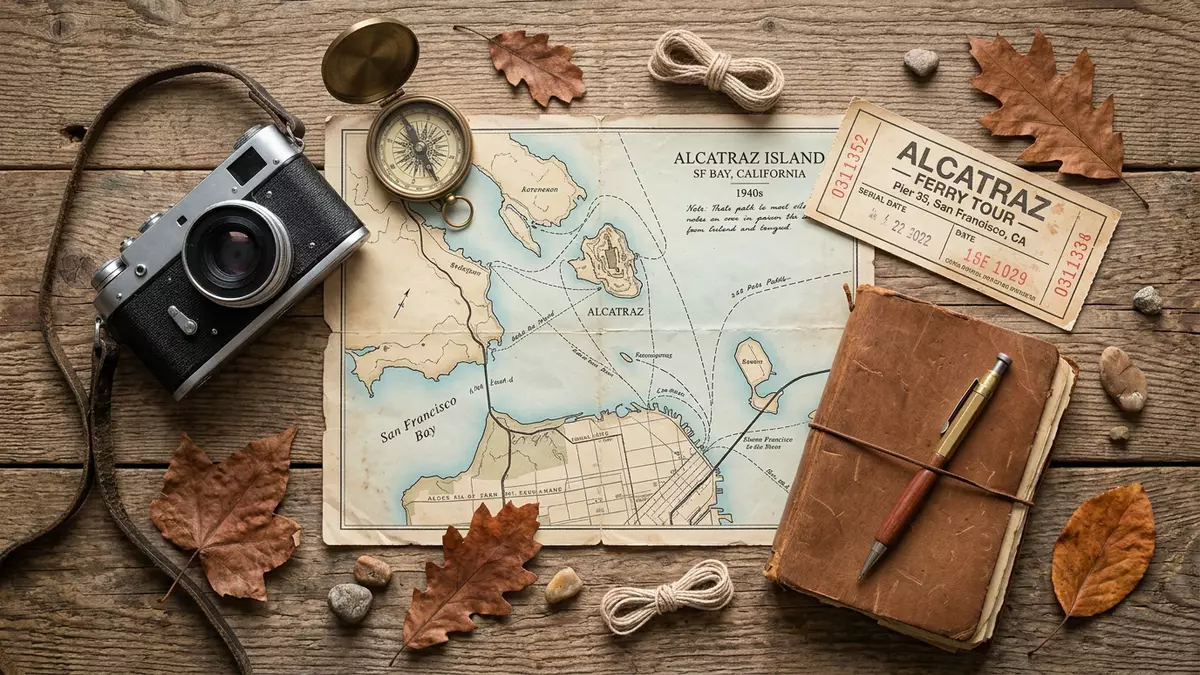
Alcatraz Island is a rocky outcrop in San Francisco Bay where massive masonry from the nineteenth century meets the concrete remains of a twentieth-century federal prison. Set apart from the city by cold water and strong tidal currents, the island became a fortified outpost in the 1850s and later housed Alcatraz Federal Penitentiary between 1934 and 1963, before entering the Golden Gate National Recreation Area in 1972 as a historic site.
A rocky island turned fortress and prison
Alcatraz Island occupies about 22 acres (9 hectares) in the centre of San Francisco Bay, lying roughly 2 km (1.5 miles) offshore from the city’s waterfront. The outcrop is steep-sided and largely composed of hard rock, with only thin soils that made early descriptions emphasise its bare, windswept character.22 acres in the centre Spanish naval officer Juan Manuel de Ayala mapped the bay in 1775 and applied the name “La Isla de los Alcatraces”, a reference to pelicans and other seabirds that gathered on the island.Spanish explorer Juan Manuel de Ayala
In 1850, President Millard Fillmore reserved Alcatraz for military use, and the U.S. Army began turning the bare rock into a fortress overlooking the approaches to the harbour.President Millard Fillmore reserved Alcatraz The Army installed heavy artillery and built a citadel on the island’s summit, while adding a lighthouse that went into service in 1854 as the first operational lighthouse on the Pacific coast.first lighthouse on the Pacific coast Shortly afterwards, the Guard House and other masonry structures turned Alcatraz into a military prison that served the Army from the late 1850s through to 1933.
Alcatraz Federal Penitentiary: concrete, cells and corridors
After more than seventy years as a military reservation, jurisdiction over Alcatraz shifted to the U.S. Department of Justice in the early 1930s, and the island was rebuilt as Alcatraz Federal Penitentiary.transferred to the Department of Justice The prison operated from 1934 to 1963 as a maximum-security facility for inmates considered difficult to manage elsewhere, among them figures such as Al Capone and other organised crime leaders.federal prison from 1934 to 1963 The main cellhouse, built in reinforced concrete atop the old fortress works, contained long rows of narrow cells separated by central corridors, while ancillary buildings housed workshops, a dining hall and administration offices.
Cold water and strong tidal currents around Alcatraz made the island an isolated environment, and escape attempts helped cement its reputation in American prison history.strong tidal currents and cold water temperatures Military prisoners had worked on earlier masonry, and later inmates were involved in constructing and maintaining parts of the penitentiary complex, creating a layered landscape where granite walls, concrete blocks and steel bars lie side by side.constructed by military prisoners between 1909 and 1911 When the prison closed in March 1963, the structures were left to weather in the marine environment, giving the island the worn, exposed surfaces that visitors see.
From military outpost to national recreation area
Beyond the prison years, Alcatraz Island has a broader twentieth-century story that includes protest and conservation. From November 1969 to June 1971, a group of Native American activists known as Indians of All Tribes occupied the island, using it as a symbolic centre for claims to sovereignty and land rights.Indians of All Tribes occupation Their presence left traces in the form of painted slogans and altered spaces that sit among the military and prison remains.
In 1972, Alcatraz became part of the newly created Golden Gate National Recreation Area, and the site opened to the public in 1973 as a historic landmark under the National Park Service.added to Golden Gate National Parks Weathered brickwork, rusting steel and concrete façades frame views across the bay to San Francisco and the Golden Gate, while the old lighthouse continues to operate as a navigational aid. Paths lead past the former parade ground, residential quarters and service buildings, and over time vegetation has taken root in corners of the island where seabirds once had almost exclusive use.open to the public and a tourist destination
Visiting Alcatraz Island: what travellers from Western Europe should know
- Alcatraz Island lies in San Francisco Bay north of the city’s waterfront, reached by boat services that cross from piers along the Embarcadero district.
- The island rises steeply from the water, and visiting involves walking on sloping roads and stairways between the landing, the cellhouse and the higher former military structures.
- The surrounding bay is open to wind and fog, so clothing that protects against damp conditions is important on the exposed paths and terraces around the buildings.
- English is the official language and the currency is the United States dollar.
Searching for Alcatraz Island on social platforms
These links open searches for Alcatraz Island on each platform.
Frequently asked questions about Alcatraz Island
Where is Alcatraz Island located?
Alcatraz Island is in San Francisco Bay, California, occupying a rocky area of about 22 acres (9 hectares) roughly 2 km (1.5 miles) offshore from the city.
What can visitors expect on a visit to Alcatraz Island?
Visitors encounter weathered military masonry, the concrete cellhouse and associated prison buildings, steep paths up from the landing and wide views across the bay and city skyline.
What makes Alcatraz Island distinctive among historic sites?
The combination of a nineteenth-century coastal fortress, a twentieth-century maximum-security federal prison and traces of Native American protest, all on a compact offshore rock, gives Alcatraz Island its distinctive layered character.


