
Alcazaba de Malaga and its layered palace-fortress design
Published on 09/23/2026 at 22:54 | Editorial responsibility: Rafael Müller, Editor-in-Chief AD HOC NEWS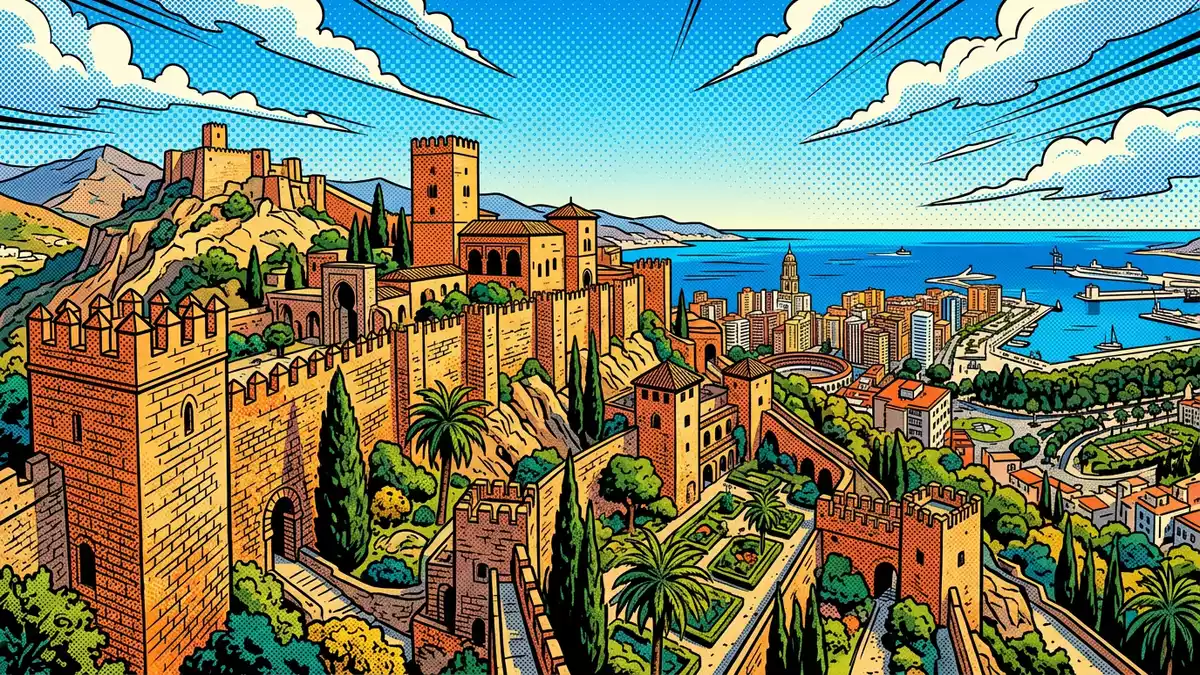
Alcazaba de Malaga rises above Malaga’s historic centre as a palace-fortress of walls, towers, courtyards and gardens. Its visible character comes from the meeting of military construction and carefully ordered residential spaces. The complex was built in the eleventh century under Badis, the Zirid ruler of Granada, and its terraces remain closely connected with the city and the bay.
Alcazaba de Malaga: a fortress arranged as a palace
The name alcazaba comes from the Arabic al-qasbah, meaning citadel or urban fortress. At Malaga, the term describes a fortified complex with administrative, residential and defensive functions. Its position above the old city places ramparts, gateways and watchtowers beside rooms decorated with arches, plasterwork and geometric tiles.
The earliest major phase belongs to the eleventh century. The construction between 1057 and 1063 is associated with Badis, the Berber Taifa king of Granada. The date places Alcazaba de Malaga within the Taifa period, when Muslim-ruled territories in Iberia were governed by competing dynasties after the fragmentation of the Caliphate of Cordoba.
Badis is also associated with the rebuilding and strengthening of the fortification. The walls follow the rising ground, while gates, towers and crenellated sections create a sequence of protected spaces. The route through the outer defences leads towards the palatial areas, where the architecture changes from heavy military surfaces to courtyards, gardens and water channels.
From Hammudid beginnings to Nasrid courtyards
The Hammudid dynasty began the palatial area of the complex. Its rulers governed Malaga during the early eleventh century, and the palace precinct became a seat of power within the fortified enclosure. The surviving architecture reflects several periods rather than a single uninterrupted building campaign.
Almohad and Nasrid rule brought further changes. Malaga entered the Nasrid kingdom in 1279 under Muhammad II Ben al-Ahmar, and the Nasrid period added architectural details associated with Islamic palace design. Rectangular courtyards, planted areas, plaster decoration and water features form the clearest contrast with the defensive walls.
The Alcazaba’s Taifa-period origins remain visible in the relationship between its early walls and later palace spaces. The complex also connects with Castillo de Gibralfaro through a fortified passage known as the coracha. That link extends the defensive landscape up the hillside, while the Alcazaba itself occupies the lower position beside the historic city.
Inside the palace precinct, patterned tilework, carved plaster and shaded arcades frame the courtyards. Water appears in channels, basins and garden features. These elements belong to the visual language of Andalusi architecture, where enclosed outdoor rooms sit alongside halls and fortified passages.
Walls, gardens and the Roman theatre below
Alcazaba de Malaga is closely associated with the Roman Theatre at the foot of the hill. Stone elements from earlier buildings appear within parts of the fortress, including columns and carved architectural pieces. The relationship between the two monuments places Roman and Islamic remains within the same urban landscape.
The lower position of the Roman Theatre and the elevated Alcazaba create a visible sequence from ancient civic architecture to medieval military and palatial construction. The fortress walls rise above Calle Alcazabilla, while the city centre extends around the monument. From upper terraces, views reach across Malaga and towards the bay.
The complex covers both military and residential areas. Its ramparts include watchtowers, arrow slits and crenellated walls, while the inner spaces contain courtyards and garden rooms. The military and civilian areas occupy different parts of the enclosure, giving the site its characteristic double identity.
After the Christian conquest of Malaga in 1487, the complex continued as a residence for Christian officials. Its role changed within the city, while the walls and palace structures remained. Restoration in the twentieth century returned courtyards, gardens and architectural details to the centre of the visitor experience.
Visiting Alcazaba de Malaga: what travellers from Western Europe should know
- Alcazaba de Malaga stands on Calle Alcazabilla beside Malaga’s historic centre. The Roman Theatre lies directly below the fortress, and Castillo de Gibralfaro occupies the higher hillside beyond the coracha.
- The route includes sloping passages, stairs, gateways and uneven historic surfaces. The complex rises above the city, with the upper walls reached through a sequence of enclosed defensive spaces.
- The official language is Spanish and the currency is the euro.
- The site forms part of Malaga’s historic monument landscape, with palace courtyards, gardens and fortified walls occupying the same enclosure.
Searching for Alcazaba de Malaga on social platforms
These links open searches for Alcazaba de Malaga on each platform.
Frequently asked questions about Alcazaba de Malaga
Where is Alcazaba de Malaga?
It stands beside Calle Alcazabilla in Malaga’s historic centre. The Roman Theatre is below the fortress, while Castillo de Gibralfaro rises above it.
What can visitors see there?
The complex contains fortified walls, towers, gateways, palace rooms, courtyards, gardens, water features and views across Malaga and the bay.
What makes the complex distinctive?
Alcazaba de Malaga combines an eleventh-century Taifa fortress with later Nasrid palace architecture. Military walls and landscaped courtyards occupy the same historic enclosure.


