
Alcazaba de Malaga, the hilltop Moorish citadel above the port
Published on 09/17/2026 at 15:35 | Editorial responsibility: Rafael Müller, Editor-in-Chief AD HOC NEWS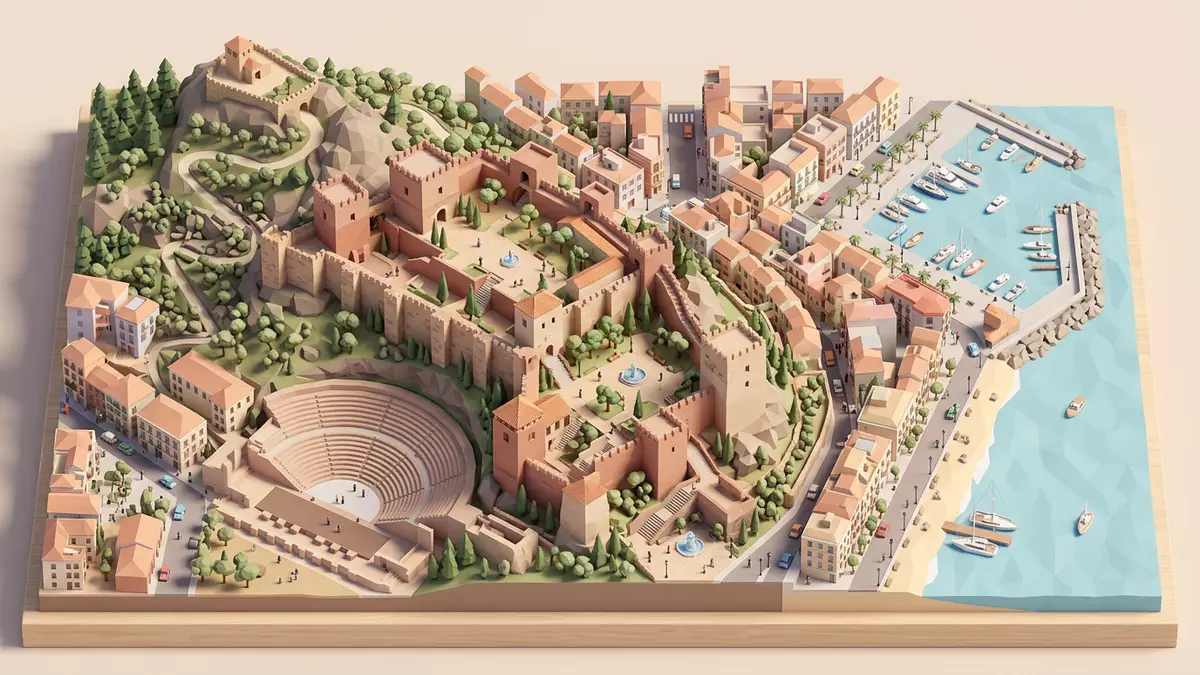
Alcazaba de Malaga is a Moorish fortress-palace on the hillside above Malaga’s historic centre, tying the city’s medieval past to the modern harbour below. Built in the eleventh century on earlier fortifications, it combines defensive walls with garden courtyards and palace rooms that look over the Mediterranean and the roofs of Andalusia’s port city.
A citadel shaped by Al-Andalus on Mount Gibralfaro
Alcazaba de Malaga occupies the western slope of Mount Gibralfaro, on elevated ground beside Malaga’s old town and the broad avenue of the Paseo del Parque. Its name derives from the Arabic term “al-qa?aba”, meaning an urban fortress or citadel, reflecting its role as a fortified seat of power in Muslim-ruled Al-Andalus.urban fortress or citadel The complex forms a prominent walled enclosure on the seaward side of the hill, with ramparts that once tied into the broader defensive system of the city.
The structure that visitors see is largely a product of the eleventh century and the later Nasrid period, when Muslim dynasties consolidated Malaga’s role as a coastal stronghold. Construction of the main Alcazaba complex began after 1021 under the Hammudid dynasty,Hammudid dynasty and sources from Malaga’s municipal authorities place key building phases between 1057 and 1063 under Badis ben Habus, the Berber ruler associated with the Taifa of Granada.between 1057 and 1063 Later, in the fourteenth century, Nasrid rulers such as Muhammad II and Yusuf I strengthened and refined the fortress, integrating it more closely with the Castle of Gibralfaro higher on the hill.
Walls, towers and the palace inside the fortress
The outer impression of Alcazaba de Malaga is of massive stone walls and towers climbing the hillside, arranged in successive defensive rings. Barlong towers and fortified gateways punctuate the enclosure in the tradition of western Islamic military architecture, creating multiple lines of defence between the city below and the inner palace.barlong towers and fortified gateways A zigzagging entrance route runs through courtyards and gates, turning the climb into a sequence of enclosed spaces rather than a single straight approach.
Within the ramparts, the Alcazaba contains both military and civilian zones. The complex covers over 14,000 m² in total, with a substantial portion occupied by buildings divided between residential quarters and defensive structures.covers an area of 14,200 m² Palatial rooms cluster around garden courtyards that echo the architecture of the Alhambra in Granada, including arcaded porticoes, pools and patterned pavements. Columns, capitals and carved stone elements drawn from the nearby Roman theatre appear in walls and doorways, a reuse of classical material that ties the Alcazaba visually to the older ruins at its foot.
From Moorish stronghold to restored monument
For centuries Alcazaba de Malaga served as the political-administrative centre of the city under Muslim rule, housing governors and officials at the eastern end of Malaga’s walled enclosure.political-administrative centre The fortress lived through successive dynasties, from the Almoravids and Almohads to the Nasrid kingdom, each leaving architectural traces in repairs, additions and decorative refinements across the hill.
In 1487 Ferdinand II of Aragon and Isabella I of Castile captured Malaga after a long siege, raising their standard on the Alcazaba’s Torre del Homenaje and bringing the citadel under Christian control.captured Malaga after a long siege Later centuries brought earthquakes, naval bombardments and gradual neglect, and parts of the complex were adapted as a prison, hospital and housing. Systematic restoration began in the 1930s under architect Leopoldo Torres Balbás, who supervised archaeological work and the recovery of walls, gardens and palace structures so that the Alcazaba could stand as a protected monument of Spain’s Islamic heritage.restoration began in the 1930s
Visiting Alcazaba de Malaga: what travellers from Western Europe should know
- Alcazaba de Malaga rises above the eastern edge of Malaga’s historic centre, close to the harbour and the Roman theatre, and is reached on foot from the surrounding streets.
- The approach within the fortress involves sloping paths, stepped ramps and stairways that climb between gateways and courtyards across the hillside.
- The site stands beside the remains of Malaga’s Roman theatre, and the Castle of Gibralfaro crowns the hill further up, linked to the Alcazaba by historic defensive walls.
- The official language is Spanish and the currency is the euro.
Searching for Alcazaba de Malaga on social platforms
These links open searches for Alcazaba de Malaga on each platform.
Frequently asked questions about Alcazaba de Malaga
Where is Alcazaba de Malaga located?
Alcazaba de Malaga stands on the hillside of Mount Gibralfaro beside Malaga’s historic centre in southern Spain, overlooking the harbour and the Roman theatre.
What should visitors expect inside the Alcazaba?
Visitors encounter stone walls, towers, gateways and garden courtyards, along with palace rooms that show Islamic architectural elements and reused Roman stonework.
What makes Alcazaba de Malaga distinctive among Spanish fortresses?
Alcazaba de Malaga combines a compact Moorish citadel and palace with extensive defensive walls on a coastal hill, closely linked to the Castle of Gibralfaro above.


