
Alcazar de Segovia, a royal fortress above Segovia’s rivers
Published on 09/21/2026 at 22:37 | Editorial responsibility: Rafael Müller, Editor-in-Chief AD HOC NEWS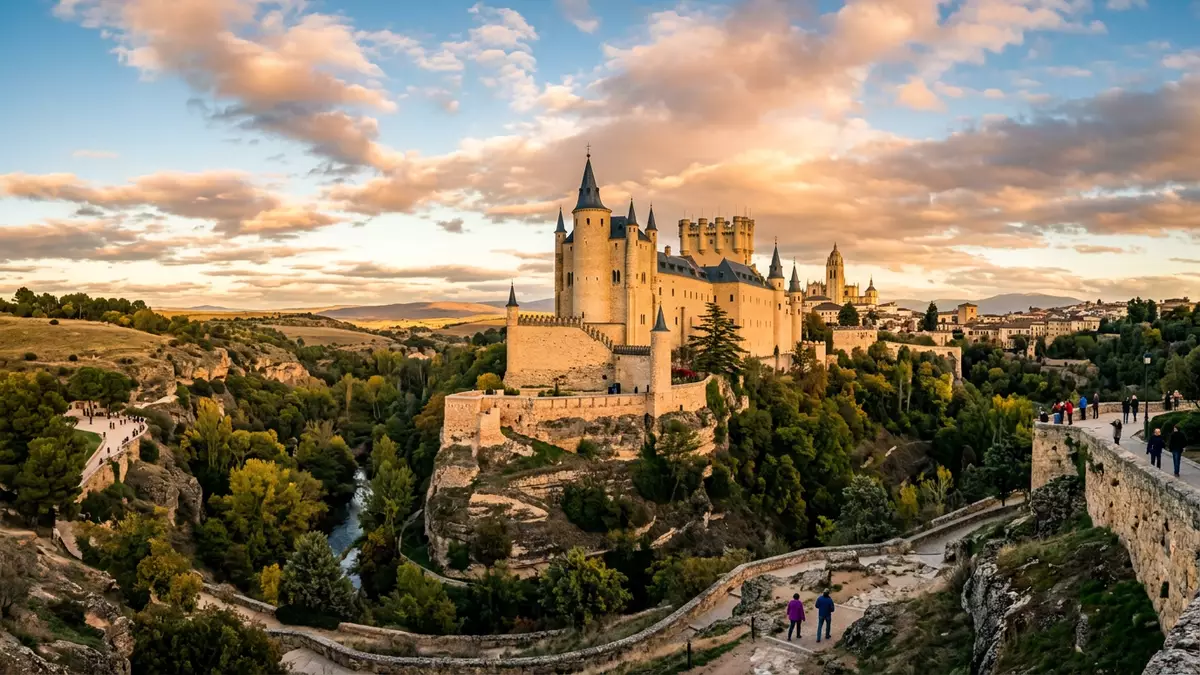
Alcazar de Segovia is a stone fortress and former royal palace that crowns a rocky spur at the western edge of Segovia’s historic centre in Spain, where two river valleys meet. Rising above the old town, which was inscribed as a UNESCO World Heritage site in 1985, the castle’s towers and slate roofs give the skyline a distinctly mediaeval profile that signals Segovia’s long role in the history of Castile.UNESCO World Heritage site
A fortress turned royal residence
The fortress stands on a narrow rocky promontory above the confluence of the Eresma and Clamores rivers, a site that gives the Alcazar a natural defensive position and a striking relationship with the surrounding landscape.rocky crag above the confluence Christian records from the twelfth century refer to a castle and “Alcázar” at this location, and by the high Middle Ages it had become one of the principal fortified residences of the monarchs of Castile.twelfth-century references to the Alcazar
Archaeological interpretations point to possible Roman and Islamic phases on the site before the mediaeval stone castle, but the documented development as a royal fortress dates from the twelfth century onwards.probable Roman and Islamic foundations Over the centuries it served as a fortress and palace, guarding the approaches to Segovia while housing the royal court, and later as a state prison and an artillery college before taking on its present role as a historic monument and military archive building.palace, prison and military academy
Mediaeval masonry and slate-roofed towers
Alcazar de Segovia is built largely in stone, combining Romanesque foundations with Gothic, Mudéjar and later Herrerian phases, so that different parts of the complex show distinct architectural languages.Romanesque, Gothic, Mudéjar and Herrerian elements Much of the basic fabric of the towers, curtain walls and principal rooms of state dates from the twelfth to fourteenth centuries, with later works shaping the profile that is visible from the town and valleys.twelfth to fourteenth-century structure
The castle’s plan divides into outer defensive works and an inner palace zone, where richly decorated halls reflect Gothic and Mudéjar craftsmanship alongside later royal interventions.divided into two nucleuses From the slate-roofed towers and battlements, views extend along the Eresma valley and across Segovia’s old town, linking the Alcazar visually with other landmarks such as the city’s Roman aqueduct and the cathedral, even though each occupies its own distinct hilltop or slope.cliff-top location above Segovia
Castilian monarchy and a changing role
Monarchs of Castile made Alcazar de Segovia one of their favoured residences in the Middle Ages, and royal patrons including Alfonso VIII and later rulers of the Trastámara dynasty oversaw significant building campaigns that shaped much of the castle visible today.Alfonso VIII and Trastámara monarchs Within its halls, the structure functioned both as a fortress securing western approaches to Madrid and Toledo and as a setting for court life, ceremonies and government during the Middle Ages and early modern period.residence and key fortress of Castile
After the royal court shifted its primary seat to Madrid in the seventeenth century, the Alcazar’s role changed, and its secure stone construction made it suited to functions such as a state prison and later a military academy and artillery college.state prison and artillery college In the twentieth century it took on its present role as a historic monument housing museum spaces and military archives, continuing the link between Segovia’s castle and the armed forces while opening its mediaeval architecture to visitors.museum and military archives building
Visiting Alcazar de Segovia: what travellers from Western Europe should know
- Alcazar de Segovia rises at the western tip of Segovia’s old town in Castile and León, Spain, above the meeting point of the Eresma and Clamores river valleys.
- The fortress sits on a rocky spur with approaches that involve walking on sloping streets and navigating interior staircases and tower climbs within the castle.
- Segovia is connected to Madrid by rail, and from the city the Alcazar is reached on foot or by road up to the promontory overlooking the rivers.
- The official language is Spanish and the currency is the euro.
Searching for Alcazar de Segovia on social platforms
These links open searches for Alcazar de Segovia on each platform.
Frequently asked questions about Alcazar de Segovia
Where is Alcazar de Segovia located?
Alcazar de Segovia stands on a rocky spur at the western end of Segovia’s old town in Castile and León, Spain, above the Eresma and Clamores rivers.
What can visitors expect at Alcazar de Segovia?
Visitors encounter a mediaeval stone castle with fortified walls, slate-roofed towers, historic halls and views along the river valleys and across Segovia’s historic centre.
What makes Alcazar de Segovia distinctive among Spanish castles?
Its position above two rivers, role as a royal fortress of Castile and combination of Romanesque, Gothic, Mudéjar and Herrerian architecture give Alcazar de Segovia a distinctive profile.


