
Alcazar de Segovia and its stone towers above Segovia
Published on 09/24/2026 at 04:47 | Editorial responsibility: Rafael Müller, Editor-in-Chief AD HOC NEWS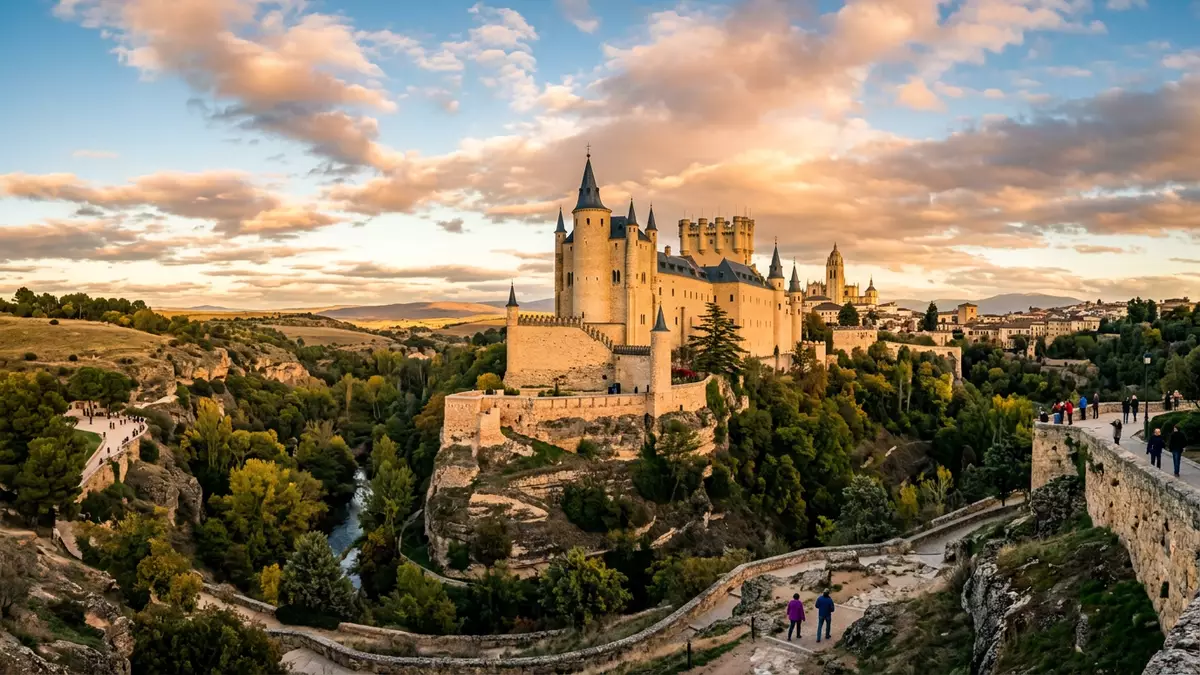
Alcazar de Segovia rises on a rocky promontory between the Eresma and Clamores rivers. Its medieval stone walls, steep slate roofs and pointed towers create a sharply recognisable silhouette above Segovia.
Alcazar de Segovia between two river valleys
The castle occupies the western edge of Segovia’s historic city, where the two river valleys meet below the rock. A deep moat and drawbridge mark the approach, while the outer walls enclose a complex shaped by royal, military and educational uses.
The first documentary references belong to the twelfth century. Alfonso VIII used the fortress as a royal residence, and the building became an Alcázar in the thirteenth century. Its position above the rivers remains part of its physical character, with the rock, moat and towers forming a connected defensive setting.
From medieval fortress to Gothic royal residence
Alcazar de Segovia acquired its Gothic appearance during the reigns of John II and Henry IV. The interior brings together halls, chapels, courtyards, coffered ceilings, friezes and painted altarpieces.
The Sala de Reyes contains a gilded coffered ceiling and a frieze with seated polychrome figures representing rulers of Asturias, León and Castile. Other named rooms include the Sala de Ajimeces, the Galera, the Throne Room, the Chapel and the Cámara Regia.
Pointed towers and Castilian history
The tower of John II reaches 80 metres (262 ft) and carries sgraffito decoration with turrets around its structure. The smaller tower of Alfonso X is associated with Alfonso X the Wise, whose name remains part of the castle’s architectural vocabulary.
Francisco de Mora completed the final architectural phase in 1587, with possible collaboration from Juan de Herrera. The building became the Royal College of Artillery in 1764, adding an educational chapter to its royal and military history.
A fire in 1862 caused severe damage to the interiors. Reconstruction began in 1882 during the reign of Alfonso XII, and the castle’s rooms contain restored ceilings, walls, friezes and religious artworks. In 1985, Segovia’s old town, including the Alcázar, received UNESCO World Heritage status.
Visiting Alcazar de Segovia: what travellers from Western Europe should know
- The Alcázar stands at Plaza de la Reina Victoria Eugenia in Segovia’s historic centre. It lies between the Eresma and Clamores rivers, near the Church of La Vera Cruz and the Pinarillo.
- The approach crosses a deep moat and drawbridge. The climb to the top of the John II Tower uses a steep, narrow spiral staircase.
- The upper tower provides views across Segovia, including San Marcos, Zamarramala and the surrounding river valleys.
- The official language is Spanish and the currency is the euro.
Searching for Alcazar de Segovia on social platforms
These links open searches for Alcazar de Segovia on each platform.
Frequently asked questions about Alcazar de Segovia
Where is Alcazar de Segovia?
It stands on a rocky promontory at the western edge of Segovia’s historic centre, between the Eresma and Clamores rivers.
What can visitors see inside?
The rooms include Gothic halls, the Sala de Reyes, the Chapel, the Throne Room, coffered ceilings, friezes and historic altarpieces.
What makes the castle distinctive?
Its distinctive form combines medieval stone walls with steep slate roofs, pointed towers, a moat and a royal palace interior.


