
Alcazar de Segovia, where fortress walls become a royal palace
Published on 08/16/2026 at 14:47 | Editorial responsibility: Rafael Müller, Editor-in-Chief AD HOC NEWS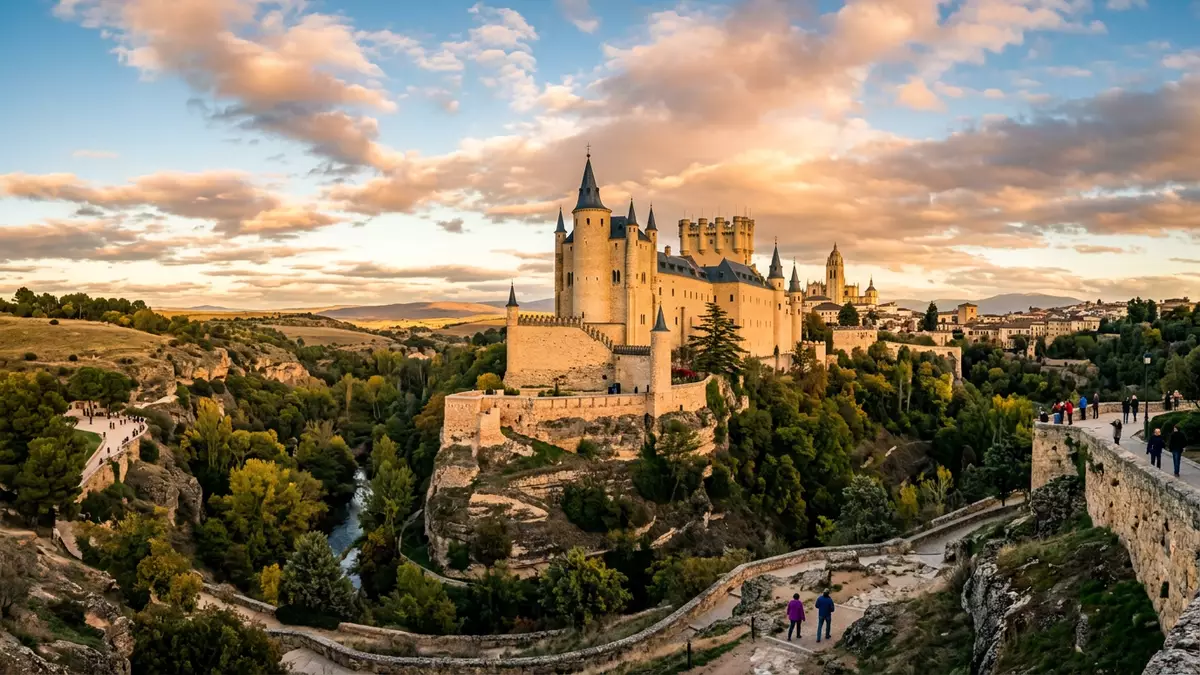
Alcazar de Segovia rises like a stone ship from the rocky tip of Segovia’s old town, its slate-roofed towers turning a medieval fortress into a theatrical royal residence that still frames the city’s skyline. Rooted in the twelfth century and reshaped under Castilian monarchs such as John II and Henry IV, it condenses centuries of Spanish history into one compact promontory.
A stone prow above two rivers
The castle occupies a narrow rocky spur at the western end of Segovia, high above the meeting point of the Eresma and Clamores rivers.The fortress stands between these waterways, with steep slopes dropping away from its walls and emphasising its role as a defensive stronghold as well as a residence. From many angles the plan reads as the prow of a ship, the tapered tip of the spur echoing the pointed arrangement of the outer walls.
Inside this outline, Alcazar de Segovia combines several architectural languages. The core fabric dates from the twelfth and thirteenth centuries, with Romanesque and Gothic elements in its great halls and curtain walls.Its documented history begins in twelfth century Christian records, where it appears as an established fortress of the Castilian crown. Later campaigns added Mudéjar decoration, with patterned plasterwork and timber ceilings showing the dialogue between Christian and Islamic craft traditions on the Iberian Peninsula.
From medieval fortress to royal residence
The site carries traces of earlier occupation, but the recognisable Alcazar emerges as a medieval castle under kings such as Alfonso VIII and Alfonso X in the thirteenth century.Alfonso VIII favoured the castle as a residence and Alfonso X created key ceremonial rooms, including halls that still frame dynastic imagery and coats of arms. These spaces underline the building’s double life as both hard-edged stronghold and courtly stage set.
Later, under the Trastámara dynasty, Alcazar de Segovia took on the profile many visitors recognise.John II and Henry IV oversaw works that gave the castle a more Gothic appearance, with a high tower and richly decorated interiors. In the sixteenth century, Philip II introduced the steep slate roofs and pointed spires that lend a central European flavour to the skyline, distinguishing the castle from the tiled roofs of Segovia below.These additions, designed by Francisco de Mora, define the present external silhouette.
A stage for the monarchy and the military
Alcazar de Segovia evolved in step with the Castilian and later Spanish monarchy. It functioned as a royal palace, overseeing territories from its elevated position, and hosted significant moments, among them the proclamation of Isabella as Queen of Castile in 1474.Isabella used the castle as a base when assuming the crown that led to the union with Aragon, binding the building to a turning point in Iberian politics. Within its walls, ceremonial halls, chapels and audience rooms illustrate the ritual of royal government.
The building’s uses extended beyond court life. From the eighteenth century Charles III installed the Royal College of Artillery in the Alcazar,turning parts of the palace into an educational and strategic military centre. After a major fire in the nineteenth century, the castle was reconstructed, and it now presents restored state rooms alongside an artillery museum and military archives.These institutions anchor the site’s role as both heritage monument and working repository of military history. As part of the Old Town of Segovia, the Alcazar forms a component of the UNESCO World Heritage listing granted in 1985.
Visiting Alcazar de Segovia: what travellers from Western Europe should know
- Alcazar de Segovia stands at the western tip of Segovia’s historic centre in central Spain, on a rocky headland above the Eresma and Clamores rivers.
- Approaching the castle from the old town involves an uphill walk over cobbled streets, and movement inside includes staircases and level changes within the towers and halls.
- Segovia lies on the northern Meseta plateau, where summers bring strong sunlight and winters can be cold, so conditions around the exposed ramparts and courtyards reflect continental inland weather.
- The castle forms part of the Old Town of Segovia ensemble, with the Roman aqueduct and the Gothic cathedral reachable on foot through the compact historic streets.
- The official language is Spanish and the currency is the euro.
Searching for Alcazar de Segovia on social platforms
These links open searches for Alcazar de Segovia on each platform.
Frequently asked questions about Alcazar de Segovia
Where is Alcazar de Segovia located?
Alcazar de Segovia stands on a rocky spur at the edge of Segovia’s historic centre in central Spain, high above the Eresma and Clamores rivers.
What can visitors expect inside the castle?
Visitors encounter fortified walls, courtyards, ceremonial halls with historic decoration, an artillery museum and military archives arranged within the restored palace-fortress.
What makes Alcazar de Segovia distinctive among Spanish castles?
Its combination of cliff-top setting, ship-like ground plan and slate-spired profile, shaped under rulers such as Henry IV and Philip II, gives the castle a recognisable silhouette.


