
Alhambra as a palatial hilltop city of Nasrid Granada
Published on 09/02/2026 at 22:11 | Editorial responsibility: Rafael Müller, Editor-in-Chief AD HOC NEWS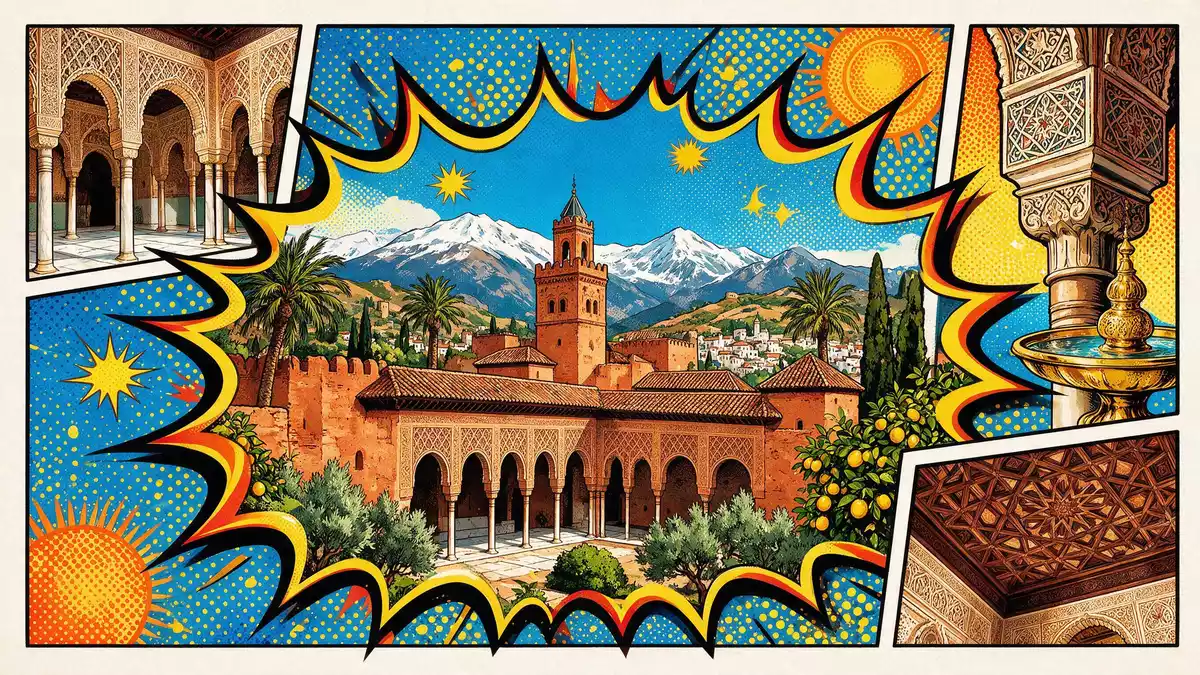
Alhambra crowns a hill above Granada as a self-contained palatial city, where Nasrid fortifications, royal courts and irrigated gardens form a continuous skyline from the thirteenth and fourteenth centuries.
A red fort on Sabika hill
Alhambra stands on Sabika hill to the west of central Granada, on a spur above the river Darro and facing the Albaicín district across the valley. The name Alhambra comes from the Arabic term al-Hamra, associated with the reddish tone of the hilltop walls and towers that dominate the view of this part of Andalusia. The complex reads from a distance as a continuous walled outline, with towers anchored on the edges of steep slopes that drop towards the city.
The medieval palatial city took shape under the Nasrid dynasty, the last Muslim rulers of the Emirate of Granada in al-Andalus, after Muhammad I ibn al-Ahmar began building the complex in 1238.began building the complex in 1238 In the fourteenth century, rulers such as Yusuf I and Muhammad V developed the Nasrid palaces with halls, courts and ornamental façades that defined the character of Alhambra.Yusuf I and Muhammad V In 1492 Ferdinand II of Aragon and Isabella I of Castile took Granada, and Alhambra became a royal residence within a Christian kingdom.took Granada in 1492
Nasrid palaces of carved stucco and patios
At the heart of Alhambra lie the Nasrid palaces, a sequence of courts and halls where stucco, carved wood and tilework cover walls and ceilings in dense patterns. The complex has three main palatial zones: the Mexuar, which served as the semi-public area for state affairs; the Comares Palace, with its throne hall in the Comares Tower; and the Palace of the Lions, which formed the more private residential area.three main palatial zones Courtyards such as the Court of the Myrtles and the Court of the Lions organise these palaces around long pools and colonnades, with arcades framing views to water and planted beds.
The interiors combine inscriptions, geometric motifs and stylised foliage into layered decorative bands, a characteristic expression of Nasrid art from the fourteenth century.characteristic expression of Nasrid art Above the palaces, delicate muqarnas vaults form honeycomb-like transitions between walls and domes in several halls, while carved wooden ceilings span reception rooms. The spaces reflect the status of Alhambra as a courtly environment, where rulers received envoys and managed the affairs of the Nasrid emirate within a walled city.
From Islamic palatine city to UNESCO site
Alhambra functioned in the Middle Ages as a palatine city, with its own walls, palaces, mosque, baths and service buildings distributed across the hilltop. After the conquest of Granada in 1492, the Catholic Monarchs used some of the Nasrid spaces as their residence, and Emperor Charles V initiated construction of a Renaissance palace within the complex in the sixteenth century.Renaissance palace within the complex This added a different architectural language to the site, with a circular courtyard set inside a square footprint, contrasting with the Nasrid palaces around it.
In 1984 Alhambra, together with the Generalife and the Albayzín district, entered the UNESCO World Heritage List as an outstanding example of Nasrid art in both architecture and decoration.entered the UNESCO World Heritage List The site preserves the layout of a medieval Islamic palatial city, while also recording later interventions from Spanish Renaissance and subsequent restoration campaigns. Its layered fabric shows how a fortress, royal court and symbolic seat of power from the thirteenth and fourteenth centuries continued in use under different rulers and regimes.
Visiting Alhambra: what travellers from Western Europe should know
- Alhambra stands above Granada on Sabika hill, west of the old centre, and is reached along roads that climb past the riverside and residential quarters up to the main access.
- The complex spreads across a hilltop with level differences between the Alcazaba, palaces and Generalife, and moving between them involves walking on sloping paths and staircases.
- The terrain includes historic paving, garden routes and fortified walls, so footwear suited to uneven stone and extended periods on foot is advisable for exploring the site.
- Granada lies in southern Spain, where the official language is Spanish and the currency is the euro.
Searching for Alhambra on social platforms
These links open searches for Alhambra on each platform.
Frequently asked questions about Alhambra
Where is Alhambra and what kind of place is it?
Alhambra is a walled palatial complex on Sabika hill in Granada, Spain, combining a fortress, royal palaces and associated buildings within one enclosed site.
What should a visitor expect on a visit to Alhambra?
A visit to Alhambra involves moving between an Alcazaba, Nasrid palaces, Renaissance courtyards and irrigated gardens, with long walks across uneven surfaces and changing levels.
What makes Alhambra distinctive among historic sites?
Alhambra combines a Nasrid palatine city from the thirteenth and fourteenth centuries with later Christian additions, all recognised together as a UNESCO World Heritage Site.


