
Alhambra in Granada: a hilltop city of palaces and water
Published on 09/07/2026 at 15:45 | Editorial responsibility: Rafael Müller, Editor-in-Chief AD HOC NEWS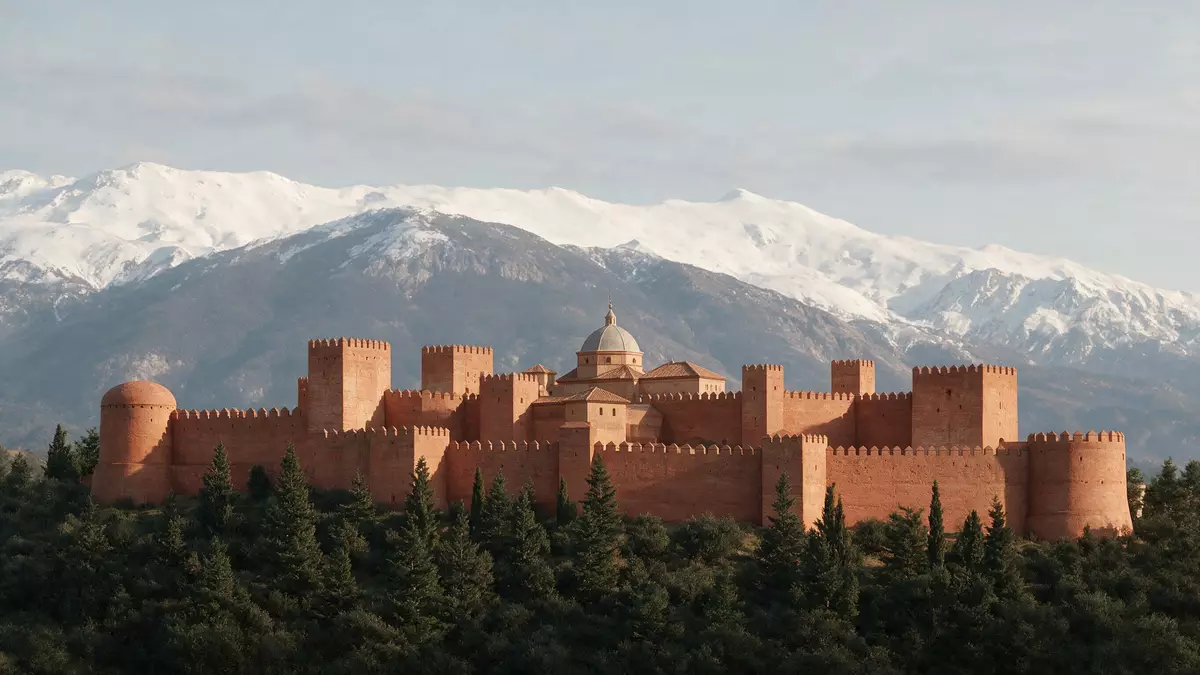
Alhambra rises above Granada as a self-contained palatine city, where fortified walls enclose Nasrid palaces, courtyards and gardens shaped around flowing water from the thirteenth and fourteenth centuries.
A Nasrid hilltop city above Granada
Alhambra occupies Sabika hill on the south-eastern edge of Granada, a terrace that falls towards the city while looking out to the Sierra Nevada mountains.Sabika hill The complex took form under the Nasrid dynasty, whose founder Muhammad I Ibn al-Ahmar secured the region in the 1230s and began his court complex on this site in 1238.Muhammad I Ibn al-Ahmar His successors continued to build over Sabika hill, turning an earlier fortress into a citadel with ramparts and towers that enclosed both military and residential zones.
By the fourteenth century, under rulers such as Yusuf I and Muhammad V, Alhambra had acquired the royal palaces that define much of its character.fourteenth-century palaces Within the walls, the complex was divided between the Alcazaba, a compact fortress area for guards and watchtowers, and the palatine city where rulers, courtiers and craftsmen lived and worked.Alcazaba and palatine city From outside, Alhambra reads as a single mass of stone above the lower town; once inside the gates, it opens into a sequence of courts, lanes and gardens that functioned as a miniature capital.
Nazrid palaces, water courts and carved stucco
Within the palatine city, the Nasrid Palaces form a chain of reception halls and courtyards where stucco, tilework and carved wood cover walls and ceilings almost continuously.Nasrid Palaces Geometry and calligraphy run across plaster surfaces, while muqarnas vaults break up corners and domes into honeycomb-like cells. Floors and lower walls carry glazed tiles in repeating patterns, whose colours stand out against the predominantly pale plaster and stone. The courts are open to the sky and centred on long channels or basins of water, which mirror arcades and upper galleries.
In the Court of the Lions, a central fountain rests on marble supports carved as lions, ringed by slender columns and arcades; the surrounding halls show some of the most dense stucco decoration in Alhambra.Court of the Lions Nearby spaces such as the Mexuar and Comares Palace reflect different courtly functions, from council meetings to ceremonial receptions, yet share the same vocabulary of inscriptions and ornamental plaster. Together they form what is widely recognised as one of the strongest surviving ensembles of medieval Islamic palace architecture in Europe.
Generalife gardens and the later Palace of Charles V
Across a small valley to the east stands Generalife, a rural residence of the Nasrid emirs with orchards and gardens arranged around terraced courts and water channels.Generalife residence Paths lead through planted plots and enclosed patios such as the Court of the Water Channel, where a long rill runs between beds and hedges. The relationship between Alhambra and Generalife is direct and visible: defensive walls and palace roofs of the main complex form the backdrop for gardens and farmed slopes beyond, tying court life to the productive land around Granada.
Within the palatine city itself, the Palace of Charles V introduces a different architectural language, with a square exterior and an internal circular courtyard formed by a two-storey colonnade.Palace of Charles V Commissioned by Charles V in the sixteenth century, this Renaissance intervention sits directly beside the Nasrid palaces, marking the shift from Muslim rule to the Christian monarchy that followed the conquest of Granada in 1492.conquest of Granada in 1492 Stone façades with classical orders contrast with the more delicate Nasrid surfaces, making Alhambra a rare place where two successive courtly cultures share adjoining buildings.
Visiting Alhambra: what travellers from Western Europe should know
- Alhambra stands on Sabika hill above Granada’s centre, on the south-eastern side of the city, and is reached by urban roads that climb steadily from the lower districts.
- The historic core is built on a slope, with stone ramps and stairways connecting the Alcazaba, palaces and Generalife, so movement involves frequent changes of level.
- Courtyards and gardens combine paved surfaces with planted areas, and some interior passages are relatively narrow compared with the open courts outside.
- Alhambra lies within Spain, where the official language is Spanish and the currency is the euro.
Searching for Alhambra on social platforms
These links open searches for Alhambra on each platform.
Frequently asked questions about Alhambra
Where is Alhambra and what kind of place is it?
Alhambra is a palace and fortress complex on Sabika hill above Granada in southern Spain, functioning historically as a walled palatine city.
What can visitors expect to see inside Alhambra?
Visitors encounter Nasrid palaces with elaborate stucco and tile decoration, open courts centred on water, the Alcazaba fortress and the Renaissance Palace of Charles V.
What makes Alhambra distinctive among historic sites?
Alhambra combines a largely preserved medieval Islamic palace city with later Spanish royal architecture and gardens, all within one continuous fortified complex.


