
Alishan Senlin Tie Lu, a mountain railway climbing into Taiwan’s cypress forests
Published on 09/09/2026 at 16:41 | Editorial responsibility: Rafael Müller, Editor-in-Chief AD HOC NEWS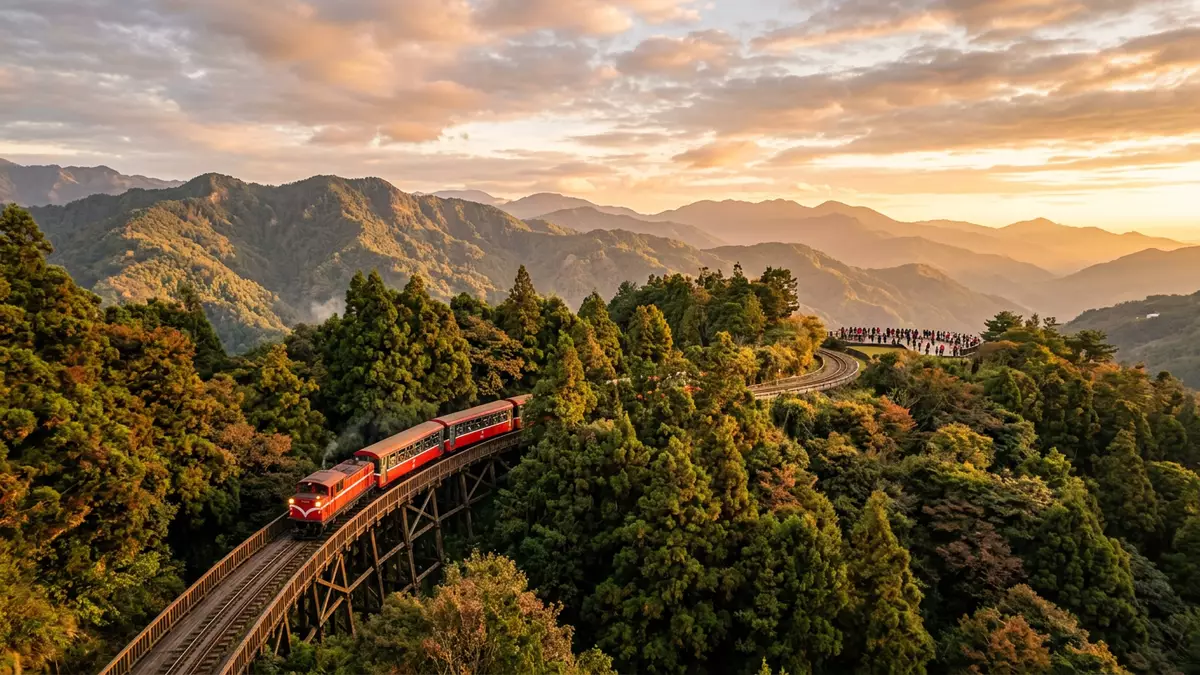
Alishan Senlin Tie Lu in Chiayi, Taiwan, is a narrow-gauge mountain railway that climbs from the lowlands into high-altitude cypress forests on the slopes of the Central Mountain Range. Built during the Japanese colonial period as an industrial line, it later became a passenger route into the Alishan National Forest Recreation Area and is now recognised as a cultural landscape that links city streets with mountain terrain. Construction kicked off in 1906 and regular operations began in 1912.
A narrow-gauge climb from Chiayi to Alishan
The lead journey of Alishan Senlin Tie Lu runs from Chiayi Station near sea level to Alishan Station high on the mountain ridge, following a narrow-gauge track that twists through varied terrain. The main line is recorded as roughly 71 km long, starting in Chiayi City and passing townships such as Zhuqi and Meishan before reaching Alishan Township in Chiayi County.The total length of the main line is 71.4 km and it climbs from around 30 m above sea level to more than 2,200 m at Alishan Station, with further elevation reached on certain branch lines.
Along the route, the railway passes through distinct climate and forest zones, from tropical vegetation near Chiayi through warm forest to temperate mountain woodland around the high stations.Descriptions of the line divide it into three forest forms, reflecting the changing altitude and environment. Travellers encounter tunnels and bridges cut into valley sides, corkscrew loops around peaks such as Mount Duli, and switchbacks that allow the trains to gain height on steep slopes without direct climbs.
From industrial line to cultural landscape
Alishan Senlin Tie Lu originated as an industrial railway for moving logged timber, particularly valuable cypress, from the Alishan Range down to the plains. Work began in the early twentieth century under Japanese administration, with the first segment between Chiayi and Erwanping opening in 1912 and subsequent extension to Jhaoping and the wider Alishan area by 1914.Traffic was opened on the initial stretch between Chiayi and Erwanping in 1912 and extended up Alishan by 1914. The line’s original purpose left a distinct legacy in the way its stations connect logging sites, forest settlements and later recreation areas.
In the decades after industrial logging declined, the railway shifted focus towards passenger services, carrying visitors into the national forest and highland villages while retaining its non-electric character and narrow-gauge profile.The Alishan Forest Railway is recognised as a cultural landscape and described as a non-electric mountain railway on 762 mm gauge, combining elements of forest, mountaineering and mountain railways. Heritage status highlights the preserved wooden depots, track structures and rolling stock, as well as the long-standing role of the line in the region’s forestry and tourism.
Engineering a mountain railway on 762 mm gauge
Technically, Alishan Senlin Tie Lu is notable for its narrow gauge of 762 mm, a standard dimension for many industrial and mountain lines in East Asia. This gauge allows tight curves and compact trackworks needed on steep terrain. The railway was engineered with gradients recorded at around 6.25% in some sections and minimum turning radii reported at about 40 m, figures that reflect the difficulty of routing tracks through deep valleys and around ridges.The line’s gradient and minimum turning radius are documented as 6.25% and 40 m respectively.
To achieve the height difference between Chiayi and the upper stations, engineers used spirals, switchbacks and extensive tunnel and bridge works rather than long straight slopes.Accounts of the railway note its spiral and zig-zag rails and a summit station at Zhushan at 2,451 m. The sequence of climbs produces wide views down valleys and across forested hillsides, while the track layout itself has become a subject of interest for railway enthusiasts, demonstrating early twentieth-century solutions to mountain railway design in Taiwan.
Visiting Alishan Senlin Tie Lu: what travellers from Western Europe should know
- Alishan Senlin Tie Lu starts in Chiayi City in southern Taiwan and runs into Alishan Township in the Central Mountain Range, with key stations at Chiayi and Alishan.
- The main line climbs from low-altitude city streets into high mountain terrain above 2,000 m, so travellers experience a marked change in elevation and cooler temperatures at the upper stations.
- Chiayi Station functions as a junction between this mountain railway and broader national rail services, making rail access from other Taiwanese cities straightforward in logistical terms.
- Within the Alishan National Forest Recreation Area, branch lines link the main station with other viewpoints and forest sections, so travellers encounter platforms and short walks at altitude.
- The official language is Chinese and the currency is the New Taiwan dollar.
Searching for Alishan Senlin Tie Lu on social platforms
These links open searches for Alishan Senlin Tie Lu on each platform.Frequently asked questions about Alishan Senlin Tie Lu
Where is Alishan Senlin Tie Lu located?
Alishan Senlin Tie Lu is based in Chiayi City in southern Taiwan and runs into Alishan Township in the Central Mountain Range, forming a link between urban lowlands and mountain forest.
What can travellers expect on a journey along the line?
Travellers can expect a narrow-gauge mountain railway journey that moves from city streets through changing forest zones, with tunnels, bridges, spirals and switchbacks leading up to the Alishan National Forest Recreation Area.
What makes Alishan Senlin Tie Lu distinctive among railways?
It is distinctive as a non-electric narrow-gauge mountain railway built in the early twentieth century, climbing more than 2,000 m and combining industrial forestry origins with recognised cultural landscape status.


