
Altstadt Bern and its sandstone arcades above the Aare
Published on 09/23/2026 at 23:11 | Editorial responsibility: Rafael Müller, Editor-in-Chief AD HOC NEWS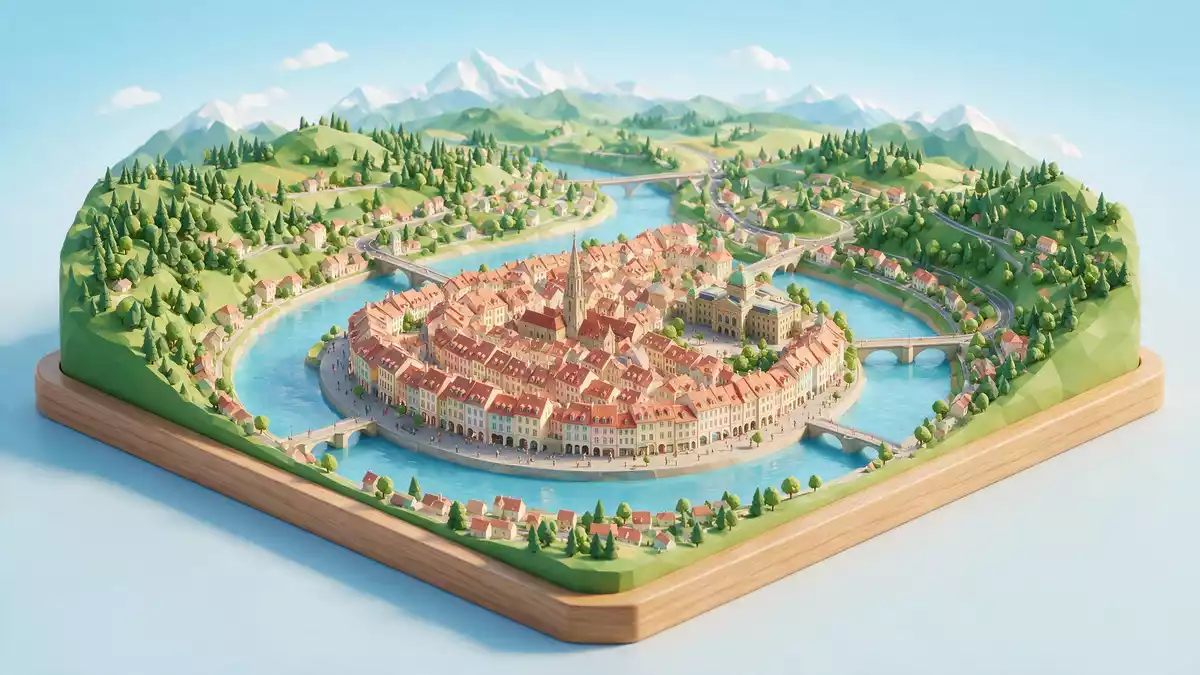
Altstadt Bern rises on a peninsula encircled by the River Aare, where a medieval street plan remains visible in lanes, towers, fountains and long sandstone façades. The covered arcades form the defining public spaces, carrying streets beneath continuous rows of historic buildings.
Altstadt Bern: a medieval plan above the Aare
Bern was founded in 1191 by Berchtold V, Duke of Zähringen, on a hill surrounded by the Aare. The city’s early layout remains the organising framework of the historic centre, with streets extending along the peninsula and buildings packed into narrow, deep plots.
The 1191 foundation plan belongs to the identity of Altstadt Bern. Since 1983, the historic centre has formed part of the UNESCO World Heritage List, with its medieval urban structure and continued civic use central to its significance.
Sandstone façades, arcades and Renaissance fountains
Much of the visible townscape is built from pale Bernese sandstone. The material appears across façades, arcades, civic buildings and churches, producing a consistent street wall along the principal lanes.
The arcades, known locally as Lauben, date in their established form from the fifteenth century and extend through the old city. Renaissance fountains from the sixteenth century punctuate the streets with painted figures, columns and basins, while the UNESCO heritage factsheet records the relationship between the medieval plan, arcades and fountains.
Zytglogge, Bern Minster and the city’s civic landmarks
At the western end of the central old-city streets, the Zytglogge rises as a medieval clock tower and former city gate. Its clockwork façade faces the flow of Kramgasse, one of the principal arcaded streets.
Bern Minster occupies a prominent position within the historic centre, with a Gothic body and a tall western tower. The Federal Palace stands at the edge of the old city, linking the medieval townscape with Bern’s role as Switzerland’s federal capital. These buildings belong to different periods, yet they share the same compact urban setting.
The old city also includes Käfigturm, the Nydegg church and the bridges crossing the Aare. Together, they mark the transition from the medieval peninsula to the wider city and make the river setting part of the town’s physical form. The historic centre’s landmarks are connected by streets whose alignments belong to the city’s founding period.
Visiting Altstadt Bern: what travellers from Western Europe should know
- Altstadt Bern occupies the historic peninsula in central Bern. Bern railway station lies at the western edge of the old city, with pedestrian streets leading towards the Zytglogge.
- The terrain includes cobbled streets, sloping lanes and stairways descending towards the Aare. The lower parts of the peninsula contain bridges, river paths and steep connections between levels.
- The arcades run beneath the historic buildings along streets such as Kramgasse and Marktgasse. They contain shops, cafés, entrances and public passageways.
- The official languages are German, French, Italian and Romansh, and the currency is the Swiss franc.
Searching for Altstadt Bern on social platforms
These links open searches for Altstadt Bern on each platform.
Frequently asked questions about Altstadt Bern
Where is Altstadt Bern?
Altstadt Bern occupies the historic peninsula in central Bern, surrounded on three sides by the River Aare. Bern railway station provides the main rail connection beside the western edge.
What can visitors expect in Altstadt Bern?
The historic centre contains arcaded streets, sandstone buildings, Renaissance fountains, churches, towers and bridges. Walking routes include slopes, cobbles and stairways between the upper town and the river.
What makes Altstadt Bern distinctive?
Its medieval street plan from 1191 remains legible within a functioning federal capital. The combination of sandstone façades, covered arcades and public fountains gives the peninsula a coherent architectural character.


