
Amer Fort and the palace courtyards of Jaipur
Published on 09/23/2026 at 14:48 | Editorial responsibility: Rafael Müller, Editor-in-Chief AD HOC NEWS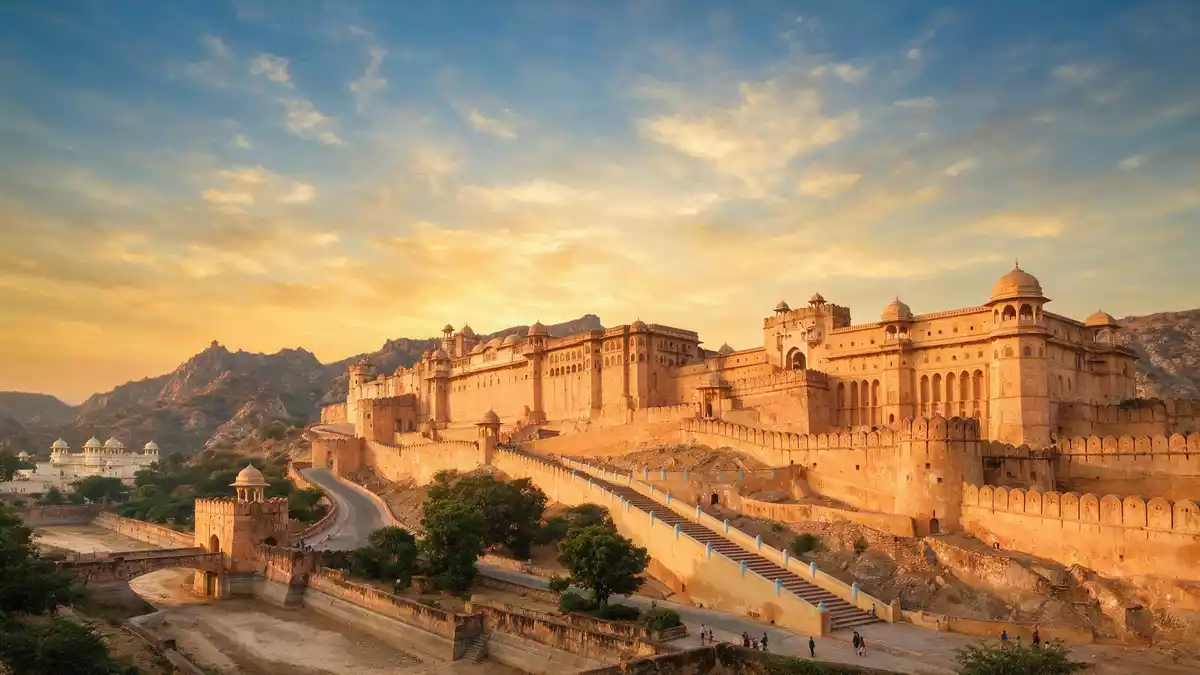
Amer Fort rises above the historic town of Amer near Jaipur as a hilltop palace of red sandstone, white marble and enclosed courtyards. Begun under Raja Man Singh I in 1592, the complex brings Rajput military architecture and Mughal-influenced palace design into one carefully layered setting.
Amer Fort: a palace above the town of Amer
Amer Fort occupies a hill beside Maota Lake, with walls, gateways and terraces following the rocky ground. The fort and palace are part of the historic settlement of Amer, which served as the capital of the Kachhwaha Rajputs before Jaipur became the principal city.
The name Amer Fort refers to a complex with several distinct spaces rather than a single enclosed hall. Defensive walls surround royal residences, audience areas, temples, gardens and passages arranged around courtyards. The result is both a fortified hill settlement and a palace designed for court life.
Raja Man Singh I and the Rajput–Mughal style
Raja Man Singh I began the principal palace construction in 1592. He was a Kachhwaha Rajput ruler and a commander in the service of the Mughal emperor Akbar. His name connects Amer Fort with the political world of sixteenth-century Rajputana and the Mughal Empire.
Construction and additions continued under successive Kachhwaha rulers. The palace remained a royal residence until the capital moved from Amer to Jaipur in 1728. Its architecture combines Rajput forms with Mughal details, including carved stonework, formal halls, courtyards and decorated private apartments.
The fort belongs to the Amer Palace history of a former capital, rather than being an isolated military monument. This relationship between palace, town and surrounding hills remains central to its identity.
Courtyards, halls and the Sheesh Mahal
The palace unfolds through successive courtyards and gateways. Public and ceremonial spaces stand alongside private rooms, gardens and religious buildings. Diwan-i-Aam, the hall of public audience, belongs to the formal side of the complex, while residential areas reveal the organisation of royal domestic life.
Sheesh Mahal is the best-known decorated interior at Amer Fort. Its name refers to mirror work set into the architectural surfaces. The palace also contains finely carved openings, painted decoration, stone screens and ornamental patterns that connect walls, ceilings and doorways.
Red sandstone gives the fort its warm exterior colour, while white marble appears in important palace interiors and decorative elements. The combination of sandstone, marble, carved surfaces and shaded courtyards creates a varied architectural sequence across the hilltop.
Amer Fort forms part of the Hill Forts of Rajasthan, inscribed on the UNESCO World Heritage List in 2013. The group records the military and courtly architecture of Rajput states across Rajasthan.
Visiting Amer Fort: what travellers from Western Europe should know
- Amer Fort lies north-east of Jaipur beside the town of Amer and Maota Lake. Road transport from Jaipur reaches the hill through the approach to the palace complex.
- The site occupies a hill, and the visit includes sloping paths, stairways, gateways and uneven stone surfaces. Comfortable footwear is useful for moving between courtyards and upper terraces.
- The fort combines open courtyards with enclosed halls, decorated rooms and narrow passages. Visitors encounter changing levels between the defensive areas and palace interiors.
- The official language is Hindi and the currency is the Indian rupee.
Searching for Amer Fort on social platforms
These links open searches for Amer Fort on each platform.Frequently asked questions about Amer Fort
Where is Amer Fort?
Amer Fort is in the town of Amer, north-east of Jaipur in Rajasthan, India. The palace stands on a hill beside Maota Lake.
What can visitors expect at Amer Fort?
Visitors find courtyards, gateways, audience halls, temples, gardens, decorated palace rooms and stairways across the hilltop complex. Stone surfaces and changing levels are part of the site.
What makes Amer Fort distinctive?
Its distinctive character comes from the combination of a fortified hill setting, Rajput palace planning, Mughal-influenced decoration, red sandstone and white marble.


