
Amer Fort, Jaipur’s hill palace of sandstone and marble
Published on 09/19/2026 at 12:34 | Editorial responsibility: Rafael Müller, Editor-in-Chief AD HOC NEWS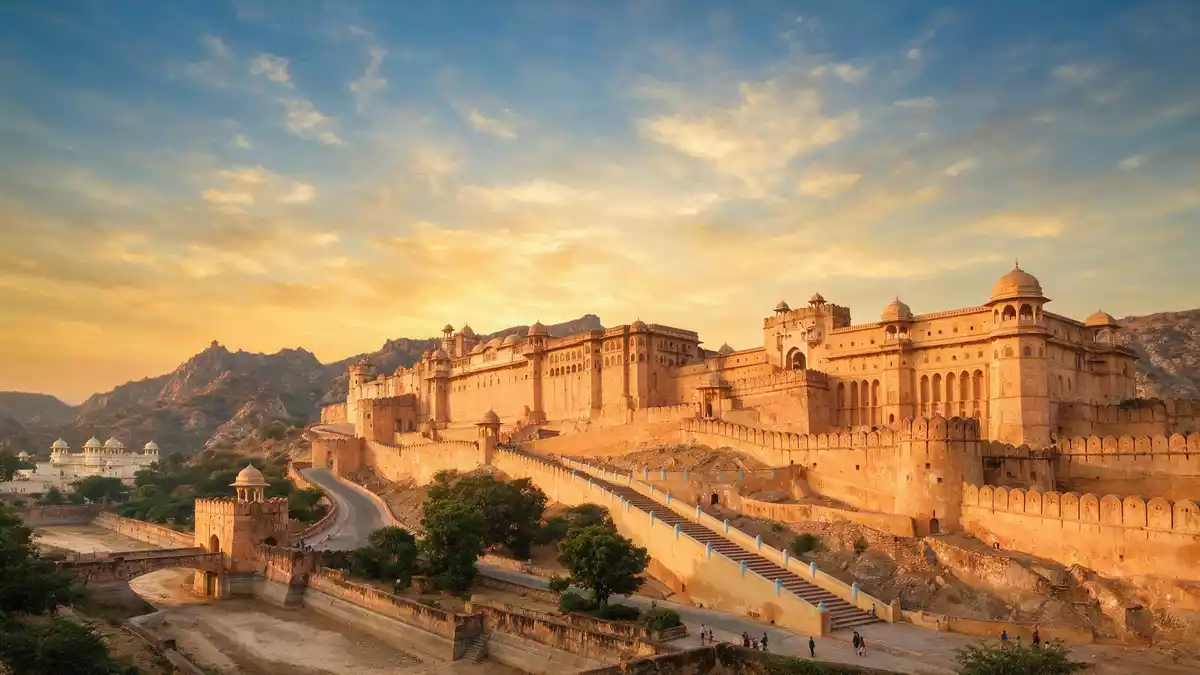
Amer Fort rises above the town of Amer on the outskirts of Jaipur, a hilltop palace-fort of red sandstone and pale stone reflected in the waters of Maota Lake. Begun in 1592 under Raja Man Singh I and enlarged by later Kachwaha Rajput rulers, it grew over the late sixteenth and seventeenth centuries into a layered residence of courts, halls and temples arranged against the slope. Amer Palace forms part of the “Hill Forts of Rajasthan” ensemble on the UNESCO World Heritage List, recognised for its Rajput military architecture and royal culture.
Amer Fort on the hill above Maota Lake
The palace complex at Amer occupies a rocky ridge north-east of Jaipur, looking down towards the reservoir of Maota Lake at the foot of the hill. Its setting links the stronghold to the town of Amer below, which served as the capital of the Kachwaha Rajput rulers before the planned city of Jaipur was founded in 1727.Amer was the Kachwaha capital for centuries before the political centre shifted to the plains.Amber Fort stands above Maota Lake
Most of the visible palace and fortifications date to the 16th and 17th centuries, when the Kachwaha Rajputs expanded Amer into a seat of power closely tied to the Mughal court. The settlement at Amer itself is older, linked in tradition to Meena communities and early Rajput groups, yet the fort known to visitors grew under rulers such as Raja Man Singh I and Mirza Raja Jai Singh I.Construction from the 1590s onward by Man Singh I and Jai Singh I gives the hill palace its present form, with curtain walls, ramped approaches and high gateways framing the ascent.
Rajput and Mughal forms in sandstone and marble
Amer Fort is built largely from red, cream and white sandstone, with white marble reserved for selected interiors and details, producing warm contrasts on its walls and gateways.The fort uses red, cream and white sandstone in combination, and these surfaces carry carved brackets, projecting balconies and ornamental bands. Rajput features such as jharokha overhangs and jaali lattice screens appear alongside Mughal-influenced garden courts and decorative panels, giving the palace a hybrid Indo-Islamic character discussed across architectural studies.Architectural analysis describes an Indo-Islamic fusion
The interior planning follows a sequence of courtyards, each edged by halls of audience, residential suites and service ranges. Hypostyle halls with rows of columns open towards parade spaces, while more intimate rooms are tucked behind screened balconies and passageways. Among the most celebrated interiors is the Sheesh Mahal, or Mirror Palace, where walls and ceilings are set with countless tiny glass elements creating dense ornamental fields.Accounts highlight the Sheesh Mahal’s mirrored surfaces and refined stone work as emblematic of Amer’s combination of Rajput craftsmanship and Mughal-era luxury.
From royal residence to World Heritage hill fort
Raja Man Singh I, a leading general in the army of Mughal emperor Akbar, began work on Amer Palace in 1592, building a residence that reflected both his position at court and his dynastic role in Rajputana.Amber Fort was originally built by Raja Man Singh in 1592 and then expanded in the 17th century under Mirza Raja Jai Singh I and other successors.Later Kachwaha rulers enlarged the complex, adding garden courts, new halls and further defensive structures along the ridge. Amer remained the royal residence until Sawai Jai Singh II founded Jaipur as a new capital in the late 1720s, transferring the primary seat of power down to the valley.Amer Palace stayed the royal residence until the move to Jaipur
Amer Fort and its associated works form part of the group of “Hill Forts of Rajasthan”, which were inscribed together on the UNESCO World Heritage List in 2013.Amber Fort is a key monument within the Hill Forts of Rajasthan The ensemble highlights Rajput hill forts as examples of regional military and palace architecture, linking Amer to other strongholds across the state. Within this context, Amer Palace is noted for its combination of fortified walls with refined apartments and courtyards, illustrating the blend of defensive and ceremonial functions associated with Rajput hill capitals.Amer Palace is an outstanding example of Rajput architecture
Visiting Amer Fort: what travellers from Western Europe should know
- Amer Fort stands on a hill above the town of Amer, north-east of Jaipur in Rajasthan, and is reached by road from Jaipur’s urban districts at the foot of the ridge.
- The ascent to the main gateways involves sloping paths and stairways on stone surfaces, with substantial height gain between the base near Maota Lake and the fort’s upper courtyards.
- Within the complex, visitors encounter a series of interconnected courtyards, halls and terraces, with some interior areas dimmer than the open courts because of their thick walls and limited direct daylight.
- Jaipur lies in India; the official language of the region is Hindi and the national currency is the Indian rupee.
Searching for Amer Fort on social platforms
These links open searches for Amer Fort on each platform.Frequently asked questions about Amer Fort
Where is Amer Fort and what is its historical role?
Amer Fort stands above the town of Amer near Jaipur in Rajasthan, India, and served as the hill palace of the Kachwaha Rajput rulers until the capital moved to Jaipur in the early eighteenth century.
What can visitors expect when exploring Amer Fort?
Visitors encounter layered courtyards, stone halls and notable interiors such as the Sheesh Mahal, all arranged on a hilltop site that combines fortified walls with palace apartments.
What makes Amer Fort distinctive among Rajasthan’s forts?
Amer Fort is distinctive for its combination of Rajput and Mughal architectural elements, its use of red and pale sandstone with marble, and its inclusion within the UNESCO-listed Hill Forts of Rajasthan ensemble.


