
Amfiteatre de Tarragona and its arena above the Mediterranean
Published on 09/22/2026 at 07:58 | Editorial responsibility: Rafael Müller, Editor-in-Chief AD HOC NEWS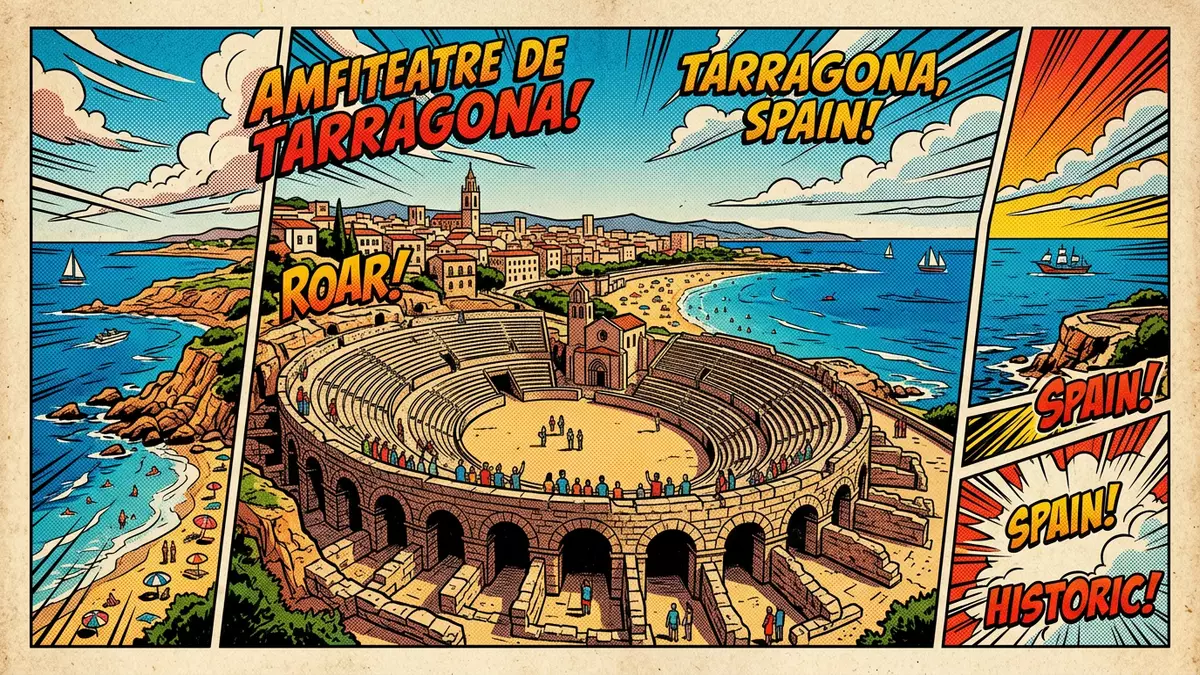
Amfiteatre de Tarragona is a Roman arena on the coastal slope of Tarragona, where ancient stonework occupies a terrace above the Mediterranean. Built in the second century AD, it combines the open space of a public amphitheatre with remains from later Christian and medieval phases.
A Roman arena on the coastal slope
The amphitheatre formed part of Tarraco, the Roman city whose monuments shaped Tarragona’s urban history. Its position outside the ancient city walls placed the arena close to the shoreline and connected it with the wider network of public buildings belonging to the provincial capital.
The surviving structure is an archaeological ruin rather than a complete building. Curving rows of seating surround the arena, while sections of the outer wall, passages and supporting masonry remain visible across the site. The arrangement makes the relationship between the arena, the rising ground and the sea part of the physical setting.
Stone, seating and the memory of Tarraco
Amfiteatre de Tarragona was constructed from Roman masonry and built around an elongated arena. The seating area follows the curve of the building, with vaulted structures and access routes surviving in fragments beneath and beside the terraces.
A major alteration belongs to 221 AD, during the reign of the emperor Elagabalus. A long inscription associated with the podium records this phase, linking the visible stonework with a named moment in the history of Roman Tarragona. The amphitheatre therefore preserves both its broad imperial setting and a specific later intervention.
The arena is also associated with the deaths of the Christian bishop Fructuosus and his deacons Augurius and Eulogius on 21 January 259. Their martyrdom gave the site a second historical identity, alongside its Roman role as a place for public spectacles.
From Roman spectacle to layered monument
After the Roman period, the building’s function changed. A Christian basilica was built within the remains to commemorate the three martyrs, adding a religious structure to the earlier arena and seating.
A Romanesque church followed in the medieval history of the site, and the remains also served as a convent and a prison. These phases are part of the monument’s physical record: Roman walls, Christian foundations and medieval masonry occupy the same coastal enclosure.
The amphitheatre belongs to the Archaeological Ensemble of Tarraco, inscribed on the UNESCO World Heritage List in 2000. The ensemble includes Roman walls, the circus, forums and other elements of Tarraco across Tarragona and its surrounding territory. Archaeological Ensemble of Tarraco
The monument’s identity rests on this layered arrangement. The Roman arena remains the clearest form, but the Christian basilica and medieval church prevent the site from being read as a single-period ruin. the 259 martyrdom
Visiting Amfiteatre de Tarragona: what travellers from Western Europe should know
- The amphitheatre lies in Parc de l’Amfiteatre, on Tarragona’s coastal side near the eastern end of Rambla Nova. Tarragona railway station and the old town connect with the site by the city’s streets.
- The ground contains archaeological masonry, uneven surfaces and changes in level. The surviving seating, arena and later religious remains are viewed across an open ruin.
- The Mediterranean lies immediately beyond the coastal slope. The setting includes the Roman arena, the sea-facing edge and Tarragona’s historic urban fabric.
- The official language is Catalan and Spanish, and the currency is the euro.
Searching for Amfiteatre de Tarragona on social platforms
These links open searches for Amfiteatre de Tarragona on each platform.
Frequently asked questions about Amfiteatre de Tarragona
Where is Amfiteatre de Tarragona?
It stands in Parc de l’Amfiteatre on Tarragona’s coastal slope, close to the Mediterranean and the historic centre.
What remains at the site?
Visitors encounter the Roman arena, curved seating, masonry passages and remains of a Christian basilica and medieval church.
What makes the amphitheatre distinctive?
Its Roman arena shares the site with Christian and medieval remains, while the coastal position places the ruin above the Mediterranean.


