
Amphitheatre of El Jem: a colossal Roman arena on Tunisian plains
Published on 09/17/2026 at 09:42 | Editorial responsibility: Rafael Müller, Editor-in-Chief AD HOC NEWS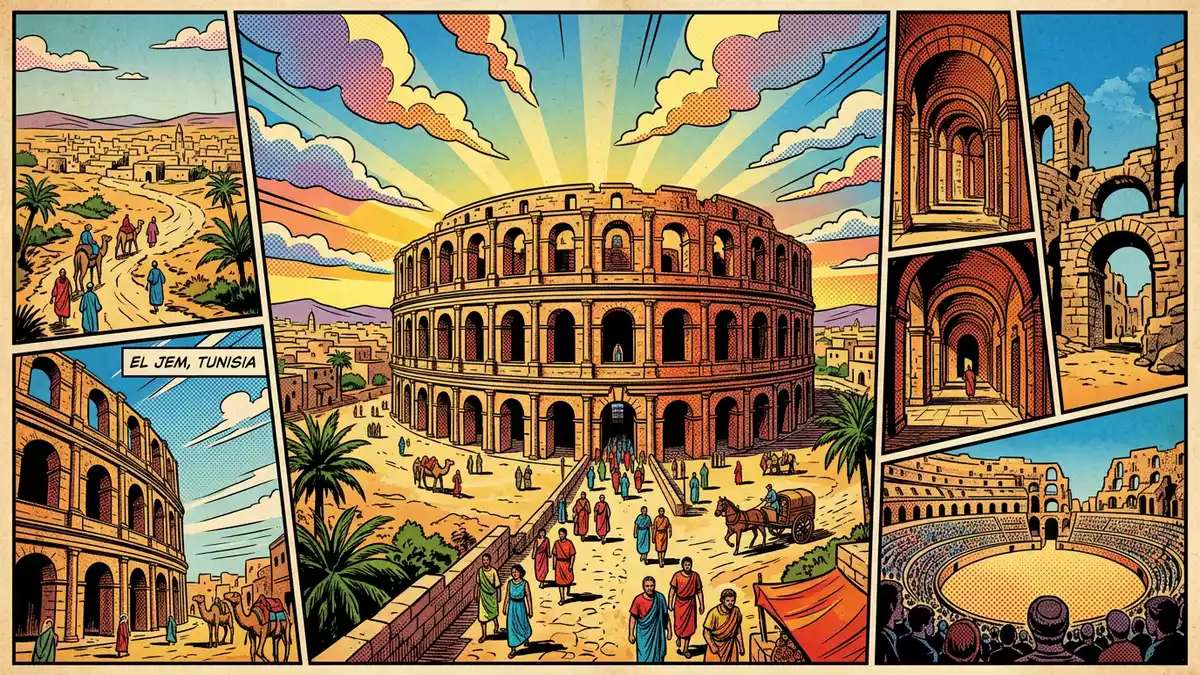
The Amphitheatre of El Jem in central Tunisia is a vast Roman arena that dominates the modern town of El Jem, its stone tiers rising above the surrounding streets and plain. Built in the third century AD when El Jem was known as Thysdrus, it reflects the power of the Roman Empire in Africa and shows how an imperial spectacle space could shape an entire settlement.
A Roman colosseum on flat ground
Amphitheatre of El Jem stands on open, level ground in the middle of the Tunisian plain, rather than against a hillside, which gives it a freestanding presence on the landscape. The site lies in the modern town of El Jem, corresponding to ancient Thysdrus in the Roman province of Africa, a location that linked the surrounding countryside with wider Mediterranean trade routes.Roman province of Africa The arena’s outer ellipse measures about 148 m (486 ft) along its major axis and around 122 m (400 ft) along the minor axis, putting it close in scale to the Colosseum in Rome and among the largest amphitheatres built by Rome.external axes of 148 by 122 metres
The amphitheatre is built entirely of large stone blocks laid without foundations, forming a ring of superimposed arcades that carries the massive structure on a system of arches. This freestanding construction gives the building a particular architectural clarity: the outer walls present tiers of arches stacked above each other, and the interior reveals a continuous circuit of corridors and staircases that once channelled spectators towards their seats. The overall height reaches about 36 m (118 ft), and estimates of the seating capacity range between roughly 27,000 and 35,000 spectators, a scale that would have exceeded the population of the town around it in Roman times.capacity judged to be 35,000 spectators
Third-century architecture and imperial spectacle
The Amphitheatre of El Jem belongs to the third century AD, a period when Roman Africa was prosperous and integrated into the wider empire through agricultural production and trade in olive oil. It is associated with Gordian, the proconsul who later became Emperor Gordian I, and was constructed around 238 AD, making it a relatively late example in the sequence of large imperial amphitheatres.constructed by Emperor Gordian between 230 and 238 AD In Roman use, such arenas hosted gladiatorial contests, animal hunts and other spectator events, and evidence from El Jem points to performances that combined combat, display and ceremonial presence.
The building’s plan follows the standard amphitheatre pattern, with an oval arena surrounded by stepped seating and enclosed by the outer wall. Below the arena lies a hypogeum, a system of underground galleries and cells that provided spaces for animals and participants before they entered the sandy floor above.hypogeum with vaulted galleries and cells The stone façade incorporates sculpted details such as protomes of Greco-Roman deities, set in the spandrels between the arches, which tied the architecture visually to the religious and mythological language of the empire. Together, these elements make Amphitheatre of El Jem an accomplished example of Roman amphitheatre design, comparable in proportion and ambition to Rome’s Colosseum.
Conservation, World Heritage and visiting the structure
Despite losses to parts of its outer ring, the Amphitheatre of El Jem remains one of the best-preserved large Roman amphitheatres in Africa, with extensive sections of seating, corridors and the arena structure still accessible. The monument covers an area of around 1.37 hectares and illustrates the reach of Roman engineering and urban culture into central Tunisia.area of 1.37 hectares In 1979 it was inscribed on the UNESCO World Heritage List as a cultural site, recognised under criterion (iv) as an outstanding example of a type of building created for mass spectator events.inscribed on the UNESCO World Heritage List in 1979
Visitors encounter not only the outer arcades and interior stairways but also views into the arena and its underground structures, which reveal how the building’s different levels interlock. The amphitheatre rises above the low-rise town around it, so that from the upper tiers the surrounding streets and fields are visible beyond the stone, while from outside the massive oval of arches forms a dominant landmark at the edge of the plain. Within the wider landscape of Tunisian heritage sites, Amphitheatre of El Jem embodies the Roman layer of the country’s history and demonstrates how imperial architecture was adapted to local topography and materials.
Visiting Amphitheatre of El Jem: what travellers from Western Europe should know
- Amphitheatre of El Jem stands in the town of El Jem in central Tunisia, reached overland from coastal cities such as Sousse and Sfax by road and rail connections.
- The monument rises on flat ground, but movement inside the structure involves stone staircases, corridors and uneven surfaces, including steps between levels of seating and access to the arena.
- The surrounding area is a Tunisian town with residential streets and small-scale commerce, and the amphitheatre’s arches are visible from various approaches as the town’s main landmark.
- The official language is Arabic and the currency is the Tunisian dinar.
- Entry requirements depend on your nationality; UK travellers can check the FCDO travel advice at gov.uk/foreign-travel-advice, Irish travellers the Department of Foreign Affairs at ireland.ie.
Searching for Amphitheatre of El Jem on social platforms
These links open searches for Amphitheatre of El Jem on each platform.
Frequently asked questions about Amphitheatre of El Jem
Where is Amphitheatre of El Jem located?
Amphitheatre of El Jem stands in the town of El Jem in central Tunisia, corresponding to the ancient city of Thysdrus in the Roman province of Africa.
What can visitors expect when exploring Amphitheatre of El Jem?
Visitors encounter extensive stone arcades, interior corridors and staircases, views over the oval arena and access to parts of the underground galleries beneath the arena floor.
What makes Amphitheatre of El Jem distinctive among Roman amphitheatres?
Its freestanding construction on flat ground, large scale comparable to the Colosseum and third-century dating in Roman Africa distinguish it among major imperial amphitheatres.


