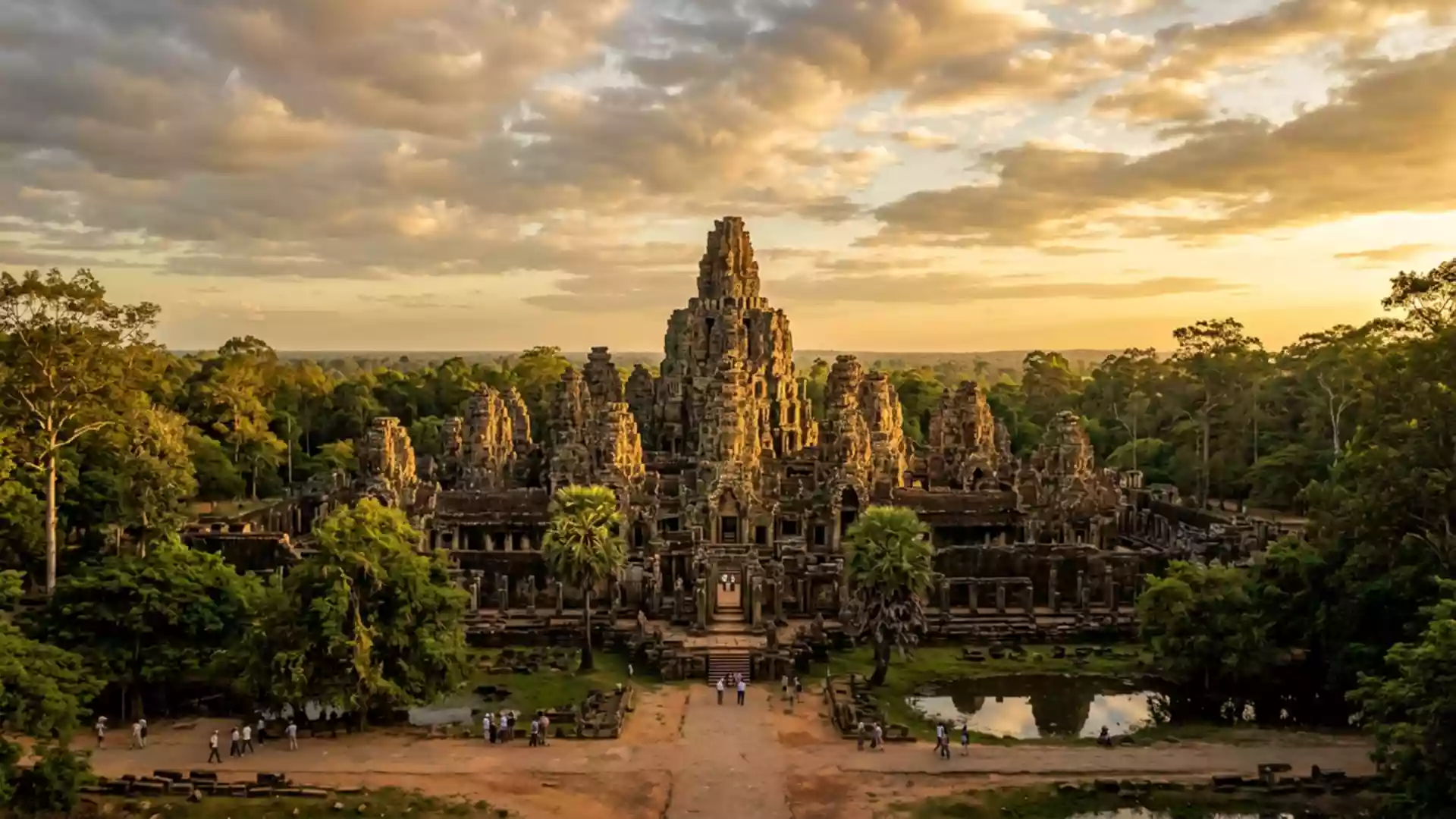
Angkor Thom and its stone gates in Siem Reap
Published on 08/07/2026 at 15:03 | Editorial responsibility: Rafael Müller, Editor-in-Chief AD HOC NEWS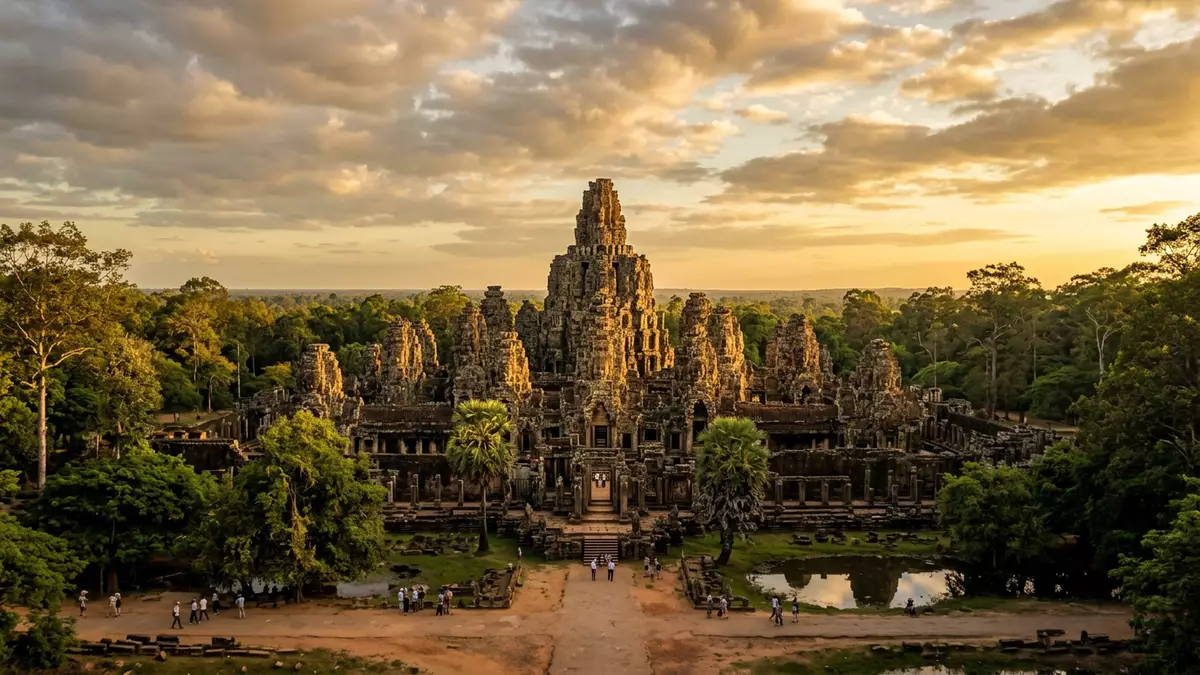
Angkor Thom is the great walled city at the centre of the Angkor complex near Siem Reap, built under Jayavarman VII in the late twelfth century. Its scale is visible at once in the long stone avenues, the enclosing walls and the gates crowned by faces.
The royal city enclosed in stone
The city covers a broad square plan and is entered through monumental gates on the cardinal sides. A causeway crosses the moat at each approach, and the faces on the gate towers have become one of its defining images.
Inside the walls, the layout is organised around large temple compounds, terraces and road lines rather than a single central square. The stonework and the remaining masonry give the place a formal, ceremonial character that fits its royal origin.
Bayon at the centre of Angkor Thom
At the centre stands the Bayon, the state temple associated with Jayavarman VII. Its upper levels carry dense clusters of towers with carved faces, and the gallery walls preserve reliefs that mix court life, processions and scenes of conflict.
The Bayon makes the city feel less like a ruin field and more like a set of interconnected monuments. Nearby structures such as the Terrace of the Elephants and the Terrace of the Leper King extend that impression, with long carved surfaces and elevated platforms close to the main axis.
Stone reliefs, gates and terraces
Angkor Thom rewards attention to details as much as to overall form. The lintels, guardian figures and carved bas-reliefs vary from one structure to another, and the surviving stone has a weathered surface that softens the edges of the ornament.
The city also shows how Khmer sacred architecture could combine defensive elements, processional space and royal display. The enclosing wall, the moats, the gates and the temple compounds belong to one landscape rather than separate attractions.
Visiting Angkor Thom: what travellers from Western Europe should know
- The site is reached from Siem Reap by road.
- Admission arrangements and opening hours are set by the site's operator and change with the season; the official website is the only binding source.
- Dry months suit long walks among the monuments, while stronger heat makes shade and water more important.
- The grounds include long approaches on foot, uneven stone and steps at several monuments.
- Cash, mixed languages and respectful dress matter across the Angkor area; restrictions may apply on site.
- Entry requirements depend on your nationality. UK travellers should check the FCDO travel advice at gov.uk/foreign-travel-advice; Irish travellers the Department of Foreign Affairs at ireland.ie; EU and EEA citizens their own national foreign ministry.
Searching for Angkor Thom on social platforms
These links open searches for Angkor Thom on each platform.
Frequently asked questions about Angkor Thom
Where is Angkor Thom?
It lies near Siem Reap in Cambodia, within the wider Angkor archaeological landscape. The site forms part of the historic Khmer capital zone.
What should visitors expect?
Expect walls, gates, temple compounds and long stretches of stonework spread across a large area. Comfortable shoes and time on foot make sense for moving between the main monuments.
What makes it distinctive?
Its combination of a fortified royal city, the Bayon at the centre and the face-towers at the gates gives it a recognisable profile. The place reads as both urban plan and sacred landscape.