
Angkor Wat and the architecture of a sacred mountain
Published on 09/24/2026 at 12:52 | Editorial responsibility: Rafael Müller, Editor-in-Chief AD HOC NEWS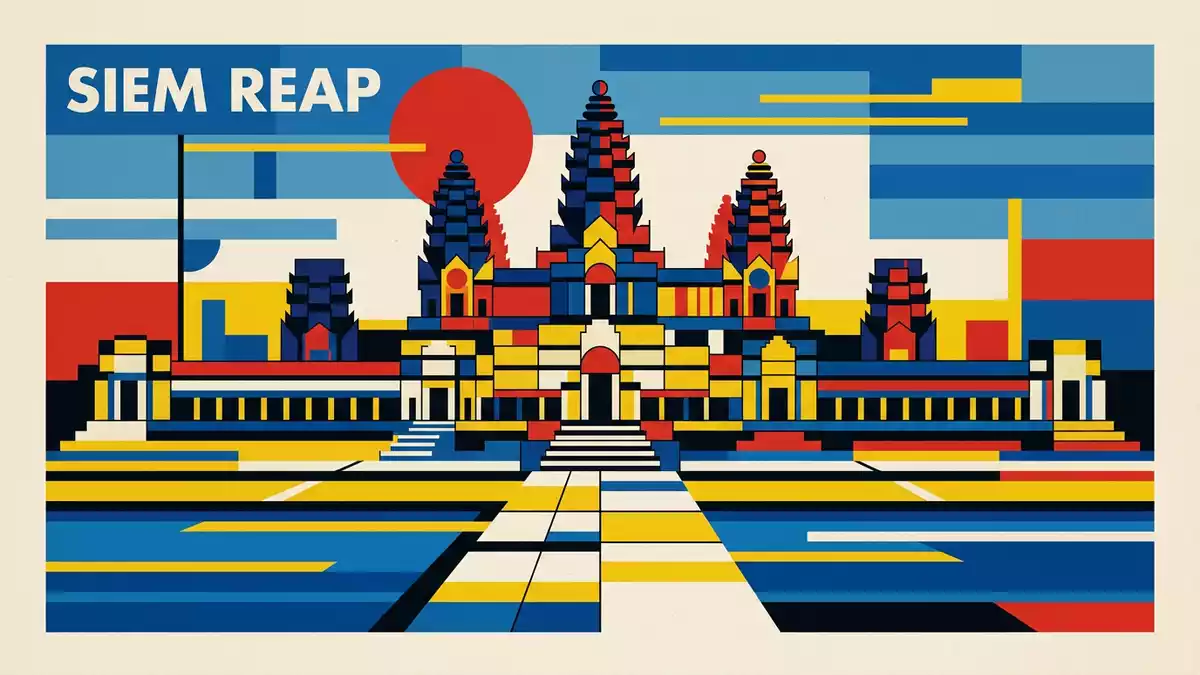
Angkor Wat is a temple complex near Siem Reap, Cambodia, organised around a monumental ascent through galleries, terraces and towers. Built in the twelfth century under King Suryavarman II, it was dedicated to Vishnu and later became a Buddhist sanctuary.
Angkor Wat’s galleries, terraces and central towers
A broad moat surrounds the temple enclosure, followed by a causeway and an outer gallery. Beyond them, successive terraces rise towards the central sanctuary. The arrangement gives Angkor Wat a stepped profile, with the highest stonework gathered at the centre.
Five towers form the central group, with four around a higher central tower. Their arrangement represents Mount Meru, the sacred mountain of Hindu tradition. The towers carry the distinctive vertical rhythm of Khmer architecture, with tapering stone forms rising above the galleries. five central towers are among the complex’s clearest architectural features.
Suryavarman II and the twelfth-century Khmer Empire
King Suryavarman II ruled the Khmer Empire from 1113 to about 1150. Angkor Wat belongs to the first half of the twelfth century, when Angkor served as the royal centre of a powerful Southeast Asian state. Its scale, stone construction and carefully ordered plan place it within the high period of Khmer architecture.
The temple was dedicated to Vishnu, one of the principal deities of Hinduism. Its reliefs combine religious imagery with scenes connected to Khmer kingship and epic literature. The walls preserve episodes from the Ramayana and the Mahabharata, alongside images of Hindu gods and scenes from the historical world of Angkor. Suryavarman II’s temple remains closely associated with this period.
Stone reliefs and a living religious tradition
The outer gallery contains extensive bas-reliefs carved into the walls. Their subjects include battles, processions, divine figures and stories from Hindu epics. The reliefs are not separate objects arranged in a museum; they form part of the architecture, running along the passages and enclosing the sacred spaces.
Angkor Wat’s religious history did not end with its Hindu foundation. Buddhist use developed at the complex, and Buddhist images appear alongside earlier Hindu carvings. This combination gives the temple a layered visual character, with different traditions represented in the same galleries, terraces and sanctuaries. Angkor World Heritage site includes Angkor Wat within the protected archaeological landscape of Angkor.
Visiting Angkor Wat: what travellers from Western Europe should know
- Angkor Wat lies near Siem Reap in north-western Cambodia. The temple is reached from the town by road, with tuk-tuks, taxis, bicycles and organised vehicles used for the approach.
- The route crosses the moat and causeway before reaching the galleries and raised central terraces. Stone steps and uneven surfaces form part of the temple experience.
- The official language is Khmer and the currency is the Cambodian riel.
- Entry requirements depend on your nationality; UK travellers can check the FCDO travel advice at gov.uk/foreign-travel-advice, Irish travellers the Department of Foreign Affairs at ireland.ie.
Searching for Angkor Wat on social platforms
These links open searches for Angkor Wat on each platform.Frequently asked questions about Angkor Wat
Where is Angkor Wat?
Angkor Wat is near Siem Reap in north-western Cambodia. It forms part of the archaeological complex of Angkor.
What can travellers expect at the temple?
The approach crosses a moat and causeway before reaching galleries, carved walls, terraces and stone steps. The central sanctuary rises above the surrounding architectural layers.
What makes Angkor Wat distinctive?
Its combination of a Mount Meru-inspired tower group, extensive bas-reliefs, a surrounding moat and a transition from Hindu to Buddhist use gives the complex its distinctive character.


