
Aoraki / Mount Cook and the alpine world above Mount Cook Village
Published on 09/18/2026 at 11:52 | Editorial responsibility: Rafael Müller, Editor-in-Chief AD HOC NEWS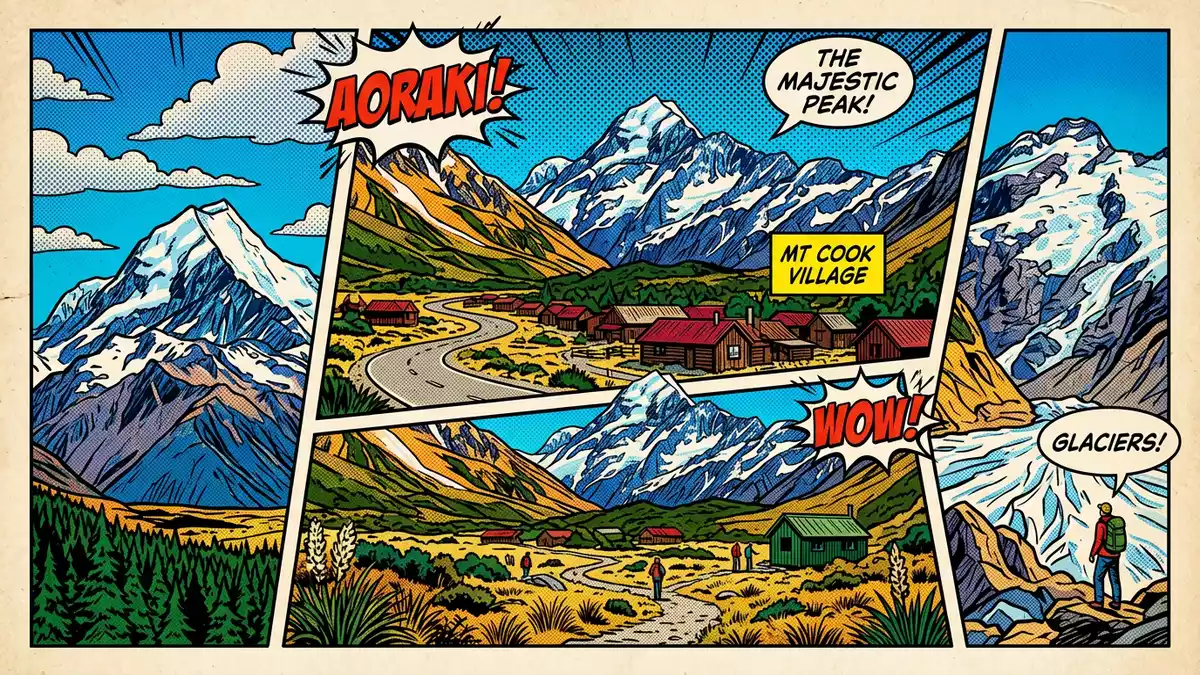
Aoraki / Mount Cook dominates the skyline above Mount Cook Village, standing as the highest mountain in New Zealand and the central summit of a high alpine national park on the South Island. The peak forms part of the Southern Alps / K? Tiritiri o te Moana, with ice, rock and glacial valleys reaching out around the mountain and into the wider landscape.
Aoraki / Mount Cook: New Zealand’s highest summit
Aoraki / Mount Cook is a permanently snow-clad mountain rising in the Southern Alps of New Zealand’s South Island, surrounded by a concentration of high peaks that give this region its alpine character.highest in New Zealand The mountain stands above glacial valleys and is flanked by the Hooker Glacier on one side and the Tasman Glacier on the other, two long rivers of ice that define the western and eastern approaches to the summit area.Hooker Glacier to the west and Tasman Glacier to the east
The central peak forms part of a trio of summits along the ridge, with lower and middle tops stepping up towards the highest point and contributing to the serrated skyline above Mount Cook Village.three summits along the ridge Aoraki / Mount Cook sits within the Canterbury Region, and the wider national park carries the mountain’s dual name in both its official designation and everyday use.Aoraki / Mount Cook National Park in Canterbury
Aoraki / Mount Cook National Park: glaciers and high peaks around the village
The mountain stands at the heart of Aoraki / Mount Cook National Park, an alpine protected area established in 1953 that extends along the main divide of the Southern Alps.park established in 1953 The park covers hundreds of square kilometres of rugged land, with numerous peaks rising above 3,000 m (9,843 ft) and a large proportion of its surface under ice.high peaks and alpine terrain Glaciers occupy a significant share of the landscape, shaping deep valleys and feeding lakes with suspended rock flour that gives the water a distinctive turquoise colour.
Aoraki / Mount Cook National Park forms part of the Te W?hipounamu – South West New Zealand World Heritage Area, recognised for its geological processes, glaciated landforms and relatively intact alpine ecosystems.Te Wahipounamu World Heritage status The park lies in the central-west of the South Island and shares a long boundary with Westland Tai Poutini National Park, linking the high crest of the Southern Alps with rainforest and coastal environments further west.common boundary with Westland National Park
Mount Cook Village and access to the alpine landscape
Mount Cook Village, officially Aoraki / Mount Cook, sits within the national park and functions as the main settlement providing access to the surrounding mountains and glaciers.village within the national park The village lies at the roadhead of State Highway 80, a route that runs north from the shore of Lake Pukaki into the interior of the park and ends near the valley floor below the mountain. From here, walking tracks, climbing routes and scenic viewpoints extend into several valley systems, including the Hooker and Tasman valleys.
The surrounding area has a network of paths and alpine huts that support walking and mountaineering, with routes ranging from glacial valley trails to high ridge climbs above the snowline.parks and recreation in Aoraki / Mount Cook National Park The national park combines steep rock faces, snowfields and crevassed glaciers, creating an environment where weather and conditions can be demanding and where routes frequently gain substantial elevation over relatively short horizontal distances.
Visiting Aoraki / Mount Cook: what travellers from Western Europe should know
- Aoraki / Mount Cook and Mount Cook Village lie in the central-west part of New Zealand’s South Island, at the end of State Highway 80 north from Lake Pukaki.
- The terrain around the village and within Aoraki / Mount Cook National Park is high alpine country with steep valley sides, substantial elevation gain on foot and routes that cross rocky ground and glacial surfaces.
- The wider region is part of Te W?hipounamu – South West New Zealand, and Aoraki / Mount Cook National Park shares boundaries with other protected areas along the Southern Alps.
- The official languages of New Zealand include English and te reo M?ori, and the currency is the New Zealand dollar.
- Entry requirements depend on your nationality; UK travellers can check the FCDO travel advice at gov.uk/foreign-travel-advice, Irish travellers the Department of Foreign Affairs at ireland.ie.
Searching for Aoraki / Mount Cook on social platforms
These links open searches for Aoraki / Mount Cook on each platform.
Frequently asked questions about Aoraki / Mount Cook
Where is Aoraki / Mount Cook located in New Zealand?
Aoraki / Mount Cook rises in the Southern Alps of New Zealand’s South Island and forms the central summit of Aoraki / Mount Cook National Park in the Canterbury Region.
What should visitors expect on a visit to Mount Cook Village and the surrounding park?
Visitors encounter an alpine environment of steep peaks, glaciers, glacial lakes and valley tracks, with Mount Cook Village providing accommodation and access points into several major valley systems.
What makes Aoraki / Mount Cook distinctive among New Zealand’s mountains?
Aoraki / Mount Cook is New Zealand’s highest mountain, set among numerous peaks above 3,000 m (9,843 ft) and extensive glacier systems within a World Heritage-listed alpine national park.


