
Arashiyama Chikurin and Kyoto’s green bamboo corridors
Published on 09/23/2026 at 18:09 | Editorial responsibility: Rafael Müller, Editor-in-Chief AD HOC NEWS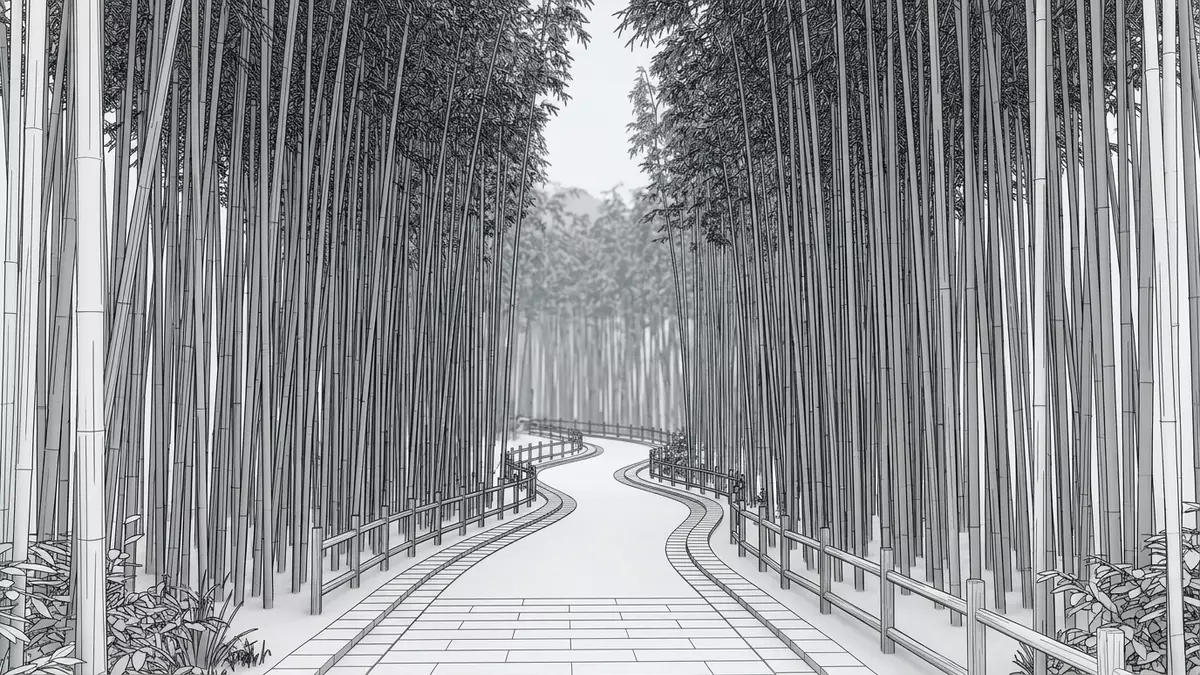
Arashiyama Chikurin is a bamboo-lined walking route in Sagano, on the western side of Kyoto. Tall m?s? bamboo rises beside the path, while Tenryu-ji Temple and Nonomiya Shrine mark two of the area’s historic landmarks. The grove’s defining feature is its vertical green canopy, which turns an ordinary woodland path into a carefully framed landscape.
Arashiyama Chikurin: a path beneath tall bamboo
The grove is associated with Chikurin no Komichi, a name that means “Path of Bamboo”. Its route passes through dense stands of bamboo, with the stalks gathered closely on both sides of the walking surface. Wooden fences separate the path from sections of the planting, preserving a clear corridor through the grove.
The main path is linked with the northern side of Tenryu-ji Temple and continues towards the gardens and villa area above Arashiyama. A further bamboo route lies near Nonomiya Shrine. Together, these paths form a landscape of narrow lanes, tall stems and filtered views of the surrounding hills.
Sagano, Tenryu-ji and the history of the grove
Sagano lies in north-western Kyoto, beside the wooded slopes of Arashiyama. The district became associated with aristocratic villas and cultivated landscapes during the Heian period, when Kyoto served as Japan’s imperial capital. Bamboo, maple trees, gardens and river scenery shaped the character of this part of the city.
Tenryu-ji dates from 1339 and belongs to the Rinzai school of Zen Buddhism. Its temple grounds include Sogenchi Garden, whose pond, rocks and planting form a separate historic landscape beside the bamboo route. Arashiyama’s western Kyoto setting places the grove within a district where religious buildings, gardens and wooded terrain meet.
Nonomiya Shrine stands within the bamboo landscape near the route. Its unpainted wooden torii and compact shrine buildings provide a distinct architectural counterpoint to the tall green stems. The shrine’s traditions connect it with purification rites before imperial women travelled to Ise.
Bamboo, sound and the surrounding landscape
The bamboo is dominated by m?s? bamboo, a species with thick green culms and narrow leaves. The stems rise in close vertical groups, while the upper foliage forms a broken canopy above the path. Sunlight appears between the leaves and the trunks rather than across an open clearing.
Wind moving through the bamboo forms part of Japan’s recognised soundscape. The grove therefore combines visible structure with a characteristic natural sound: upright culms, rustling leaves and the changing acoustics of a narrow woodland route. Sagano’s bamboo paths include Chikurin no Komichi and a second Bamboo Forest Trail nearby.
The route also belongs to a broader Arashiyama landscape. The Katsura River, wooded hills, temple gardens and the Togetsukyo Bridge lie within the same district. The bamboo path is not an isolated woodland, but one element within Kyoto’s western cultural landscape.
Visitors encounter a sequence of connected spaces: the approach through Sagano, the temple precincts, the shrine, the bamboo corridor and the wooded slopes beyond. The green walls of the grove make the route immediately recognisable, while the adjoining landmarks add layers of religious and garden history.
Visiting Arashiyama Chikurin: what travellers from Western Europe should know
- Arashiyama Chikurin is in Sagano, north-west Kyoto. JR Saga-Arashiyama Station on the Sagano Line provides a rail approach, and the Keifuku Randen line reaches Arashiyama Station.
- The route is a walking path through a dense bamboo planting. Its surface is generally level, but the wider Arashiyama district includes slopes, temple approaches and uneven garden paths.
- Tenryu-ji Temple lies beside the southern section, while Nonomiya Shrine stands close to the bamboo route. The Togetsukyo Bridge and Katsura River are nearby landmarks.
- The official language is Japanese and the currency is the Japanese yen.
Searching for Arashiyama Chikurin on social platforms
These links open searches for Arashiyama Chikurin on each platform.
Frequently asked questions about Arashiyama Chikurin
Where is Arashiyama Chikurin?
Arashiyama Chikurin is in Sagano, on Kyoto’s western side. The grove lies near Tenryu-ji Temple and Nonomiya Shrine.
What does a visit involve?
A visit follows a walking path through dense bamboo, with nearby temple grounds, shrine buildings and wooded hills forming the wider setting.
What makes the grove distinctive?
Its tall m?s? bamboo creates a continuous vertical landscape beside the route. The rustling bamboo and adjoining historic sites give the path its particular character.


