
Archaia Agora in Athen, an open landscape of democracy
Published on 08/25/2026 at 17:19 | Editorial responsibility: Rafael Müller, Editor-in-Chief AD HOC NEWS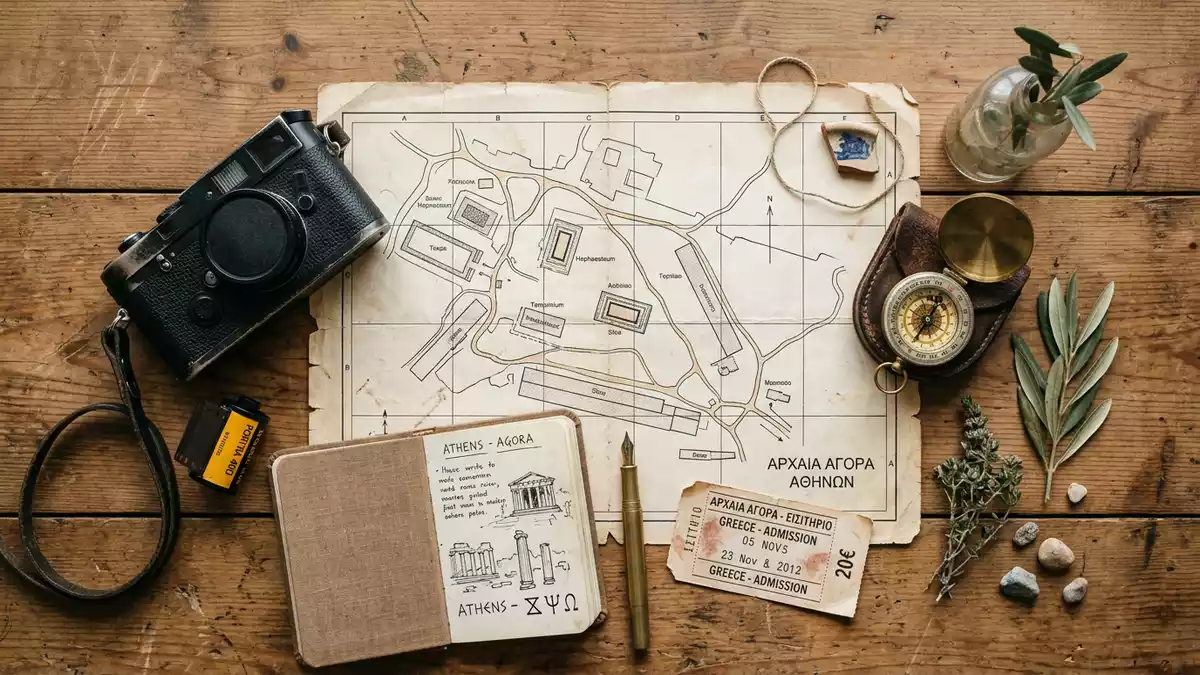
Archaia Agora, the Ancient Agora of Athens, lies below the Acropolis where the ruins of temples, stoas and civic buildings still frame the open ground that once carried daily political life. Set out in the sixth century BC as the main civic space of the city, it became the centre of Athenian democracy and commerce for many centuries.
An open civic plain below the Acropolis
The Ancient Agora occupies a natural hollow northwest of the Acropolis rock, between the slopes of Areopagus and the hill known as Agoraios Kolonos. A broad processional route, the Panathenaic Way, cut across the space, linking the city’s streets with the sanctuary on the Acropolis and turning the Agora into a corridor between sacred and civic ground.The Agora of Athens was laid out between Areopagus and Agoraios Kolonos From the sixth century BC onwards the open area was enclosed gradually by public buildings, creating a loose frame of stoas, temples and administrative structures around the central field.By the second century BC the square was largely built around with public structures
Standing in the site today, the ground is still largely open, with paths crossing low grass, foundations emerging from the soil and the Acropolis rising sharply to the east. The relationship between the hollow of the Agora and the limestone outcrop of the Acropolis is clear in almost every direction; temples and colonnades sit beneath the sanctuary rather than beside it, and the civic remains stretch out where the terrain eases into the modern districts of Thissio and Monastiraki.The site lies between the neighbourhoods of Thissio and Monastiraki, northwest of the Acropolis
Democracy in stone: Stoas, council houses and temples
From around the sixth century BC the Agora developed into the main political assembly space of Athens, a place where free citizens met to vote, serve on juries and attend councils.The Agora functioned as the focal point of administrative, judicial, commercial and social life The Bouleuterion, the council house of the city, stood here, housing the council of 500 that formed one of the core organs of Athenian democracy.The Agora contained the Bouleuterion, where the council of 500 met Nearby lay law courts, administrative offices and stoas used for meetings, commerce and philosophical discussion.
The most striking surviving monument on the site is the Temple of Hephaestus, a well-preserved Doric temple in stone that overlooks the northern side of the Agora from a low rise.The Ancient Agora plateau carries the Temple of Hephaestus above its northern edge Below it stands the Stoa of Attalos, a long colonnaded building originally erected in the second century BC and reconstructed in the twentieth century as a museum and exhibition space for finds from the Agora.The Stoa of Attalos, rebuilt in the twentieth century, now houses the Agora museum Together these structures, alongside stretches of paving, altar bases and administrative foundations, turn the ground into a readable plan of the classical city.
Layers of destruction, abandonment and rediscovery
The Ancient Agora was used continuously as Athens’ civic centre from the sixth century BC into late antiquity, surviving repeated damage and rebuilding.The Agora carried more than a millennium of continuous civic use Persian forces destroyed many buildings in 480 BC, leading to extensive reconstruction in the fifth century BC, and new structures enclosed the square further during the second century BC.After Persian destruction in 480 BC, new buildings rose and the square became fully built around in the second century BC A separate Roman Agora was laid out to the east in the Roman period, but the older Agora retained major functions until the Herulian invasion of AD 267, after which many buildings were ruined and the area declined as a civic focus.Herulian attacks in AD 267 destroyed most Agora buildings and contributed to its abandonment in the sixth century AD
In the Byzantine and later periods much of the ancient surface disappeared beneath houses, workshops and streets, and parts of the area remained buried under the fabric of Monastiraki until systematic archaeological work uncovered large sections of the classical layout.The modern archaeological site represents only a part of the Agora, with other sections still under later buildings Excavations revealed foundations of stoas, civic offices and shrines, along with inscriptions and everyday objects, and the reconstructed Stoa of Attalos now presents many of these finds inside its colonnaded halls. Walking the site, the visitor moves through successive layers of stone and earth where the long history of Athens, from early city-state to later imperial centre, is written into the ground.
Visiting Archaia Agora: what travellers from Western Europe should know
- Archaia Agora lies northwest of the Acropolis in Athens, between the districts of Monastiraki and Thissio, with main entrances on Adrianou Street and Apostolou Pavlou.
- The archaeological area covers a broad, uneven terrain with earth paths, low steps and slopes, and the climb to the Temple of Hephaestus follows a steady gradient.
- Nearby landmarks include the Acropolis itself rising to the east and the separate Roman Agora to the north-east, both within easy walking distance across the urban fabric.
- The official language is Greek and the currency is the euro.
Searching for Archaia Agora on social platforms
These links open searches for Archaia Agora on each platform.
Frequently asked questions about Archaia Agora
Where is Archaia Agora in Athen?
Archaia Agora stands northwest of the Acropolis in Athens, between the modern districts of Monastiraki and Thissio, in the hollow below the sacred rock.
What should visitors expect at Archaia Agora?
Visitors walk through an open archaeological landscape of paths, foundations and surviving monuments, including the Temple of Hephaestus and the reconstructed Stoa of Attalos.
What makes Archaia Agora distinctive among Athen’s ancient sites?
Archaia Agora combines a broad open ground with ruins of civic buildings where Athenian democracy took shape, set directly beneath the Acropolis and alongside the later Roman Agora.


